

























































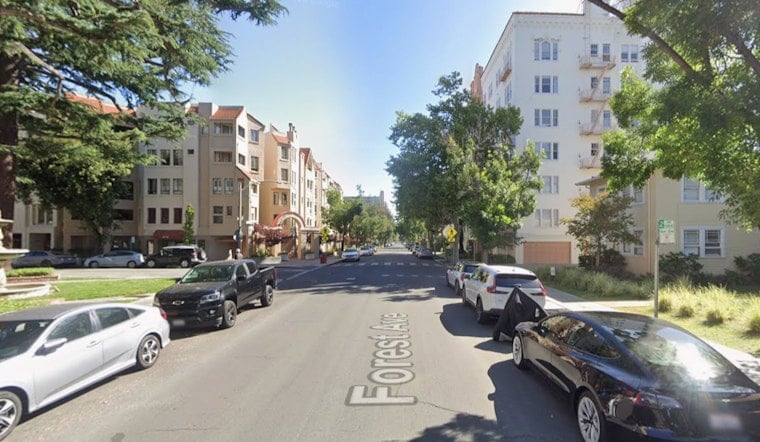
A downtown Palo Alto housing proposal cleared a key city hurdle this week even though its own developer could have skipped the review entirely. The Planning and Transportation Commission voted 4-2 to advance a project at 332 and 350 Forest Ave. to the Architectural Review Board, all while the development team continues to hold a separate, faster application in reserve that would require far less city input.
The project, whose team includes developer Sares Regis, initially applied to build 89 units across eight stories using the city's Planned Home Zoning process, according to Palo Alto Online. That plan places its affordable housing component off-site rather than within the building itself. But the same team also filed a more recent, scaled-back version under state Senate Bill 79 — a 69-unit, six-story project — because the Forest Avenue site sits close enough to the Caltrain station to qualify for the law's streamlined path.
The dual-track approach has become a familiar maneuver on the Midpeninsula since SB 79 took effect statewide on July 1, according to the Metropolitan Transportation Commission, which confirms the law legalizes 65- to 75-foot mid-rise housing within a half-mile of high-frequency transit stations through ministerial review that bypasses public hearings and council votes. All three of Palo Alto's Caltrain stops — University Avenue, California Avenue, and San Antonio — qualify for the law's top tier because each handles more than 72 weekday train arrivals, per the same agency.
A Two-Week Window That City Officials Didn’t See Coming
Palo Alto tried to blunt the state law’s reach by passing a local ordinance that caps development capacity at 50% of what SB 79 would otherwise allow and exempts historic properties, according to the City of Palo Alto. But that ordinance did not take effect until July 16, leaving a two-week stretch when SB 79 applied in the city with no local restrictions at all. Developers rushed in nine projects during that window using full SB 79 height and density standards, the city said.
City planning commissioner Jeff Smith noted that the Forest Avenue project could still be pushed onto the easier Senate Bill 79 route, according to Palo Alto Online's reporting. Commissioner Bart Hechtman went further, cautioning that neighbors would have significantly less input on that version of the project, and separately warned that a lengthy Planned Home Zoning process could itself push property owners toward the state law option.
Fellow commissioner Kevin Ji framed the choice in terms of process rather than just speed, saying the Planned Home Zoning path is meant to involve real discussion with neighbors. Ji noted that the development team had continued pursuing the local zoning process even though it had the SB 79 option available the whole time.
Commissioners Flag Daylight, Affordability and Demolition Concerns
Sixteen existing apartments on the site are slated for demolition during construction, a detail that fed into the concerns commissioners raised before voting. Members flagged issues involving daylight planes, affordability, and the loss of those existing units as they weighed the project, per Palo Alto Online. Commissioner Bryna Chang said the project presented, in her words, quite a number of large issues.
Chang and Ji ultimately dissented from the 4-2 vote to advance the project, though their no votes did not slow the proposal's path to the Architectural Review Board. Planning Commission members had identified potential in the Forest Avenue project even as they debated its shortcomings, and the panel reviewed the Planned Home Zoning version specifically with the Planning and Transportation Commission before advancing it.
Why Palo Alto’s Housing Fights Keep Circling Back to State Law
The tension over Forest Avenue echoes a pattern playing out across Palo Alto since SB 79 arrived. The project's site sits next to Casa Real, an existing 85-foot historic apartment building that developers have cited as justification for matching similarly tall construction in the neighborhood, according to the Palo Alto Daily Post. Developers elsewhere in the city have used the same leverage: at 414 California Ave., a development team submitted an SB 79 application only after first applying under Planned Home Zoning, and Sares Regis previously won City Council approval in April for a seven-story, 321-unit project at 3606 El Camino Real by invoking the state’s Builder’s Remedy, a move Hoodline covered in a report on that 321-unit approval.
The underlying pressure is structural. Palo Alto is required under the state's 6th Cycle Regional Housing Needs Allocation to plan for 6,086 new housing units through 2031, with 3,664 of those reserved for low- and very-low-income households, according to the city's own Housing Element. Cities that fall out of compliance with that state mandate risk losing local control entirely to Builder's Remedy filings, which sidestep municipal zoning altogether.
For now, the Forest Avenue proposal moves forward through the slower, more public path its developer chose to keep pursuing. But as commissioners themselves acknowledged, the SB 79 version remains available and would simplify the city's approval timeline while reducing the community input that has shaped the project so far.





