

























































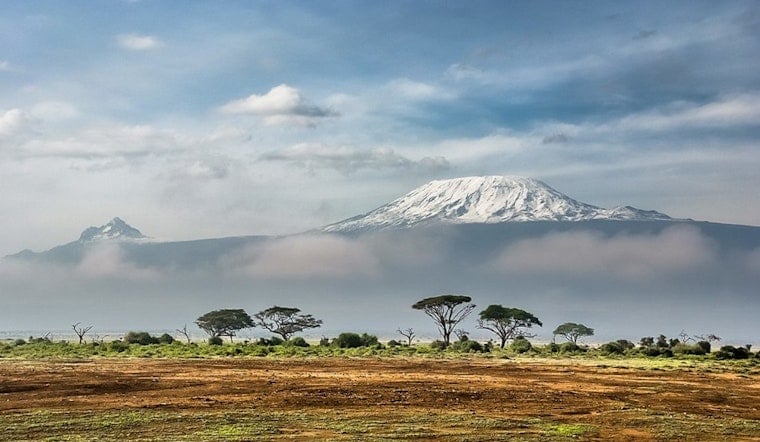
Jamie MoCrazy spent five years dreaming of standing atop Mount Kilimanjaro, and this past June she finally got there — cartwheeling across the summit of Africa's highest peak at 19,341 feet before breaking down in tears. It was a remarkable physical feat for anyone, but for MoCrazy, a Park City resident and former professional freestyle skier, it capped an 11-year comeback from a brain injury doctors once believed she would never fully recover from.
MoCrazy was one of the best freestyle skiers in the world and had made history as the first woman to land a double backflip at the X Games before a 2015 skiing crash changed everything, according to KUTV. She woke up from the accident with serious amnesia and became paralyzed on the right side of her body. The crash, she has said, caused her brain to bleed in eight separate spots.
The accident happened during her second run at the World Tour Finals in Whistler on April 11, 2015, when she landed an off-axis double backflip but caught a ski edge on the landing, whipping her head hard enough to fracture her right brain stem, according to Global News. MoCrazy spent 10 days in a coma. Doctors told her she would never live independently, would never return to normal, and would never make her own money again.
A Groundbreaking Treatment in Vancouver
What happened next in the hospital may have been just as pivotal as anything that came later on a mountainside. Following the crash in Whistler, British Columbia, MoCrazy became the first patient in the province to undergo experimental autoregulation monitoring at Vancouver General Hospital, where doctors threaded a catheter into her brain to continuously track oxygen levels and used medication to normalize her brain oxygenation within hours, according to Vancouver Coastal Health. The procedure came at a moment when doctors initially expected she might die.
MoCrazy has said she had to relearn everything after the crash — walking, talking, basic motor function that most people never think twice about. Her path back to elite physical capability was not new to her; before she ever chased podiums on skis, the Connecticut native won state gymnastics and skiing titles at age 9 and later took gold in slopestyle at the 2010 Junior World Championships in New Zealand, per Wikipedia. That foundation of discipline, built over a lifetime, became the scaffolding for a much harder climb back.
Turning Recovery Into Advocacy
MoCrazy eventually became a motivational speaker and started a foundation to help others living with brain injuries. What began as a viral social media campaign her sister created during MoCrazy's 2015 hospital stay evolved into the MoCrazy Strong Foundation, which obtained official 501(c)(3) non-profit status in August 2022 to provide peer guidance, caregiver support, and community events like Alive to Thrive for traumatic brain injury survivors, according to Freeskier. The foundation's website is mocrazystrong.org.
Her advocacy work has since reached beyond speaking engagements and social media. MoCrazy co-directed the short documentary #MoCrazyStrong with filmmaker Mark Locki in 2023, which premiered at the Big Sky Documentary Film Festival, won Best Biographical Short Documentary at the Atlanta DocuFest, and was screened on Capitol Hill for federal policymakers, the outlet's report notes. Her story fits into a much larger national picture: traumatic and acquired brain injuries are the second most common cause of disability in the United States, affecting an estimated 13.5 million Americans and generating $76.5 billion in annual societal costs, according to data cited by the Brain Injury Association of America. Roughly 230,000 Americans survive hospitalizations for traumatic brain injuries each year, while about 50,000 die from TBI-related injuries annually, according to International Brain Injury Association data reported by KSL TV.
Training Her Brain for Thin Air
Climbing Kilimanjaro required more than willpower. MoCrazy said she chose to climb an alternative peak rather than her original target, and to prepare, she trained five days a week using SmartFit Method oxygen-deprivation training, a program designed to simulate conditions at 20,000 feet. She has said the training made the summit's brutal conditions feel less dramatic once she was actually standing in them.
The stakes of that preparation become clearer when measured against how unforgiving the mountain can be. Kilimanjaro's overall summit success rate sits at roughly 65 percent, with completion rates on shorter five-day treks ranging from just 27 to 50 percent because climbers' bodies often cannot acclimatize quickly enough, according to Vertical Sky. The Park City studio behind her training uses what it calls Smart Ride O₂ protocols, alternating 90 percent oxygen concentration with 14 percent oxygen-deprivation intervals to condition athletes for extreme mountain elevations, per The SmartFit Method.
When she finally reached the top in June, MoCrazy cartwheeled across the summit and cried. She has said that belief must be followed by action — a line that, for her, was never just a motivational slogan but a description of the eleven years it took to get from a hospital bed in Vancouver to the roof of Africa.





