

























































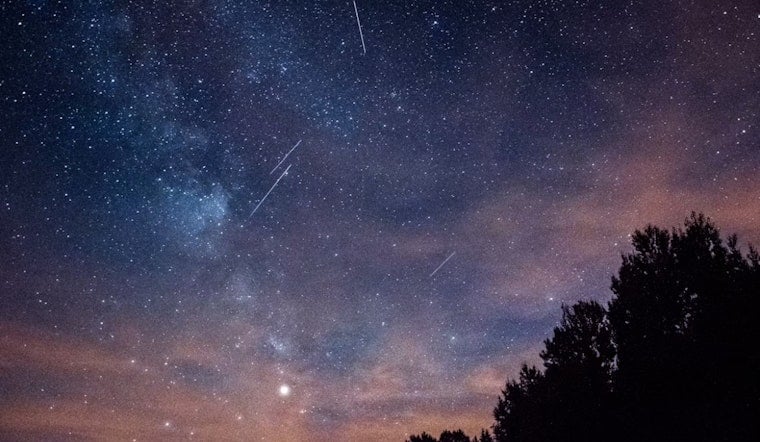
The Perseid meteor shower is streaking across the night sky this week, and Anza-Borrego Desert State Park's famously dark skies mean it could be one of the best shows in years. But the same desert basin drawing stargazers to Borrego Springs is also under an extreme heat warning, with daytime temperatures expected to top 100 degrees Fahrenheit nearly every day this week and forecasters urging anyone heading out after dark to plan carefully before they go.
According to Times of San Diego, park officials have warned stargazers to prepare for high temperatures, advising visitors to bring extra water and fuel, keep electronic devices charged, and make contingency plans before venturing into the remote park. The outlet also notes that air quality in the Anza-Borrego region is questionable for some people with sensitivities, as forecasters say a large amount of dust is circulating through the area. Overnight lows are expected to stay in the 70s and 80s, a detail confirmed by KPBS, which reported that the National Weather Service issued extreme heat warnings for San Diego County deserts, including Borrego Springs and Ocotillo Wells, forecasting highs up to 115 degrees.
Why This Year's Peak Looks So Promising
The Perseids are active every year from mid-July through August, but this year's peak night of August 12 into August 13 lines up with a new moon, eliminating the moonlight that has washed out fainter meteors in past years. The Planetary Society has called this pairing one of the better viewing setups in recent memory, since a dark, moonless sky lets even faint streaks stand out clearly overhead.
The shower's reputation as a crowd favorite isn't just hype. Research from NASA's Meteoroid Environment Office, highlighted by Sky & Telescope, identifies the Perseids as the “fireball champion” among annual meteor showers, tracking 568 fireballs — meteors at least as bright as Jupiter or Venus — over a five-year period. Hoodline reported earlier this month that the shower produces hundreds of these bright, detectable events every August, a pattern documented in Hoodline's coverage of a fireball flash over Montgomery, Alabama that coincided with this year's ramp-up in Perseid activity.
Comet Swift-Tuttle's Annual Calling Card
The meteors themselves trace back to debris shed by Comet 109P/Swift-Tuttle, which NASA says spreads a trail of dust around its orbit as it travels through the solar system. Earth passes through that debris trail every year, and when the comet's leftover particles slam into the upper atmosphere at roughly 37 miles per second, they compress and heat the surrounding air to thousands of degrees, creating the fiery, colorful streaks skywatchers see overhead, according to Royal Museums Greenwich. Swift-Tuttle itself orbits the sun once every 133 years, last swinging through the inner solar system in 1992 and not due back until 2125, per CNET's reporting on the comet's history. The meteors appear to radiate from the constellation Perseus, which gives the shower its name.
A Dark-Sky Destination Built for This Moment
Anza-Borrego Desert State Park, established in 1932, sprawls across roughly 650,000 acres of San Diego, Imperial, and Riverside counties, making it the largest state park in California and the second-largest in the contiguous United States, according to the California Department of Parks and Recreation. The park received International Dark Sky Park designation in 2018, and its remote location and tightly regulated lighting have made it a longtime destination for stargazers and astrophotographers.
That designation is reinforced by the community at its center. Borrego Springs, which sits entirely surrounded by the park, was named California's first International Dark Sky Community by DarkSky International back in 2009, a distinction tied to the valley's natural shielding from urban light pollution in San Diego and Los Angeles thanks to mountains flanking it on three sides. Together, the park and the town are counted among the few International Dark Sky Communities in the nation.
Heat Rules Change the Calculus for Night Owls
That dark-sky pedigree is exactly why the extreme heat warning matters so much this week. San Diego County already enforces annual summer closures at nearby desert and canyon preserves, including Agua Caliente and Vallecito County Parks, from Memorial Day weekend through Labor Day weekend, according to the Borrego Sun — a reflection of how seriously local agencies treat heat risk in this stretch of desert.
California State Parks guidelines direct visitors to hike only in early morning hours before 9 a.m. during high heat alerts, stay on designated trails, carry extra water, and leave detailed travel plans with emergency contacts, since desert terrain offers almost no shade and cell coverage can vanish in remote park zones. For anyone planning to catch the Perseids' peak over Anza-Borrego this week, that guidance is the difference between a clear view of a rare fireball and a genuine emergency in triple-digit heat.





