

























































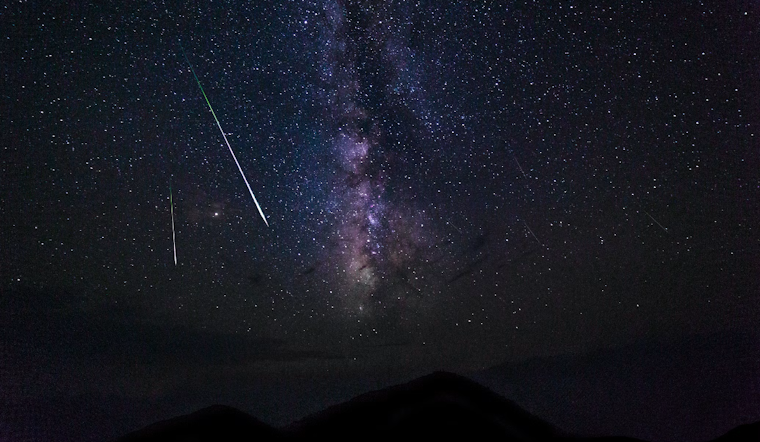
A sudden burst of light over Kane County on Thursday sent viewers scrambling to explain what they had just seen, after a video captured a bright flash in the sky over Montgomery, Illinois. Viewers reported the possible meteor sighting on Thursday, and the phenomenon is now awaiting an official determination from the nation's leading meteor-tracking organization.
According to ABC7 Chicago, the station asked the Adler Planetarium to weigh in on the footage, and the storied Chicago institution said the phenomenon could be a type of meteor that explodes in the atmosphere. The American Meteor Society is expected to issue a formal determination on the flash within a few days, per the station's report. Montgomery, the village along the Fox River that straddles Kane and Kendall counties roughly 45 miles southwest of Chicago and home to about 20,262 residents as of the 2020 U.S. Census, sits in the outer western suburbs bordering Aurora.
Why Fireballs Explode in the Atmosphere
The Adler Planetarium, founded in 1930 on Chicago's Northerly Island by Sears executive Max Adler, was the first planetarium in the Western Hemisphere and remains a major Midwestern authority on public astronomy, according to Astronomy Magazine. Astronomers classify a fireball as a meteor shining brighter than the planet Venus, while an exploding fireball that produces a loud shock wave or visible disintegration is specifically termed a bolide, per the Robert Ferguson Observatory. Fireballs enter the upper atmosphere at speeds between 25,000 and 160,000 mph, and the resulting friction and pressure often force space rocks to detonate or fragment between 15 and 60 miles above the ground, the Los Angeles Times reports, though most meteors burn up entirely before ever reaching the surface.
The American Meteor Society determines official fireball trajectories by aggregating crowdsourced eyewitness data, including compass direction, angular height, duration, flash intensity, and sound reports, then running that information through automated trajectory models within days, according to the observatory. That process is now underway for the Montgomery sighting.
A Fireball Season Tied to the Perseids
The reported flash came as the annual Perseid meteor shower ramps toward its peak, which falls on the night of August 12-13 this year and coincides with a new moon for especially dark skies, according to The Planetary Society. The Perseids, caused by Earth passing through debris shed by Comet 109P/Swift-Tuttle, produce more fireballs than any other annual meteor shower, generating hundreds of detectable fireball events each August, per tracking by NASA's Meteoroid Environment Office cited by Sky & Telescope. The comet's roughly 16-mile core sheds unusually large chunks of debris, which helps explain why bright meteor explosions cluster statistically around this time of year.
This is not the first time Northern Illinois skies have lit up with a dramatic flash. Just two months earlier, on June 1, 2026, the American Meteor Society collected nearly 200 eyewitness reports across Illinois and eight other Midwestern states after a bright fireball streaked over Chicago-area communities including Aurora, Carpentersville, and Warrenville, according to CBS Chicago. And in one of the most densely populated meteorite falls in modern history, a major meteor exploded over Northern Illinois on March 26, 2003, raining dozens of stone fragments across Park Forest in Cook and Will counties, roughly 45 miles east of Montgomery, per the Lunar and Planetary Institute; those fragments reportedly struck homes and a fire station.
Part of a Bigger National Pattern
The Montgomery report also lands within a broader spike in fireball activity nationwide. Across North America, the American Meteor Society logged an unusually high volume of fireball reports in 2026, recording 4,462 fireball entries in April alone following several multi-state sightings, according to The Journal Record. Skywatchers have reported multiple booming bolide events across the country earlier in the year, adding this latest Kane County sighting to a growing list of bright, unexplained sky flashes documented in 2026.
Whether the American Meteor Society ultimately confirms a high-altitude bolide breakup over Montgomery, and whether any acoustic shockwave was felt or heard on the ground in Kane and Kendall counties, remains unknown for now. The organization's determination is expected within days, and residents who witnessed the flash can expect more clarity once that review is complete.





