

























































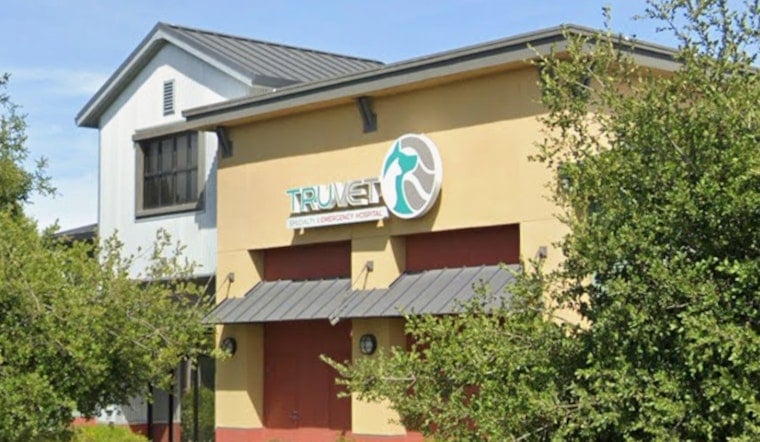
A new 24-hour animal hospital has opened its doors on Lakeville Highway in Petaluma, giving pet owners in the area and northern Marin County somewhere close to home to turn to when a dog or cat needs emergency care in the middle of the night. TruVet Specialty & Emergency Hospital, a 6,300-square-foot facility at Lakeville Highway and Casa Grande Road, is staffed around the clock, seven days a week, and receives walk-in patients between 8 AM and 8 PM.
The hospital was co-founded by Dr. Freya Kruger and Dr. Sam Tucker, both board-certified internal medicine specialists, according to The Press Democrat. Kruger earned her Doctor of Veterinary Medicine from UC Davis in 2006 and completed a residency in small animal internal medicine there in 2010, while Tucker earned his VMD from the University of Pennsylvania in 2009 and finished his internal medicine residency at Tufts University in 2013, according to TruVet Specialty and Emergency Hospital. Before opening TruVet, Kruger worked at PetCare Veterinary Hospital in Santa Rosa for a decade.
Kruger said the timing reflects a broader shift in the industry. “Right now, the veterinary industry is exploding,” she said, according to The Press Democrat. Petaluma previously lacked an animal hospital staffed with both internal medicine specialists and surgeons, leaving pet owners to drive to Santa Rosa, Rohnert Park or San Rafael when something went wrong after hours.
Long Waits at Regional Emergency Centers
The nearest similar facility to the south is the Pet Emergency & Specialty Center of Marin in San Rafael, which has been inundated with cases, per the Press Democrat's reporting. Pet emergency and specialty centers around the region have seen waits stretch up to six hours, and veterinary oncology appointments in Sonoma County can take about a month to schedule.
The pressure on regional emergency centers isn't limited to private practices. The Humane Society of Sonoma County's Community Veterinary Clinic has stopped offering urgent medical care and overnight observation, according to the Humane Society of Sonoma County, referring pet owners who need critical care to private facilities like TruVet instead. Other emergency options serving Sonoma and Marin county residents include VCA PetCare East in Santa Rosa and VCA Animal Care Center of Sonoma County in Rohnert Park.
A National Surge in Pet Care Demand
The strain on emergency veterinary care didn't start in Petaluma. Nationwide veterinary appointment bookings rose 4.5% between 2019 and 2020, then grew another 6.5% in the first half of 2021 compared with the same period the year before, according to data from the analytics firm VetSuccess cited by the American Veterinary Medical Association. VetSuccess tracks financial data from roughly 2,800 U.S. animal clinics, and its figures show veterinary clinics and animal hospitals saw double-digit revenue increases during much of the pandemic.
That surge traces back to a nationwide pet adoption boom. An estimated 23 million American households — nearly one in five nationwide — adopted a pet during the COVID-19 pandemic, according to 2021 figures from the American Society for the Prevention of Cruelty to Animals cited by the Los Angeles Times. At the same time, a 2022 study by Mars Veterinary Health projected the country will face a shortage of nearly 15,000 companion animal veterinarians by 2030, potentially leaving 75 million pets without adequate medical care, according to Best Friends Animal Society.
California lawmakers have introduced legislation aimed at offering student loan debt relief to licensed veterinarians who agree to work in animal shelters or designated high-need areas for at least five years, the Los Angeles Times reports. Meanwhile, corporate consolidators have rapidly bought up independent veterinary practices over the past decade, most notably when Mars Inc. acquired VCA Inc. in 2017. TruVet, by contrast, operates as an independent and privately owned hospital, a structure its founders have pointed to as a distinguishing feature amid that consolidation trend.
Building Out Specialty Equipment and Staff
TruVet's building includes an operating room, a laboratory, separate wards for cats and dogs, and an isolation area for pets with parvo or kennel cough. The hospital had planned a grand opening but canceled it because of the coronavirus pandemic, according to the Press Democrat's reporting; it opened quietly in Petaluma in late December instead. In the early weeks, Kruger and Tucker alternated 24-hour shifts for six weeks to keep the hospital staffed, and Dr. Kristin Conover now also works shifts there.
The hospital plans to further expand its capabilities, including hiring an oncologist and installing a $100,000 oncology ventilation and hood system. TruVet also plans to purchase a $600,000 computed tomography machine. Kruger and Tucker have said they wanted the hospital to treat pets like members of the family.
That approach has already played out in the hospital's first cases. A dog named Rebel came in suffering from gastrointestinal issues, while a dog named Ryan was treated for pancreatitis and placed on a feeding tube. A dog named Dory awaited an endoscopy, and Osito, an anemic chihuahua, underwent a blood transfusion — an early glimpse, according to the Press Democrat, of the kind of critical care TruVet was built to provide.





