

























































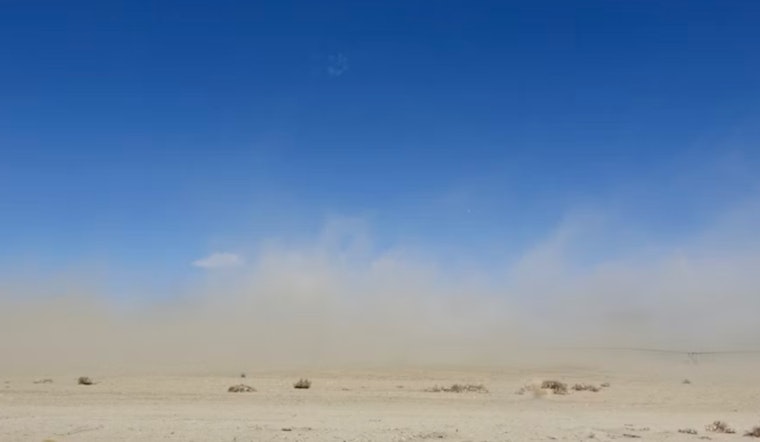
Phoenix spent Tuesday under a blanket of lingering desert dust, with pollution monitors registering some of the worst readings the Valley has seen in recent memory. The overnight storm turned the air hazardous, triggered a countywide no-burn day and left officials warning that another round could arrive before the week is over.
Air pollution readings across the metro climbed above 14 times the normal level after high winds carried dust north from southern Arizona, according to KTAR News. Most monitors were above 200 micrograms per cubic meter of PM10, compared with a normal reading below 50; several topped 300, one passed 500 and another exceeded 700. An Arizona Department of Environmental Quality meteorologist described the distant visibility as “almost a whiteout.”
The dust did not clear quickly because there was no rain behind the storm, while cloud cover helped keep particles trapped near the ground. The storm was fueled by thunderstorms and powerful outflow winds in Pima County late Monday, which pushed dust across the lower deserts and into the Phoenix area.
The Maricopa County Air Quality Department said ADEQ issued a PM10 High Pollution Advisory because particle levels were expected to exceed the federal health standard. The advisory prohibits wood burning in fireplaces, chimineas and outdoor fire pits, discourages leaf-blower use and off-road driving, and urges residents to limit outdoor activity—especially children, older adults and people with heart or lung conditions.
A Category 5 Dust Storm By Phoenix’s New Scale
Arizona State University rated the event Category 5 on the new PHX-DUST scale, the highest level in a system designed to rank Phoenix dust storms after they occur. As explained by ASU researchers, the scale considers PM10 concentrations, wind gusts, storm duration and geographic coverage, giving residents a way to compare a dramatic-looking dust wall with the actual severity recorded by Valley monitors.
The latest storm also fits a familiar monsoon pattern in which collapsing thunderstorms send fast-moving outflow winds across exposed desert soil. Earlier this summer, a separate Valley dust storm temporarily halted inbound flights at Phoenix Sky Harbor, underscoring how quickly airborne dust can move from an air-quality concern to a transportation problem.
More Dust Could Reach The Valley This Week
The active monsoon pattern is not finished, with another chance for dust Tuesday night and additional thunderstorm development possible Wednesday and Thursday. The outlook, reported by KTAR News, means residents may need to keep windows closed, limit strenuous outdoor activity and watch for rapidly changing visibility if new outflow winds sweep through.





