

























































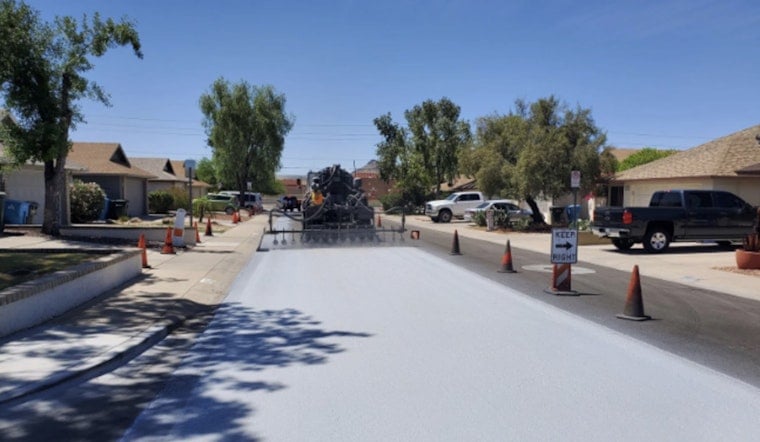
Phoenix is expected to reach 200 miles of its light-gray, solar-reflective “cool pavement” coating this week, marking a major expansion of a heat-fighting program the city began in 2020. In Maryvale, where the coating rolled out in 2025, residents are reporting mixed results — some say the evenings feel noticeably cooler, while others say the punishing midday heat hasn't changed much at all.
According to ABC15 Arizona, the city's Streets Department applies the reflective coating to low-volume residential roads that are already due for maintenance rather than treating it as a standalone climate fix. Trish, who lives near 67th Avenue and Lower Buckeye Road, told the outlet her neighborhood recently received its first coat and that she has three children who do not do well in the heat. Ronald, a fellow Maryvale resident, said he has noticed that heat does not linger as much after sunset since the coating went down, giving kids more time to play outside once the sun drops.
Not everyone in the neighborhood is convinced. Some Maryvale residents told the station they noticed little difference during the hottest part of the day, even as others praised the cooler evenings. The city itself is careful not to oversell the technology, stating plainly that cool pavement is not a solution to Phoenix's extreme heat crisis on its own — officials instead hope that each incremental degree of cooling can add up to make a difference.
How the Reflective Coating Works
The cool pavement contains titanium dioxide, which helps reflect sunlight instead of letting the asphalt absorb and re-radiate as much heat, per ABC15's reporting. The city says the treatment can lower pavement surface temperatures by up to 12 degrees and typically lasts about eight years before it needs to be reapplied. Phoenix isn't new to hiccups with the technology, either — an earlier version of the coating peeled following a major storm in 2022, according to the same report.
The program traces back to a 2020 pilot in which the city applied the reflective coating to roughly 36 miles of residential streets across eight neighborhoods, one in each City Council district, according to the City of Phoenix. Paved surfaces cover roughly 40% of the city's urban land area across a roadway network spanning more than 4,850 miles, which the city says is central to why asphalt has become a focal point of its heat mitigation strategy. Phoenix has since pushed the concept beyond residential streets, partnering with Desert Ridge Marketplace in September 2023 to coat 65,000 square feet of a north Phoenix parking lot, as reported by 12 News.
The Science Behind the Trade-Offs
Independent research helps explain why Maryvale residents' experiences diverge so sharply depending on the time of day. A study by Arizona State University found the coating initially reflects between 33% and 38% of solar radiation compared to just 12% for standard black asphalt, though that reflectivity fades to between 19% and 30% after 10 months as street dirt and tire wear degrade the surface. Separate research relayed by Smart Cities Dive found that while cool pavement can cut surface temperatures by up to 12°F, nighttime air temperatures measured six feet above the ground drop by an average of only 0.5°F, since ambient air is shaped heavily by broader regional wind and climate patterns.
That gap between surface cooling and how people actually feel outside is most pronounced at midday. Arizona State University researchers using a biometeorological instrument cart nicknamed “MaRTy” measured a 5.5% average increase in human radiant heat exposure at midday over cool pavement compared to standard asphalt, since the lighter coating bounces more sunlight upward toward pedestrians rather than absorbing it. That finding tracks with what some Maryvale residents described to ABC15: little noticeable relief during the hottest stretch of the day, even as evening temperatures ease.
Part of a Broader Municipal Heat Strategy
Phoenix created the nation's first publicly funded municipal Office of Heat Response and Mitigation in September 2021, naming Arizona State University climate scientist Dr. David Hondula as its inaugural director, according to KJZZ. That office coordinates urban forestry, cooling centers, and surface cooling projects citywide, situating cool pavement as one tool among several rather than a cure-all. The city also adopted a regulation in August 2020 requiring any utility or contractor that excavates a cool-pavement street to reapply the reflective coating at its own expense, preventing repair patches of ordinary dark asphalt from breaking up treated corridors.
The stakes behind the program are stark. Heat-related fatalities in Maricopa County dropped to 430 in 2025 after reaching record highs of 645 in 2023 and 608 in 2024, according to the Maricopa County Department of Public Health, which tracks such deaths through medicolegal investigations by the Office of the Medical Examiner. Phoenix isn't alone in testing reflective streets as a heat-fighting tool — Los Angeles ran a similar experiment across 700,000 square feet in Pacoima between 2022 and 2026, recording pavement surface drops of up to 16°F and ambient air drops of up to 3.4°F during a major heat wave, as Hoodline previously reported.
For now, Phoenix officials are framing the 200-mile milestone as incremental progress rather than a breakthrough. As the city itself acknowledges, cool pavement is not a solution to Phoenix's extreme heat on its own — but for residents like Trish and Ronald, even small changes in how the streets feel after sunset carry real weight during the Valley's brutal summers.





