

























































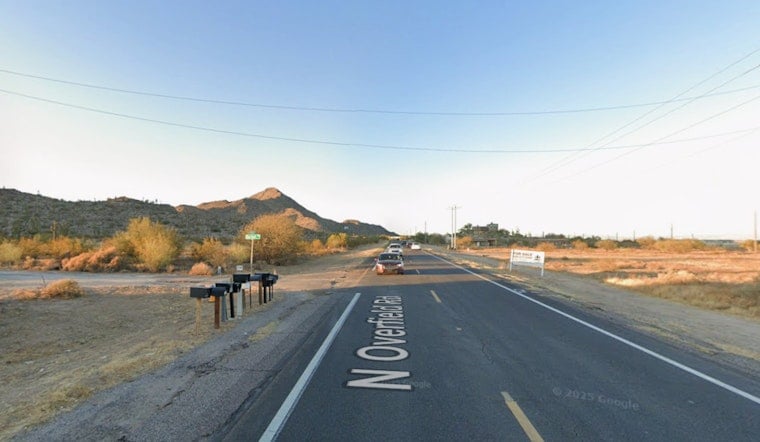
A guest house near West Bartlett and North Overfield roads in unincorporated Pinal County burned to a total loss Monday night, hospitalizing one firefighter and sending two others down with heat exhaustion as crews battled the blaze in triple-digit heat. Occupants got out safely, but firefighters arriving after 7 p.m. found the structure fully engulfed behind a larger main house, with no hydrant close enough to help and a long, narrow gravel driveway already clogged with emergency apparatus.
The fire broke out as Casa Grande and rural Pinal County sat under an Extreme Heat Warning, with afternoon highs reaching 111 degrees, according to Weather Underground. As FOX 10 Phoenix reported, the closest fire hydrant sat more than 900 feet away on Overfield Road, and Chief Steven Kerber said using it would have blocked access for mutual aid units navigating the curved, congested driveway. Firefighters instead used water tender shuttles to keep water flowing to the fire ground.
Regional Fire & Rescue Department crews responded first, and the department says it deployed 11 firefighters and four vehicles — Engine-587, Tender-586, Car-586, and Air-586 — to hold the blaze until mutual aid tankers arrived. Regional Fire called in backup from the Casa Grande, Coolidge, and Eloy fire departments, and four area departments in total responded to the fire, per the station's report.
Three Firefighters Down in the Heat
Three Regional Fire firefighters suffered heat exhaustion while working the scene, and one was transported to Banner Casa Grande Medical Center for treatment and observation, the outlet reported. Banner Casa Grande is a 141-bed acute care hospital with a 26-bed emergency department holding Level IV Trauma Center certification, treating roughly 40,000 emergency patients a year, according to Banner Health. The extreme heat that night helps explain why the physical strain of the operation escalated so fast for crews already fighting a stubborn fire with limited water access.
Firefighters worked into the early hours of Tuesday morning mopping up hot spots, and Kerber himself stayed on scene overnight to monitor smoldering areas inside the destroyed structure before daylight overhaul operations resumed, the department said in a statement. The cause of the fire remains under investigation, per Kerber, and no additional details on how it started have been released.
Why Rural Pinal County Relies on Subscriptions, Not Taxes
The water shortage that shaped the response is tied to a broader structural reality in unincorporated Pinal County. Regional Fire & Rescue Department is an IRS non-profit established in 1995 that receives zero tax dollars, instead relying on annual subscription fees to fund emergency operations across 96 square miles of unincorporated territory, the department says on its website. Because these areas fall outside municipal boundaries and tax districts, protection depends on subscription-funded outfits like Regional Fire rather than a city fire budget.
An estimated 17% to 20% of residents in the department's service area actually pay the annual subscription, according to the department, leaving non-subscribing property owners exposed to hourly fee-for-service billing if their property catches fire. The department operates out of a single station on McCartney Road with four full-time paid firefighters backed by 18 paid-on-call reserves covering nearly 100 miles of highway and desert terrain, per Fire Apparatus & Emergency Equipment. That subscription model isn't unique to this stretch of desert — commercial provider Rural Metro Fire operates under a similar framework elsewhere in unincorporated Pinal County, including a recently formalized agreement with San Tan Valley, according to SanTanValley.com.
Equipment Mismatches Complicate Mutual Aid
Rural coverage gaps aren't the only wrinkle when Regional Fire calls in help. The department runs 4-inch Large Diameter Hose for its supply lines rather than the 5-inch standard many municipal departments use, which can create adapter headaches when linking hose with mutual aid crews from cities like Casa Grande, Coolidge, and Eloy. Under NFPA 1142 standards, which govern water supply for firefighting in unhydranted areas, departments are required to set up dedicated tender shuttles or static drafting points based on a structure's size and hazard level — exactly the kind of operation Regional Fire ran Monday night once the Overfield Road hydrant proved impractical to use.
Extreme heat has been a recurring threat across the region this summer. Hoodline previously reported on a dust storm that slammed I-10 near Casa Grande, part of a string of severe weather hazards testing the area's public safety response this year.





