

























































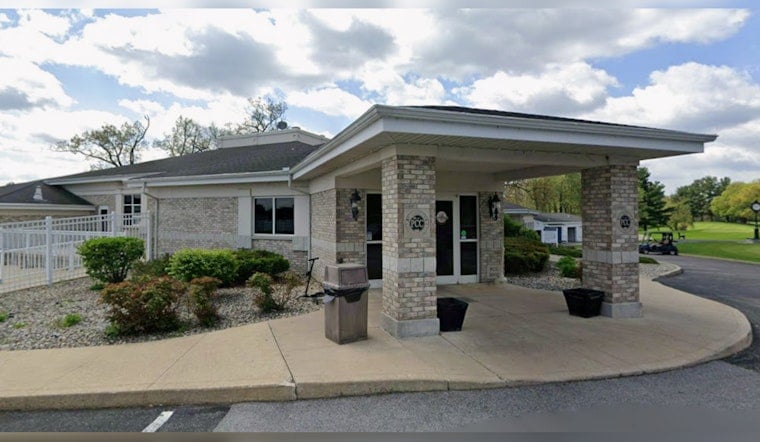
A 64-year-old Plymouth man is dead after the golf cart he was driving went off an embankment and landed on an asphalt parking lot near Pretty Lake Golf Club early Sunday morning. James Galt Jr. had just left the club when the crash happened, and officials believe alcohol was a factor.
According to the WSBT, police responded to the 10000 block of Pretty Lake Trail just after 1 a.m. Sunday, where the Marshall County Sheriff's Office reported that Galt had left Pretty Lake Golf Club on the cart before driving off the embankment. He was pronounced dead at the scene.
The Marshall County Coroner's Office logged the emergency in precise detail: an initial 911 call came in at 12:56 a.m., and the office was officially notified of the fatality at 10055 Pretty Lake Trail at 1:09 a.m., where Chief Deputy Coroner John Lampkins pronounced Galt dead at the scene from crash injuries, according to GIANT fm. The response drew three local agencies to the scene: the Marshall County Sheriff's Department, the Marshall County Coroner's Office, and the Plymouth Fire Department, as reported by ABC57.
A Club With Deep Roots on Pretty Lake
Pretty Lake Golf Club sits along the water at 10055 Pretty Lake Trail, and its history stretches back over a century. The course was founded in 1923 as a nine-hole private club called Plymouth Country Club before expanding to 18 holes across 130 acres in 1967, and it once hosted the LPGA Hoosier Classic from 1974 through 1978, per Michiana Golf. The venue even carries a bit of golf lore: late professional golfer Payne Stewart set a course record of 63 there in 1979, a mark that stood for nearly 28 years until local member Justin Murphy shot a 62 in September 2007, according to the same account.
Pretty Lake is also a residential lake community where golf carts are an everyday form of transportation, with homeowners regularly using them for short trips between private residences and the clubhouse, according to real estate listings reviewed on LakeHomes.com. That everyday familiarity with carts as neighborhood transport is part of what makes a crash like this one land so close to home for residents.
Golf Carts Fall Under Indiana's Drunk Driving Law
Even though golf carts are low-speed vehicles typically confined to private courses and neighborhoods, Indiana law does not treat them differently when it comes to intoxicated driving. Under Indiana Code § 9-30-5, the state's Operating While Intoxicated laws apply to any land transportation device categorized broadly as a vehicle, meaning drunk driving statutes cover golf carts regardless of whether they are operated on public roads or private property, according to Hurst Limontes. Indiana's blood alcohol threshold is set at 0.08%.
Separately, Indiana Code § 9-21-8-57 prohibits operating golf carts on highways and public roadways statewide unless a local city, town, or county has specifically enacted an authorizing ordinance, per TIGON Golf Carts. A first-offense Class C misdemeanor OWI in Indiana carries potential penalties including up to 60 days in jail, fines up to $500, and driver's license suspension, according to the state's own guidance published by IN.gov.
Rollovers Drive Most Fatal Golf Cart Crashes
Golf cart accidents cause more injuries nationwide than many drivers realize. U.S. Consumer Product Safety Commission data cited by Technology Associates indicates roughly 15,000 to 17,500 golf cart-related injuries require emergency room treatment across the country each year, with occupant ejections accounting for about 38% to 40% of all incidents. Standard golf carts lack factory seatbelts and doors, leaving occupants especially vulnerable during a tip-over.
National statistical analyses compiled in 2026 show rollovers account for 65% to 70% of golf cart fatalities, with alcohol involvement reported in roughly 28% of fatal golf cart crashes, according to data compiled by Gitnux. Investigators have not released toxicology results confirming impairment in Galt's case, and it remains unclear whether the cart involved was privately owned or belonged to the club, or how the embankment's exact height and slope factored into the crash.





