

























































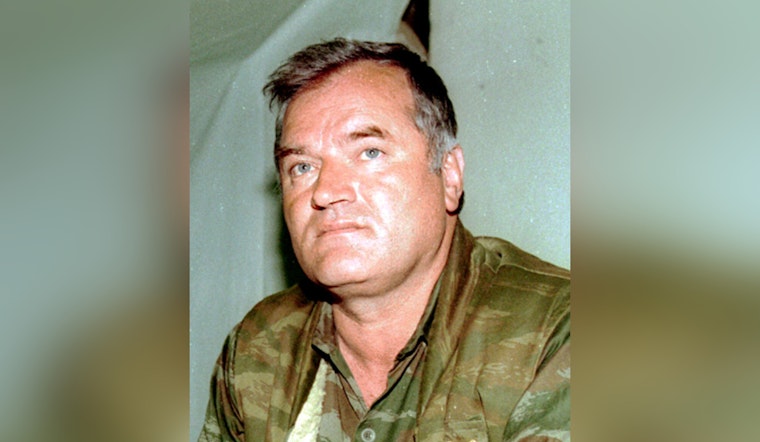
Ratko Mladić, the former Bosnian Serb military commander convicted of genocide and crimes against humanity, died Thursday at age 84 while hospitalized in The Hague during his life sentence at the United Nations Detention Unit. His death has prompted reflection among genocide survivors living in the St. Louis area, home to tens of thousands of Bosnian refugees and their families who experienced loss of loved ones and displacement during the Bosnian war of the 1990s.
Mladić's death has prompted the International Residual Mechanism for Criminal Tribunals, the UN body that inherited the work of the tribunal that convicted him, to open a formal inquiry into how he died, according to the International Residual Mechanism for Criminal Tribunals. As reported by STLtoday.com, Mladić was transferred to The Hague, tried, convicted of genocide and crimes against humanity, and sentenced to life in prison for his role in the Bosnian war, which lasted more than three years.
Just a week before he died, IRMCT President Graciela Gatti Santana rejected an urgent petition from Mladić's defense team seeking his early release to a Serbian hospital. Per the Sarajevo Times, defense lawyers had argued his death was imminent due to severe health deterioration and requested transfer to Serbia, but Gatti Santana ruled that extraordinary release was inappropriate for someone serving a life sentence. He lost his final appeal of his conviction in June 2021, following his arrest in 2011 after evading capture for 16 years.
A Community Built by Survivors
Metropolitan St. Louis is home to an estimated 60,000 to 70,000 Bosnians, representing the largest Bosnian population outside of Bosnia and Herzegovina itself, according to Saint Louis University. That population took root after thousands of war refugees resettled in South St. Louis during the 1990s, followed by additional secondary migration from elsewhere in the country. The community has helped combat population decline and stagnation in St. Louis, and academic research on Bosnian place-making credits the arrival of more than 11,000 Bosnian war refugees between 1993 and 2001 with reversing decades of population loss in South St. Louis by establishing hundreds of small businesses, including trucking firms, bakeries, and restaurants.
For many St. Louis families, Mladić stood as a symbol of the war crimes that shattered their communities, according to the same STLtoday.com report. The Bosnian genocide, which occurred in July 1995, saw forces under Mladić's command execute more than 8,000 Bosniak Muslim men and boys in Srebrenica and the surrounding areas — a United Nations-designated safe area at the time. The massacre included killings, rape, torture, forced starvation, and executions, and international courts have classified it as the worst atrocity on European soil since World War II, according to PBS FRONTLINE.
Beyond Srebrenica
Mladić's record of violence extended well beyond Srebrenica. He also commanded the 1,425-day siege of Sarajevo, from April 1992 to February 1996 — the longest siege of a capital city in modern military history, according to the Sarajevo Times. That siege killed more than 11,000 civilians, including 1,601 children, as Bosnian Serb forces bombarded the city daily with artillery and sniper fire from the surrounding hills.
Following Mladić's death, UN Secretary-General António Guterres issued a statement standing in solidarity with genocide victims and survivors, per the United Nations. Guterres emphasized that the tribunal's judicial findings are final and firmly condemned any denial of the Srebrenica genocide — a message aimed squarely at the genocide denial that remains prevalent among nationalist factions in Serbia and Republika Srpska, where Mladić is still defended by some.
Preserving Memory in St. Louis
St. Louis's Bosnian genocide survivors hold annual marches and events commemorating victims. In July 2025, the community held a commemoration and march of remembrance in downtown St. Louis marking the 30th anniversary of the Srebrenica genocide, per the STLtoday.com report. The community has said it plans to continue educating future generations about the genocide.
A permanent physical marker of that commitment already stands in the city. In 2013, to mark St. Louis's 250th anniversary, the local Bosnian community built and donated a replica of Sarajevo's 18th-century Sebilj wooden fountain at the intersection of Gravois and Morganford roads in the Bevo Mill neighborhood, according to Atlas Obscura. Bosnian President Željko Komšić traveled to St. Louis that September to take part in the landmark's groundbreaking ceremony.
Institutional efforts to document survivor testimony have also deepened. In 2025, the Center for Bosnian Studies — originally founded in 2006 as the Bosnia Memory Project to record oral histories and preserve artifacts from local genocide survivors — permanently transferred its operations to Saint Louis University following the closure of Fontbonne University. The center is the only academic initiative in North America dedicated exclusively to documenting the Bosnian war and diaspora, ensuring that the accounts of survivors now living throughout the St. Louis area will remain preserved even as the man responsible for their suffering is gone.




