

























































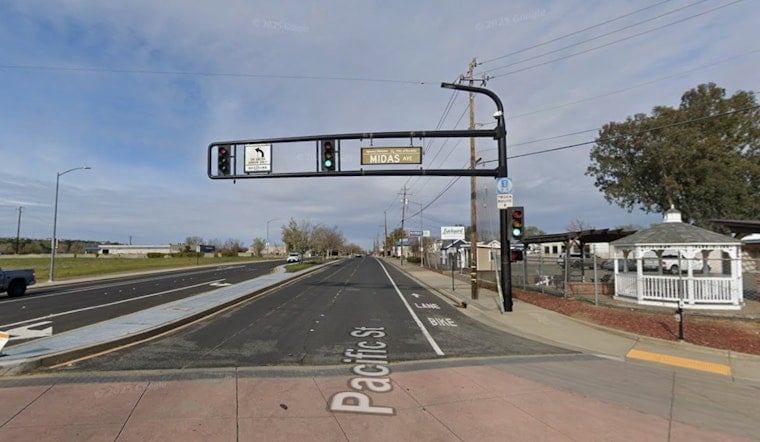
A 281-unit affordable housing project planned for a vacant lot beside a Kinder Morgan fuel pipeline and Union Pacific railroad tracks in Rocklin goes before the City Council on September 1, with city staff having already concluded there's little legal room to reject it. The Midas Apartments would rise in three four-story buildings on roughly 7.1 acres at the northwest corner of Pacific Street and Midas Avenue, placing the nearest building about 140 feet from a pipeline that feeds a massive petroleum storage facility next door.
The project, tracked by the city as Design Review DR2026-0002, was formally submitted on March 24, 2026, and covers five parcels, according to the Sacramento Bee. Rocklin's Planning Commission recommended approval of the project and its environmental exemption on August 4, after a consistency analysis concluded the development aligns with the city's general plan and creates no new significant environmental impacts beyond what was already studied in the plan's prior environmental impact report. City officials determined that both the pipeline and the residential development had already been considered during that general plan environmental review, which is why Rocklin used the consistency analysis rather than ordering a fresh environmental impact report.
A Pipeline That's Operated Since Eisenhower
The pipeline in question runs within the railroad right-of-way just west of the Midas property and connects to Kinder Morgan's Roseville Station, a bulk petroleum storage facility that has operated continuously on Pacific Street since 1957. Per the city's Community Safety Element, the station holds 455,000 barrels — about 19 million gallons — of capacity and receives gasoline, diesel and jet fuel through a 90-mile, 12-inch pipeline that originates in Concord. Kinder Morgan reviewed the Midas project plans and, per the city, said it had no objection to the proposed development.
City records cited by the Bee show none of the project's site improvements or underground infrastructure will fall within 20 feet of the pipeline. Construction crews will still be required to contact an underground service alert center before any excavation, maintain required clearances throughout the build, and have a Kinder Morgan damage-prevention inspector monitor any work within 25 feet of the pipeline.
Trains, Traffic and Two Ways In
The Midas complex sits adjacent to Union Pacific railroad tracks, and the surrounding rail corridor sees roughly 18 train crossings a day, including about eight at night. The complex will have two vehicle entrances: one on Pacific Street offering full turning movements, and a second on Midas Avenue limited to right turns in and out. Pacific Street itself carries two through lanes in each direction, and the Bee reports emergency vehicles would still be able to use those through lanes if a train were blocking the Midas Avenue entrance.
Both the Rocklin Police Department and Rocklin Fire Department reviewed the project and, according to the Bee's reporting, expressed no concerns about emergency access being blocked by passing trains. The development must still meet Rocklin's fire-access requirements, including emergency vehicle access, fire hydrants and other fire-safety infrastructure, alongside the planned parking, a community facility, a playground and landscaping.
New State Law Raises the Financial Stakes
Looming over the council's decision is Assembly Bill 712, authored by Assemblymember Buffy Wicks and signed into law in October 2025. Under the statute, effective January 1, 2026, cities that illegally deny qualifying housing projects after receiving a warning from the state Department of Housing and Community Development face fines of $10,000 per unit — a penalty that multiplies fivefold for repeat violations within the same housing element cycle, according to LegiScan. The law also lets successful housing applicants recover attorney's fees and bars cities from requiring developers to sign indemnification agreements covering a city's legal defense costs, a change detailed by the Association of Bay Area Governments.
Rocklin Mayor David Bass said the new law has sharpened the financial risks cities face when they consider challenging housing projects. Bass told the Bee that Rocklin could face state enforcement, litigation, attorney's fees and significant penalties if it rejects qualifying housing developments. He said he supports workforce housing even as residents have raised concerns to him about density, traffic, parking, construction impacts and the loss of commercial property to housing.
Companion legislation, Senate Bill 808, also took effect January 1 and requires state courts to prioritize housing litigation, compressing trial schedules for developer lawsuits against cities to roughly 75 days, per a summary from Holland & Knight. Rocklin has already drawn a warning from the state housing department tied to another project, and the city is separately working under California's 6th Cycle Regional Housing Needs Allocation, which requires cities to maintain certified housing elements and rezone enough parcels between 2023 and 2031 or risk state decertification.
Not Rocklin's Only Contested Project
Midas isn't the only affordable housing fight playing out in Rocklin this summer. The council previously delayed a decision on the proposed Sierra Wilds Apartments, a 120-unit project near Maria Montessori Charter Academy from Pacific West Communities, a subsidiary of Idaho-based The Pacific Companies. That project is moving forward under Senate Bill 330 and the State Density Bonus Law, and the state housing department has told the city, per city information, that Sierra Wilds qualifies for protections under California's Housing Accountability Act — the same law, along with density bonus provisions, that can limit a city's ability to reject qualifying housing projects like Midas. Rocklin resident Jill Gayaldo has raised concerns about local control over such decisions.
Rocklin has continued approving affordable housing elsewhere even as these fights unfold. In May 2026, the city broke ground on Pacific Street Apartments, a 110-unit fully electric affordable family development built by Community HousingWorks on city-owned land under an 87-year ground lease, according to the National Equity Fund. The city bought that Pacific Street land in 2019 specifically to convert underused real estate near the downtown Rocklin train station into affordable workforce housing. The council also approved a $2.23 million loan to help finance The Steven, a 180-unit affordable senior apartment complex — 178 units plus two manager units — on 7.3 acres along Rocklin Road, reserved for residents 55 and older earning 30% to 70% of area median income, with expected rents ranging from about $650 to $1,850 a month. Placer County set its 2025 area median income benchmark at $120,800 for a four-person household, the yardstick used to determine who qualifies for units like those at The Steven and the proposed Midas complex.



