

























































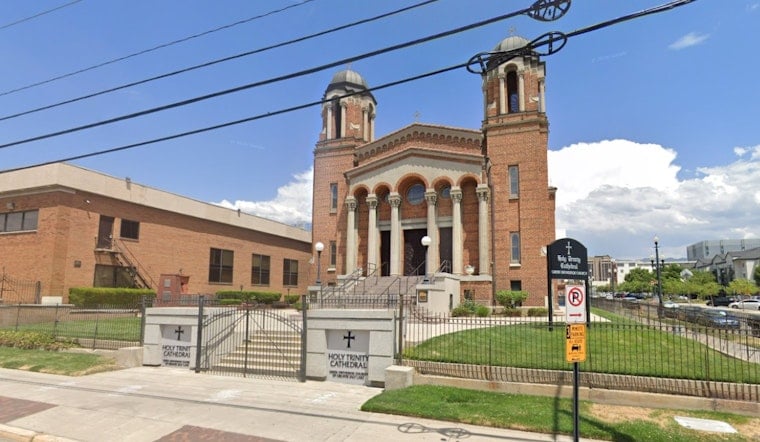
Holy Trinity Cathedral in downtown Salt Lake City is preparing to be stripped down to its bare brick for a multi-million-dollar seismic overhaul, more than five years after the magnitude 5.7 Magna earthquake tore nearly 1,500 feet of cracks through its interior walls. The historic Byzantine Revival landmark, which has stood at the corner of 300 South and 300 West for more than a century, was found to be structurally sound overall, but the damage was severe enough to trigger a full seismic upgrade of the entire building.
The March 18, 2020, earthquake damaged multiple buildings in and around Salt Lake City, part of a broader disaster that struck nearly 150 historic structures statewide and caused more than $600 million in building-related economic losses, largely to older unreinforced masonry buildings like the cathedral, according to the Utah Geological Survey. As reported by KSL News, the cathedral's golden dome itself came through undamaged, and its bell towers had already undergone seismic upgrades before the quake hit, according to George Karahalios, the parish council president at Holy Trinity Cathedral. Still, the roof and choir loft were left with cracked plaster requiring repair, and examination of the damage ultimately pushed leaders toward a comprehensive retrofit rather than a patch job.
What the Retrofit Will Actually Change
The scope of the work is dramatic for a building this old: crews will strip the entire structure down to the brick, then add shotcrete to thicken and strengthen the walls, per the same KSL account. Karahalios said the exterior walls are going to come in six inches on each side, and specialized cranes will lift the cathedral dome so a diaphragm can be placed under and around it, allowing the dome to move with the earth during any future earthquake. The stained-glass windows will be boarded up during construction, and the iconostasis will be completely replaced, though some of the cathedral's icons date back to 1906, and original icons will be displayed at the museum in the cathedral basement rather than lost to the renovation.
That basement space carries its own historical weight. The Hellenic Cultural Museum, dedicated on May 3, 1992, is recognized as the first Greek ethnic museum in the United States, according to Project MUSE, and it documents early 20th-century Greek immigrant labor and religious culture in the Intermountain West. Because the cathedral has been listed on the National Register of Historic Places since July 8, 1975, per the National Park Service, every repair approval must go through federal historic preservation review before contractors can touch the walls.
Paying for an $18 Million Job
The renovation project's overall cost is estimated between $16 million and $18 million, down from an original estimate of $20 million to $25 million, the same KSL report notes. Donations and fundraising have raised a little over $1 million so far toward the parish's required 10 percent share of the total project cost, with government grants and funding expected to cover the remainder. The Utah State Legislature already appropriated $1 million in state grant funding to the cathedral for building renovations and seismic updates under Senate Bill 2 in 2025, according to Utah.gov records, with that money awarded through the state's Department of Cultural and Community Engagement.
Parish leadership has also folded FEMA grant coordination into its post-earthquake planning, aiming to bring the entire building up to modern seismic safety codes, according to a 2022 parish bulletin from the Greek Orthodox Church of Greater Salt Lake. That federal involvement fits into a much larger regional problem: FEMA estimates put the number of unreinforced masonry buildings along Utah's Wasatch Front at more than 140,000, prompting Salt Lake City to launch its “Fix the Bricks” retrofit program to reduce collapse hazards in future quakes. Utah banned new unreinforced masonry construction back in the 1970s because of the seismic risk posed by the nearby Wasatch Fault.
A Century of Greek Orthodox History Downtown
The cathedral's roots trace back to Greek immigrants who began arriving in the Salt Lake Valley as early as 1870, with larger numbers settling in the city around 1900. The Greek Community of Utah organized in 1905 and established the first Greek Orthodox church between St. Louis and San Francisco, holding its first service on October 29, 1905. The original church building, designed to hold 1,500 worshippers, was sold for $18,000 in 1920 to make way for the present cathedral.
Construction on the new building began in 1923 and finished in 1924, with the first liturgy planned for August 15 of that year and the church formally consecrated on August 2, 1925, once the parish paid off its construction mortgage — making this year the centennial of that consecration. The building was designed in the Byzantine Revival style by the Salt Lake City firm Pope & Burton, working with Chicago-based Greek architect N. A. Dokas, according to the Utah Center for Architecture, and it was elevated to cathedral status in 1986. It underwent an earlier major restoration between 1997 and 2005 costing $4.2 million, and today it operates as part of the unified Greek Orthodox Church of Greater Salt Lake parish alongside Prophet Elias Greek Orthodox Church in Holladay, both under the Greek Orthodox Metropolis of Denver.
The Festival Funding the Repairs
Father George Nikas, the cathedral dean, and parish leaders are leaning on the community's biggest annual event to help close the funding gap. The 50th annual Greek Festival will raise funds for the cathedral building, and Karahalios said the festival brings about 40,000 to 42,000 people through the cathedral and museum during the weekend. Last year's festival generated an estimated $4 million economic impact on the Salt Lake Valley, per KSL's reporting, and Karahalios noted that Greek Orthodox Church converts have numbered at least 85 over the past year alone. For a congregation trying to raise its share of an $18 million retrofit while honoring a century of history downtown, the festival crowds and the fundraising appeal now go hand in hand.





