

























































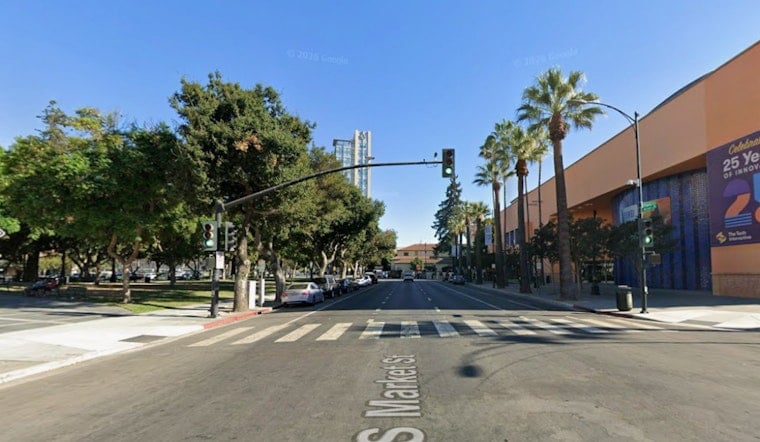
Every one of the 32 palm trees ringing downtown San Jose's Circle of Palms Plaza is coming down, with contractors beginning the emergency removal today after city arborists determined the remaining trees had deteriorated enough to pose a public-safety hazard. Fifteen of the palms were already found dead or dying, and some of the rest were leaning and at risk of falling, according to arborists cited in the city's assessment.
City Forester Sara Davis and Transportation Department Public Information Manager Colin Heyne hosted an on-site media availability today to walk through the timeline, as reported by the San Francisco Chronicle. The city says the removal work is expected to take up to nine days. Crews had already barricaded the plaza on August 7, cutting off the 2.3-acre space at 124 S. Market St. and forcing scheduled summer community activities to relocate while arborists conducted safety assessments.
A Landmark With No Clear Diagnosis
San Jose has not said what caused the palms to die or decline, and the Chronicle's report notes the city has offered no public explanation for the sudden deterioration. Emergency officials in earlier public messaging described cordoning off the area after identifying dead and leaning trees that posed an immediate hazard, but the underlying cause behind the decline remains an open question. Whatever is behind it, the city says the situation has moved from routine maintenance to urgent removal.
The plaza itself carries outsized historical weight for a patch of downtown pavement. It is designated California Historical Landmark No. 461, marking the site of an 1830s two-story adobe hotel that served as California's first state capitol when the first state legislature assembled there in December 1849, according to the landmark's official history. San José served as the seat of California's state government from 1849 to 1851 before the capital moved on to Vallejo and then Sacramento.
Layers of History Beneath the Trees
The land carries a darker chapter, too. Before the modern plaza was built, the site held San Jose's Second Market Street Chinatown, which was destroyed by arson in May 1887, displacing roughly 1,400 Chinese residents amid a period of widespread anti-Asian hostility. In September 2021, the city held an official ceremony at the Circle of Palms to apologize for that history and for the 1887 city council resolution that had declared Chinatown a public nuisance.
Today, the plaza sits ringed by a design that places the palms around an outline of the California state seal, adjacent to the San José Museum of Art and near the Signia by Hilton hotel and the Silicon Valley Financial Center. Across South Market Street sits Plaza de César Chávez, originally laid out by Spanish authorities in 1797 as the Plaza Mayor of Pueblo de San José de Guadalupe and considered the oldest continuous public open space in Northern California, per its Wikipedia entry.
Winter Tradition Loses Its Anchor Trees
The Circle of Palms has also served as the backdrop for one of downtown's most popular seasonal traditions. The San Jose Downtown Association has hosted its annual winter Downtown Ice skating rink at the plaza every holiday season since relocating the event there in 2004, using the 32 palm trunks as anchors for synchronized light displays that draw tens of thousands of skaters each winter. It's unclear how, or whether, that tradition will continue once the trees are gone.
City officials say they plan to take a deliberate approach to planning the site's future, but San Jose has not announced a replacement design or a budget for rebuilding the plaza. Officials say the next steps will be announced later, and in the meantime, are urging people to stay outside the restricted area and follow instructions from city staff and contractors during the removal work.
A Broader Debate Over Palms in San Jose
The removal lands amid a wider local conversation about whether tall, non-native palms still make sense in San Jose's urban canopy. Mexican fan palms, like those planted in the Palm Haven district around 1913, can grow up to 100 feet tall but provide minimal shade compared with broadleaf trees during extreme heat, as the San Jose Mercury News has reported. That tradeoff has fed a growing preference among some urban forestry voices for climate-resilient shade trees over ornamental palms.
San Jose has also seen the physical risks of maintaining its aging palms firsthand. In April, a tree trimmer suffered a severe medical emergency while working 75 feet up inside the crown of a palm tree in the city, requiring a daring helicopter rescue by Cal Fire crews. And tree removals in San Jose have drawn public pushback before: in 2021, contractors cut down two mature Mexican fan palms at downtown's Pellier Park despite earlier assurances the trees would be relocated intact, prompting neighborhood outcry at the time.





