

























































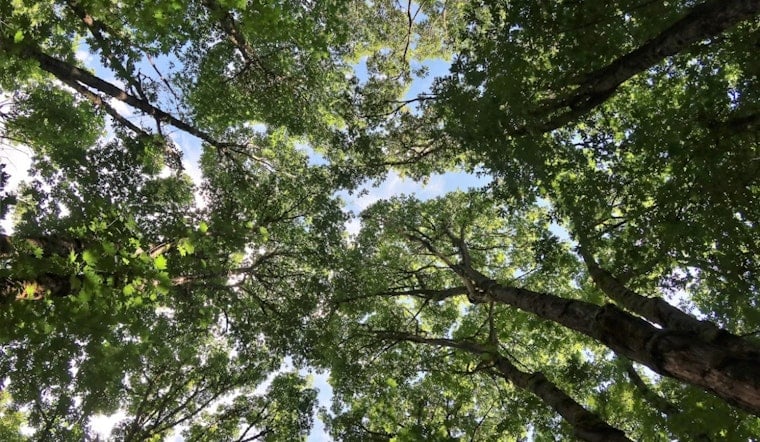
Santa Clara County has finished drafting a 40-year Urban Forest Master Plan designed to reverse decades of shrinking tree cover across its 15 cities, with a sharp focus on schools, parks and transit corridors in disadvantaged neighborhoods that have the least shade. The plan is set to go before the county's Housing, Land Use, Environment and Transportation Committee on Thursday, and committee staff will then forward recommendations to the Board of Supervisors, which may ultimately approve it.
The effort comes from the county's Office of Sustainability and Resilience, whose director, Cayce Hill, said collective tree planting can improve air quality, cool cities, beautify communities and create a more resilient environment, according to Opportunity Now. The plan is meant to serve as a roadmap and toolbox that gives the county and its cities shared tools and support to grow a greener landscape, rather than leaving each jurisdiction to tackle the problem alone.
A City That Has Lost Ground
The stakes are clearest in San Jose, the county's largest city, which lost roughly 1,728 acres — about 2.7 square miles — of tree cover between 2012 and 2018, according to the City of San Jose. That decline dropped the city's canopy from 15.3% down to 13.5%, even as single-family and multi-family residential lots account for roughly 70% of all the city's trees. In February 2022, the San Jose City Council responded by adopting its own Community Forest Management Plan, setting a target of reaching 20% canopy coverage by 2051. City arborists have estimated that recovering just one percentage point of lost canopy requires planting roughly 40,000 mature-spread trees.
The urgency was underscored again this year when the Santa Clara County Civil Grand Jury released a report titled “A Canopy in Decline: Is San José serious about expanding its tree coverage?” on May 19, examining ongoing tree loss and municipal management challenges in the city, per the Superior Court of California, County of Santa Clara. That report prompted formal responses from San Jose city departments over the summer.
Mapping Where the Gaps Are
Baseline geospatial data compiled by the county shows urban areas across Santa Clara County currently maintain just 18% tree canopy cover, while possessing 33% possible plantable space, according to county mapping posted on ArcGIS. That mapping, built at the census block group level, allows planners to target planting efforts at a granular neighborhood scale rather than applying a one-size-fits-all approach countywide.
An assessment tied to the master plan identifies priority tree-planting areas — schools, parks and transit corridors — specifically in disadvantaged areas, according to the seed facts underlying the County of Santa Clara's announcement of the draft plan. That canopy and land cover assessment was produced by Davey Resource Group and funded through the 2021/2022 fiscal year state general funds, administered through CAL FIRE's Urban and Community Forestry Grant Program, which awarded the county $930,800 that cycle specifically for its Urban Forest Analysis and Collaboration project, according to CAL FIRE. California's urban forestry grants draw on state cap-and-trade auction proceeds.
The Office of Sustainability and Resilience has drafted an Urban Forest Master Plan to plant more trees in our community, which means cleaner air, cooler cities and more beautiful gathering spaces, especially in underserved areas. Learn more at https://t.co/bB1hUm4MPX. pic.twitter.com/rwj74WVlfc
— County of Santa Clara (@SCCgov) August 16, 2026
The Palo Alto Contrast
The disparities within the county are stark. Neighboring Palo Alto has set a goal of reaching 50% tree canopy coverage by 2030, a target that stands in sharp contrast to less-canopied communities in East San Jose and South Palo Alto, according to WoodlotLedger. Palo Alto's neighborhood-level canopy coverage ranged from 35% up to nearly 56% back in 2010, dwarfing San Jose's 13.5% citywide figure.
That inequity is why national conservation group American Forests named San Jose in 2021 as one of 20 major U.S. cities with populations over 500,000 that stand to gain the most health, economic and climate benefits from achieving Tree Equity in lower-income neighborhoods, per American Forests. Tree equity scores, which the group developed, combine median income, race, age, surface temperature and existing canopy cover to identify where new trees would do the most good — and the county and its cities plan to use those same scores to measure tree distribution against demographics and environmental conditions going forward.
What the Trees Already Do
The existing tree canopy is already doing significant environmental work. Trees across Santa Clara County capture 464,600 tons of carbon, manage 864 million gallons of stormwater, and remove approximately 25 million pounds of air pollutants, generating about $101.4 million in ecosystem benefits every year, based on figures cited in the county's plan. Expanding that canopy further is expected to bring wildlife habitat, better stormwater management, cooler cities amid climate change, improved air quality and greater tree equity in disadvantaged communities.
To grow the canopy, the plan proposes training residents to lead tree planting and maintenance work, along with incentives, technical assistance and partnerships aimed at private property owners, who control much of the plantable land. The Office of Sustainability and Resilience is also proposing a county-managed data system to track tree inventory and maintenance, which officials say could evolve into a regional urban forestry data hub within a decade. A companion climate-ready species list will identify drought-tolerant, pest-resistant and climate-adaptable trees suited to the region's changing conditions.
Building the Workforce and Community Buy-In
Community outreach has been central to shaping the plan. The county conducted extensive multilingual community outreach, with help from nonprofits Canopy and Our City Forest in mobilizing community planting efforts. Jean Paul Renaud, executive director of Canopy, said community tree planting builds community and democracy, reflecting a philosophy that treats planting days as civic engagement as much as environmental work.
That workforce dimension isn't new to the region. San Jose was selected in 2021 as one of three national pilot cities for the TAZO Tree Corps, an urban forestry workforce development program that provided paid training and employment for underrepresented residents in low-income neighborhoods, according to American Forests. The program included wraparound support such as career coaching and transportation to help ensure long-term employment retention. More recently, in April, the Santa Clara Valley Transportation Authority partnered with Our City Forest on a Free Trees Program targeting East San Jose and Sunnyvale to replace trees removed during transit and road construction, since infrastructure projects frequently require mature roadside tree removals that trigger mandatory replanting.
Funding Remains the Open Question
Even with the plan drafted, county and city officials acknowledge that money remains the central obstacle. The county and its 15 cities will need to find diversified revenue sources, including state and federal grants, and the plan calls for a funding roadmap that establishes diverse revenue streams and multijurisdictional grant opportunities. Kyle Peczowski, a senior management analyst with the Office of Sustainability and Resilience and a master arborist, said regional support and a network are needed so cities can successfully implement urban forestry tools rather than each trying to do so alone.
Brent Johnson, the office's integrated natural resource manager, said creative implementation will be needed to make the plan work in practice. Much of that coordination is expected to run through the Santa Clara Valley Urban Forestry Alliance, which includes county and municipal representatives and provides policy tools, community outreach, technical advisory assistance and funding strategies. The plan also calls for creating a forestry working group drawing staff from multiple county departments, and the county says it will track canopy growth — especially in disadvantaged communities — through annual reports and five-year air-quality reviews.
San Jose already has some models to build on, including its first pocket forest, planted in District 4 in April 2022 through a public-private partnership between the city, Bloom Energy and the Santa Clara Valley Open Space Authority to combat severe urban heat island impacts. Local open space officials have emphasized that preserving mature trees is just as vital as planting new seedlings — a reminder that even as the county looks 40 years ahead, protecting what canopy remains today is part of the job.




