

























































Editor's Note: This article has been updated to correct the number of parking spaces associated with the proposed project at 1517 15th Street.
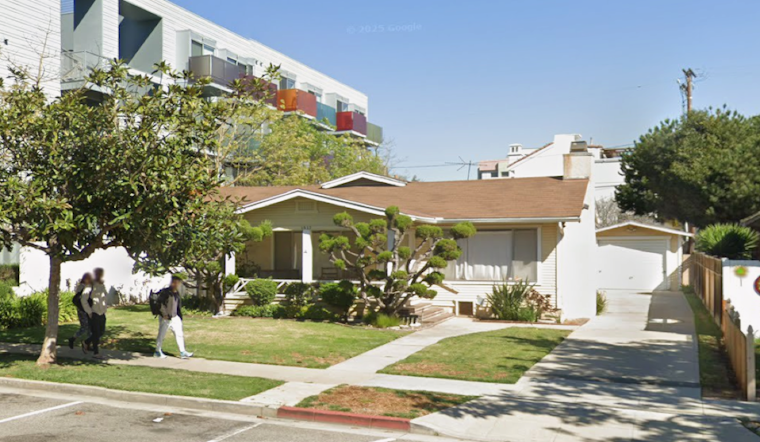
A single-family house built in 1923 at 1517 15th Street in Santa Monica could soon be demolished to make way for a 12-story residential tower rising 138 feet above street level, with 32 one- and two-bedroom homes and between four and eight vehicular parking spaces. The filing, submitted by property owner Bruce Adler on behalf of a family trust, marks the second project in the city to invoke California Senate Bill 79, the state law that strips local governments of discretionary review over qualifying housing near major transit stops.
As reported by Urbanize LA, the project would rise as 11 floors of mass timber construction stacked atop a single-story concrete base, with six of the 32 units set aside for very low-, low-, and moderate-income households. The 7,495-square-foot parcel currently holds a modest 1,908-square-foot home, according to property records from Redfin, a striking contrast to the scale of what's proposed to replace it. The site sits close to the E Line's 17th Street/SMC station, placing it squarely inside the transit radius that SB 79 was designed to unlock.
How SB 79 Cleared the Path
SB 79, formally titled the Abundant & Affordable Homes Near Transit Act and authored by state Sen. Scott Wiener, was signed into law by Gov. Gavin Newsom in October 2025 and took effect statewide in July 2026, according to California YIMBY. The law applies across 15 urban transit counties statewide, granting by-right approval for multifamily housing up to 160 units per acre near light rail stops without conditional use permits or public hearings, per an analysis from Manatt, Phelps & Phillips.
Because the proposed tower exceeds 85 feet, it falls under SB 423 labor standards, which require prevailing wages or a skilled and trained workforce for construction — an added financial and regulatory obligation baked into the state mandate. Santa Monica, along with the cities of Los Angeles and Beverly Hills, has adopted a local implementation ordinance for SB 79, according to the same coverage from Urbanize LA.
A City Trying to Slow the Wave
Santa Monica has not embraced SB 79 without resistance. The City Council adopted an ordinance in July 2026 temporarily excluding five of the city's six transit-oriented development zones from state SB 79 standards until one year after adoption of its 2029–2037 Housing Element, Hoodline previously reported on the council's SB 79 debate. That exclusion took effect Thursday.
But the Expo/Bundy TOD zone — which covers the stretch near 1517 15th Street — didn't meet the state's criteria for exclusion. City officials held a public meeting two days ago to propose upzoning 89 single-family parcels in the Pico Neighborhood in an attempt to qualify that zone for exclusion too, a move that has drawn pushback from residents, according to the Santa Monica Lookout.
Building Tall in Wood
The 1517 15th Street proposal isn't the first SB 79 filing in the city. Santa Monica's first project under the law would replace a single-family home near Bergamot Station with townhomes, as Hoodline reported in its piece on the city's first SB 79 filing. The 15th Street project is far larger in scale, relying on updated California Building Code provisions that now allow Type IV mass timber construction to reach as high as 12 stories (Type IV-B) or even 18 stories (Type IV-A), a major jump from the six-story limit under older heavy-timber rules, according to Perkins&Will.
The Bigger Housing Math
The filing arrives as Santa Monica works to meet a state-mandated Regional Housing Needs Allocation of 8,895 total new units for the 2021–2029 cycle, with more than 69% — 6,168 units — reserved for low- and very low-income households, per city figures. Progress has been steady but incremental: the city's FY 2024–25 housing report found 58 affordable units completed, 321 under construction, and 367 more in the planning pipeline, according to the Santa Monica Daily Press.
Nearby, Venice Community Housing and Community Corp. of Santa Monica are already building a fully affordable project along the same transit corridor — the 20th Street Apartments, a 7-story, 78-unit development supported by a $14.75 million award from California's National Housing Trust Fund, which Hoodline covered in its report on the affordable complex rising by the E Line. Together, the projects reflect a broader pattern of multi-story housing filings clustering around Santa Monica's rail stops as the city works to satisfy both state mandates and its own housing goals.





