

























































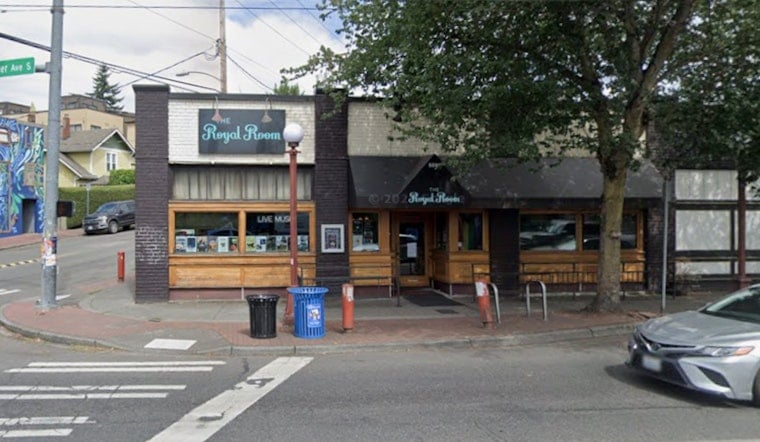
Ghetto Chilldren, the Seattle rap duo whose refusal to bend to a major-label deal in the 1990s became local legend, will headline the first night of the Staycation Music Festival at the Royal Room in Columbia City on September 4. Derrick “Vitamin D” Brown and William “B-Self” Rider take the stage at 8 p.m., and the show could mark a step toward the group’s first new music in decades.
The festival takes place at the Royal Room, located at 5000 Rainier Ave. S., with tickets running $23.62 in advance with fees or $25 at the door, and the event is all ages until 10 p.m. As reported by The Seattle Times, the show is being produced by Tish Gallow. Rider, who works a day job as a warehouse inventory specialist, told the paper he expects the performance to precede potential new Ghetto Chilldren music, describing the sound of any new tracks as an older, wiser version of the group.
Brown, who now works as a teacher in Seattle and teaches theater and multimedia art alongside his daughter, said the Royal Room performance will present Ghetto Chilldren in its pure form, per the same account. The group hopes to release an EP or album early in 2027, a modest but meaningful milestone for a duo that never released a solo album despite decades of local influence.
Roots Tracing Back to Garfield High School
Brown and Rider met through mutual friends at Garfield High School in the early 1990s, and Ghetto Chilldren formed after the two developed a mutual love of hip-hop. Brown established a makeshift recording studio called the Pharmacy at his mother's house in the Central District, a space that could host up to 20 people on a given day, according to the outlet's report. The group debuted at the Langston Hughes Performing Arts Institute in 1993, and at one point had roughly six members before later being reduced to just Brown and Rider during his senior year.
Brown's own connection to Seattle's earliest hip-hop scene runs deep: he is the son of Motown studio guitarist Herman Brown of the funk group Ozone, and the cousin of Eddie “Sugar Bear” Wells of the Emerald Street Boys, widely regarded as Seattle's first hip-hop group, according to Arte Noir. That lineage helps explain the deep well of musical knowledge Brown brought to Tribal Productions, the collective that also included Sinsemilla, Union of Opposites, Phat Mob and Narcotik alongside Ghetto Chilldren.
Walking Away From Geffen Records
Geffen Records once offered Ghetto Chilldren a major-label record deal, and the group recorded a demo with the Dust Brothers production duo in California as part of that process. But Brown and Rider ultimately declined the deal over concerns about creative control, walking away rather than surrender their organic, homegrown beat-making style, as detailed by Town Love. It was a defining moment that kept the group an underground Pacific Northwest phenomenon rather than a mainstream act.
Author David Abe, who wrote Emerald Street: A History of Hip Hop in Seattle, has praised Brown's production and Rider's lyricism specifically on their 1996 release Do the Math, one of several Tribal Productions releases that also included Untranslated Prescriptions in 1994. Ghetto Chilldren later contributed to 14 Fathoms Deep in 1997 and Classic Elements in 1998, cementing their reputation even without a dedicated solo LP. In a 1993 interview highlighted by festival organizers, Rider explained the group's conscious lyrical approach, questioning why rap artists of that era felt compelled to project aggression on tape rather than focus on everyday experiences and intellectual wordplay, according to The Royal Room's event page.
A Legacy That Shaped Seattle's Sound
The group's fingerprints are visible across Seattle hip-hop's later breakout era. Macklemore called Brown and Rider his “greatest teachers” in the 2010 song “The Town,” a nod to Ghetto Chilldren's influence on local artists and producers who followed. Brown also served as a production mentor to Seattle native Jake One, who went on to earn multiple Grammy nominations producing for Drake, 50 Cent, J. Cole and Travis Scott, per Arte Noir.
Brown's own production career later reached a national television audience when he produced 50 Cent's 2014 single “Big Rich Town,” featuring Joe, which flipped a 1974 Michael White jazz sample and served as the opening theme for all six seasons of the Starz drama Power. Belgian archival label Back 2 Da Source Records also released a 2xLP and CD compilation in March 2021 titled 90's Unreleased, Demos & Rare Tracks, restoring 11 previously unheard Ghetto Chilldren recordings from the mid-1990s, according to Discogs listings of the release.
Ghetto Chilldren disbanded in the late 1990s but reunited for a performance at the Museum of Pop Culture in 2017, and the group has performed two to three shows a year since then. The Staycation Music Festival appearance adds to that steady drumbeat of reunion shows, this time with the added anticipation of a possible 2027 release.
Preserving the Central District's Hip-Hop History
The Royal Room itself has deep roots in Columbia City's music community. Composer Wayne Horvitz opened the venue in December 2011, and it now operates in tandem with the South Hudson Music Project, a 501(c)(3) nonprofit founded in 2016 to support equitable artist pay and community-based programming, according to Earshot Jazz.
The Staycation show also arrives amid a broader community push to document Seattle's early rap history. In June, local music researcher Gary Campbell published The Seattle Hip-Hop Walking Map, a free zine tracing 23 historical landmarks across the Central District and Downtown, including Garfield High School, in honor of the early 1990s origins of Ghetto Chilldren and Tribal Productions, as reported by the South Seattle Emerald. For a group that has spent three decades building a local hip-hop legacy and brotherhood rather than chasing a major-label spotlight, the walking map and the Royal Room stage stand as parallel forms of the same recognition.



