

























































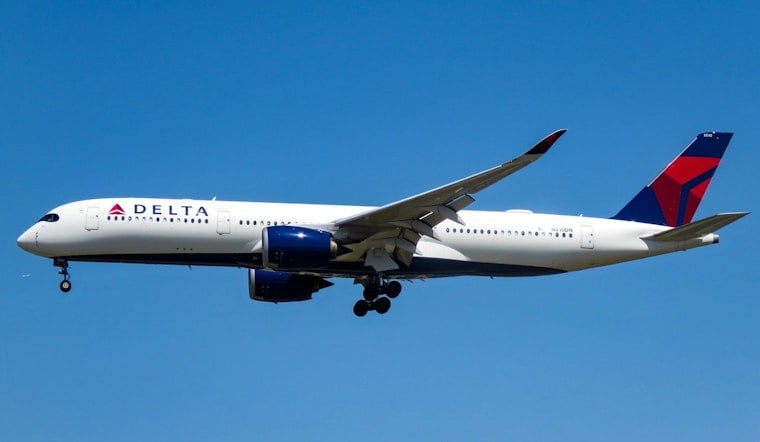
A Delta Air Lines flight bound for Fort Lauderdale turned back to Hartsfield-Jackson Atlanta International Airport Wednesday morning after flight crew members detected a smoky odor onboard, forcing an emergency landing with 181 passengers and crew members aboard. Air traffic controllers reported smoke in the cockpit of the Airbus jet based on air traffic control audio, and alerted the airport fire chief as the plane circled back to Atlanta.
The flight, Delta Flight 1334, had originally departed Hartsfield-Jackson around 7 a.m. for Fort Lauderdale before making the turnback out of an abundance of caution, according to WSB-TV. The jet had roughly 17,000 pounds of fuel on board at the time, as reported by FOX 5 Atlanta. It landed without incident, a Delta spokesperson said, and none of the passengers required medical evaluation following the emergency landing.
Delta said its flight crew followed established procedures to keep everyone on board safe, according to the spokesperson. Officials have not confirmed the exact cause of the smoky odor inside the cockpit. Per FlightAware tracking data, the flight is expected to resume its trip to Fort Lauderdale roughly two hours and 30 minutes behind schedule.
A Second Smoke Scare at the Same Hub in Days
This is not the first time in recent days that a Delta jet has turned back to Atlanta over cockpit or cabin fumes. On Aug. 8, Delta Flight 2204, a Boeing 757 bound for Orlando carrying 205 passengers and crew, made an emergency return to Atlanta after fumes filled the cockpit, resulting in a taxiway evacuation via emergency slides, as reported by FOX 5 Atlanta. Hoodline previously covered that Orlando-bound slide evacuation.
The pattern extends further back. In February 2025, Delta Flight 876, carrying 99 passengers and crew, was forced to make an emergency landing back in Atlanta after crew members reported possible smoke in the flight deck and a haze filled the cabin, according to the Associated Press as reported by ET Infra. Together with Wednesday's turnback, the incidents point to a recurring issue with flight deck smoke and fume reports on Delta departures out of its Atlanta hub.
Why Pilots Turn Back So Fast
Aviation regulations leave little room for hesitation when smoke shows up in the cockpit. Federal Aviation Administration advisory circular guidance updated in March 2021 dictates that the mandatory first step in flight deck smoke, fire, or fume checklists is for pilots to don oxygen masks set to 100 percent oxygen to maintain safety and internal cockpit communications. Airbus flight operations guidance published in 2019 goes further, stating that any in-flight smoke or fume event whose source cannot be immediately identified and isolated at an early stage must be judged significant enough to warrant an immediate diversion or turnback.
Those protocols are backed by hard design standards. Commercial aircraft design standards reviewed by the U.S. Government Accountability Office require emergency ventilation systems capable of evacuating dense smoke from the cockpit within three minutes. Smoke and fume events like Wednesday's are far from rare nationally — roughly 900 such incidents occur annually aboard U.S. transport category airplanes, according to Federal Aviation Administration guidance, frequently prompting flight crews to declare emergencies and request priority landings or turnbacks.
Regulators Are Already Watching the Trend
The frequency of these events has drawn scrutiny from federal safety regulators. In May, the National Transportation Safety Board issued safety recommendations calling on the FAA to mandate realistic, scenario-based simulator training for smoke-in-cockpit emergencies, noting that passenger airlines currently rely heavily on verbal discussions during annual refresher training rather than hands-on drills.
The stakes are especially high at Hartsfield-Jackson, which handled 106.3 million passengers and more than 805,000 aircraft operations in 2025, according to Simple Flying. The airport serves as Delta's primary corporate hub, with the carrier operating more than 1,000 daily flights from the location, making any recurring mechanical or fume-related issue there a matter of outsized operational consequence. What exactly caused the smoky odor aboard Flight 1334, and whether it points to the same underlying issue as the Aug. 8 slide evacuation, remains unconfirmed by officials.




.jpg)