

























































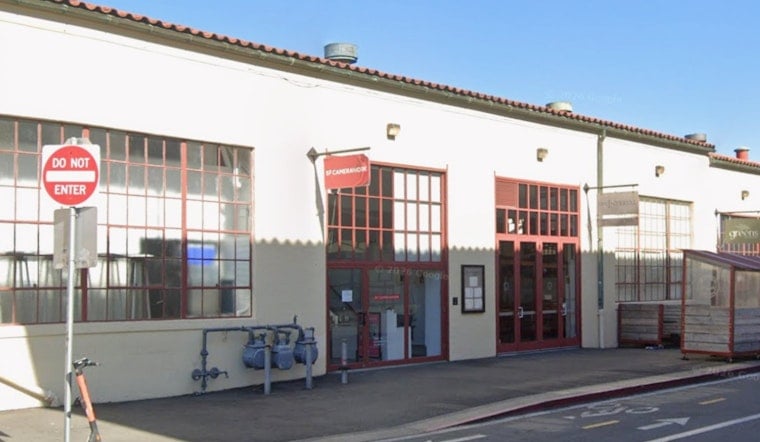
SF Camerawork, the nonprofit photography gallery that has anchored San Francisco's contemporary art scene for 52 years, will close its doors after years of rising operational costs and a decline in public funding. The gallery's final exhibition, John Chiara's “Bay Panel,” remains open to the public through next Sunday, August 16, at its home in Building A of the Fort Mason Center for Arts & Culture.
Founded in 1974 by a group of artists, SF Camerawork said it can no longer continue operations, citing years of rising costs and a changing philanthropic landscape, according to The San Francisco Standard. The nonprofit began life as the Lamkin Camerawork Gallery in Fairfax, before founder John Lamkin moved the operation to San Francisco and sold it to gallery volunteers for one dollar, officially incorporating as a nonprofit in 1977, according to KQED. Over the decades it became one of San Francisco's prized venues for fine art photography, per the Standard, serving as a launchpad for artists including Robert Mapplethorpe and Sally Mann.
From Fairfax Basement to Fort Mason Waterfront
The gallery's path to its current waterfront home wound through several San Francisco neighborhoods. It previously operated in Mid-Market and SoMa before relocating to Fort Mason in August 2022, per city records reviewed by SF.gov. That move came as Aay Preston-Myint took over as executive director in 2022, transitioning from the Headlands Center for the Arts to oversee the shift to Fort Mason, according to SF/Arts.
SF Camerawork's role went beyond exhibitions. The gallery incubated First Exposures, a youth photojournalism and mentoring program that began inside its walls before growing into an independent Bay Area nonprofit, as Hoodline reported in 2016 in a profile of photographer and former SF Camerawork interim director Hal Fischer, who helped establish the program. Hoodline also covered “Ain't Nothing Tender,” a 2013 exhibition at the gallery built around a youth photojournalism initiative documenting the Tenderloin.
Legacy Status Wasn't Enough
In February 2024, the San Francisco Small Business Commission designated SF Camerawork a Legacy Business for helping to grow the city's photography community and for presenting materially experimental work, according to SF.gov documentation. That status made the gallery eligible for annual business assistance grants of up to $500 per full-time employee, capped at $50,000, plus landlord rent-stabilization grants of up to $22,500 a year. Those civic supports ultimately weren't enough to offset the broader financial pressures the nonprofit cited in announcing its closure.
SF Camerawork's founders left a lasting mark on the medium itself. In 2020, SFMOMA displayed work by several of the gallery's founders in a group show titled “Thought Pieces,” featuring photographs by Lew Thomas, Donna Lee Phillips, and Hal Fischer, per the Standard's reporting.
Part of a Wider Wave of Closures
SF Camerawork's shutdown is not an isolated event. San Francisco has experienced at least five major gallery closures since June 2025, the Standard reports, including Kadist, Rena Bransten Gallery, Altman Siegel Gallery, and Jack Fischer Gallery, all of which cited financial struggles. Separately, four commercial galleries at the Minnesota Street Project complex in Dogpatch — Altman Siegel, Rena Bransten, Anglim/Trimble, and Jack Fischer Gallery — announced closures between late 2025 and early 2026, representing a quarter of that facility's tenants, according to KQED.
The pressures extend beyond gallery rent rolls. In May 2025, the National Endowment for the Arts abruptly terminated active grants for more than a dozen Bay Area arts nonprofits, including SFJAZZ, Berkeley Repertory Theatre, and the Frameline film festival, per KQED. At the municipal level, San Francisco Mayor Daniel Lurie proposed consolidating the San Francisco Arts Commission, Grants for the Arts, and the Film Commission under a single agency while cutting departmental staff, as the city confronted a projected $600 million budget deficit for 2025–2026, according to 48 Hills.
KQED notes that other long-standing San Francisco cultural and educational institutions have also announced closures or severe contractions in 2026, including the Mission Cultural Center for Latino Arts and the California College of the Arts. Taken together, the losses point to a funding environment in which even institutions with half a century of community history and official Legacy Business recognition are struggling to keep their doors open. For now, SF Camerawork's final chapter closes next Sunday, when “Bay Panel” comes down for good.





