

























































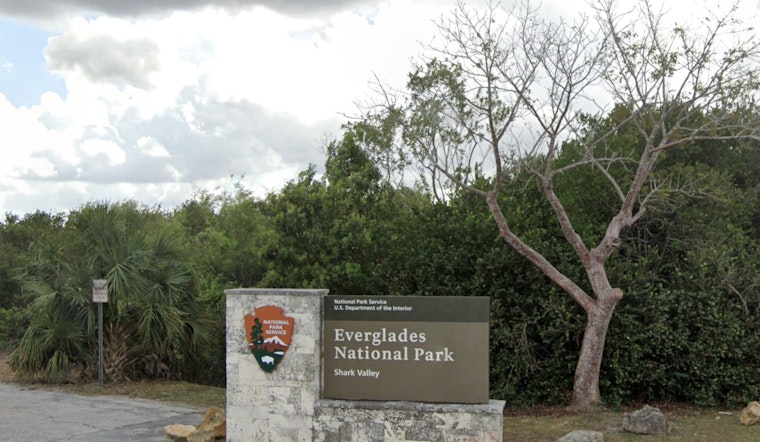
Everglades National Park has closed its popular Shark Valley district as wildland firefighters battle the lightning-caused Chipmunk Fire, now estimated at roughly 11,000 acres with 40% containment, along with several other blazes burning simultaneously across South Florida's wetlands.
The Chipmunk Fire was first reported Friday about two miles southwest of Shark Valley and has continued active burning along its eastern and southern flanks, according to WGCU News. A second lightning-ignited blaze, the Vulture Fire, ignited Saturday east of the Shark Valley Tram Road and has grown to 347 acres, though overnight rain helped crews push containment to 80%.
The National Park Service confirmed it temporarily closed Shark Valley, according to Local10 News. The closure order covers every administrative and public facility in the district — the visitor center, parking lots, hiking trails, and the entire 15-mile Shark Valley Tram Road loop — though commercial airboat concessions located outside park boundaries remain open, per the same WGCU report.
A Popular Overlook Goes Dark
Shark Valley, tucked in far western Miami-Dade County along Tamiami Trail, is built around that 15-mile paved loop leading to a 65-foot observation tower, the highest accessible vantage point anywhere in Everglades National Park. Visitors climb it for sightlines stretching up to 20 miles across open sawgrass prairie, according to Visit Florida. The shutdown effectively closes off one of the park's busiest wildlife-viewing destinations while crews work the fire lines nearby.
Chipmunk and Vulture are not the only fires firefighters are tracking inside the park. Crews are also monitoring the 116-acre Lemur Fire and the much larger 6,222-acre Movie Dome Incident, the station's report notes, underscoring how much lightning-driven fire activity is unfolding across the Everglades at once this week.
Fires Also Burning Outside the Park
Beyond the national park, the Florida Forest Service's Everglades Field Unit responded to an 800-acre fire in northern Miami-Dade County that was 30% contained as of Sunday, per Local10 News. The unit also handled a wildfire in southwestern Palm Beach County that burned 350 acres and reached 85% containment.
Farther west, the Florida Forest Service's Caloosahatchee Field Unit responded to a smaller wildfire in western Collier County that burned seven acres and was 95% contained. Wildfire response across the region is split between these two jurisdictions, with the Everglades Field Unit covering Miami-Dade, Broward, and Palm Beach counties while the Caloosahatchee Field Unit handles Collier, Lee, Hendry, and Charlotte counties, according to Local10 News. Smoke from the fires was visible from the park's main road and along U.S. Highway 41, the outlet reported.
A Summer of Recurring Wetland Blazes
This week's fires extend a pattern that has played out across South Florida for months. Persistent rainfall deficits left peat soils dry heading into summer, setting the stage for the 14,300-acre Berger Fire in Palm Beach County's Rotenberger Wildlife Management Area in July and the 4,793-acre Coptic Fire inside the national park in June, according to the National Park Service. Just two days before the Chipmunk and Vulture fires ignited, Hoodline reported on a 200-acre brush fire choking West Miami-Dade with zero containment, and earlier in August, three separate Everglades fires forced a lengthy Krome Avenue shutdown that trapped drivers for hours.
Drift smoke poses its own hazard beyond air quality. When it mixes with nighttime and early-morning humidity over highways like U.S. 41 and Krome Avenue, it can form super fog, a phenomenon capable of dropping roadway visibility to zero within minutes.
Lightning-sparked fire is not inherently unnatural in this ecosystem. Wildfires in the Everglades typically strike at the start of the summer wet season, when early storms ignite dry vegetation, and they play a critical ecological role by holding back tree and shrub encroachment on open sawgrass marsh while recycling nutrients into the peat, according to research published by BioOne Complete. Statewide, the Florida Forest Service also runs one of the country's most active prescribed-fire programs, issuing roughly 88,000 burn authorizations a year to treat more than 2.1 million acres and reduce the fuel loads that make wildfires like these more severe.
Whether the fires burning now will be fully doused or simply multiply depends largely on the next round of summer storms. Scattered thunderstorms could bring enough rain to knock down the flames, but they also carry fresh lightning that could spark new ignitions across still-parched marshland before the wet season fully takes hold.



