

























































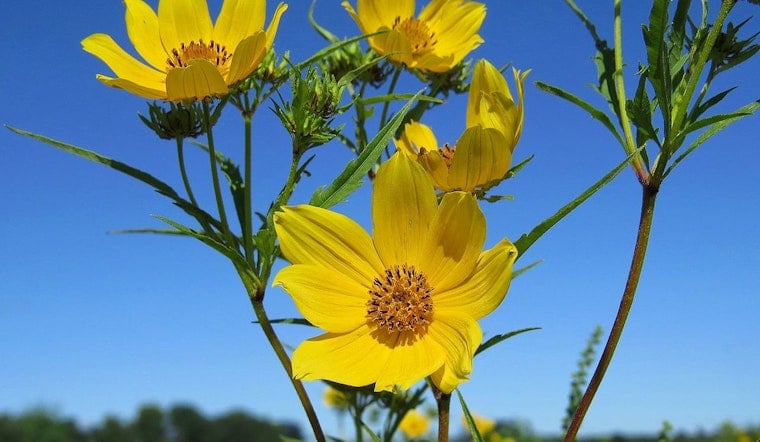
Yellow flowers are starting to poke through the meadow at Shelby Bottoms, and East Nashville visitors have already noticed the first signs of the park's annual superbloom. The tickseed sunflower display, expected to peak between late August and early September, transforms a stretch of the Cumberland River floodplain into a sea of gold each year, drawing walkers, cyclists, and photographers to the greenway's trails.
The bright yellow blooms come from tickseed sunflower, a plant that produces its signature color across the meadow near the Shelby Bottoms Nature Center, according to WZTV. Nature center naturalists have been fielding questions from eager visitors and are offering flower-viewing tips ahead of the peak, per the station's report. The Observation Deck Overlook Loop meadow has been identified by nature center staff as the best place to take in the display, with the Ecology Trail and the Overlook Loop both leading directly to the superbloom meadow.
For visitors who can't walk far on trails, the nature center is offering an accessible viewing option, the same report notes. Staff have also recommended a spot under the train trestle as a way to catch a drive-by preview of the superbloom without leaving the car. Alongside the tickseed sunflower's yellow, the meadow features ironweed's purple blooms, adding a second layer of color to the late-summer landscape.
A Meadow Built By Design, Not Accident
The superbloom isn't a wild accident of nature. According to a social media update from Friends of Shelby Park and Bottoms, the primary meadow was once mowed turf grass before it was ecologically restored into a native ecosystem through a partnership between Metro Parks Nashville, the Shelby Bottoms Nature Center, and the nonprofit. That transformation turned an unremarkable patch of urban grass into a genuine floodplain prairie habitat.
Tickseed sunflower, known scientifically as Bidens aristosa, is a North American native annual that thrives in moist bottomlands like the Cumberland River floodplain, producing dark brown seeds with barbed awns that stick to passing animals and clothing, per the Missouri Department of Conservation. That seed-dispersal trait is part of how the plant naturally spreads across the meadow year after year. Beyond the yellow sunflowers and purple ironweed, the restored meadow also hosts white late boneset, rounding out a late-summer native floral community, according to Friends of Shelby Park and Bottoms.
Why Naturalists Want Everyone Off the Grass
Visitors are prohibited from going off-trail for photoshoots and from picking the flowers, restrictions the Shelby Bottoms Nature Center enforces by asking everyone to stay on trails and leave no trace. Those rules exist to protect the environment and wildlife within the meadow. Trampling the delicate annual seed bank can jeopardize the very blooms that draw crowds back each year, since the sunflowers need to reseed themselves naturally to return.
The stakes go beyond aesthetics. Native late-summer wildflowers like tickseed sunflowers offer essential late-season nectar for bees and butterflies before winter, while their mature seed heads become a food source for songbirds, quail, and waterfowl, per the Missouri Department of Conservation. Purple ironweed and boneset extend that ecological function further into the season, giving pollinators a longer runway before colder weather sets in.
A Park Complex Still Under Restoration
The bloom sits within the Shelby Bottoms Greenway and Natural Area, a 960-acre stretch of protected Cumberland River floodplain located under four miles east of downtown Nashville, according to The Cultural Landscape Foundation. The park offers more than five miles of paved, ADA-accessible paths alongside more than five miles of primitive unpaved trails, giving visitors multiple ways to reach the meadow. Restoration work is happening elsewhere in the complex too: the adjacent 130-acre Cornelia Fort Airpark trailhead has a brief closure scheduled this month for maintenance and grassland habitat restoration.
That airpark project ties into a broader push for native grassland reconstruction. Nashville.gov, the city's official government portal, notes that the Shelby Bottoms Nature Center hosted a public presentation earlier this year with the Southeastern Grasslands Institute focused on restoring historic prairie habitat at the Cornelia Fort site. The nature center itself, which opened at the park's main trailhead in late 2007 under the Metropolitan Board of Parks and Recreation, was designated a certified Tennessee Smart Yard in August 2022, incorporating green roofs and drainage swales designed to protect the Cumberland River ecosystem, according to the University of Tennessee Institute of Agriculture.
Shelby Park first opened on July 4, 1912, on 151 acres of former amusement park land along the river. Today, the combined footprint of Shelby Park, Shelby Bottoms, and Cornelia Fort Airpark spans more than 1,000 acres, making it Nashville's third-largest public park complex, as Hoodline previously reported. As peak bloom approaches, park officials are betting that a century-old greenway can keep drawing crowds while still protecting the fragile prairie that makes the late-summer spectacle possible each year.





.jpg)