

























































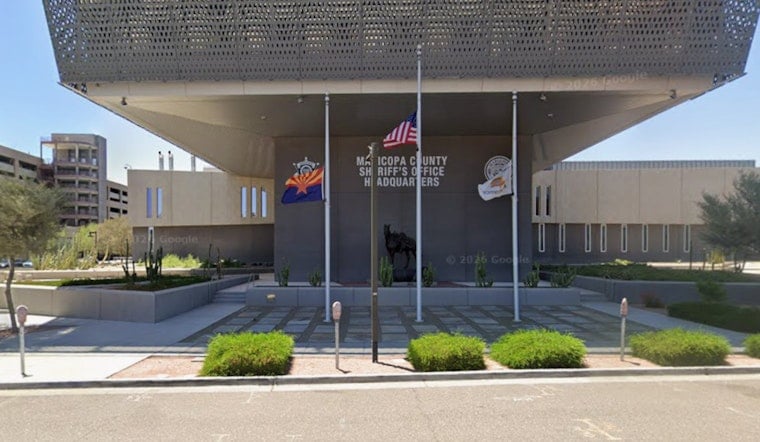
Maricopa County Sheriff Jerry Sheridan says his agency will sit down with the families of victims in roughly a dozen unsolved Guadalupe murders dating back to early 2024, a pledge that comes as community leaders say residents remain too afraid of deputies to share what they know. The announcement followed a Maricopa County Sheriff's Office town hall held on August 24 to update residents on the agency's progress toward satisfying federal court orders. That same night, the Guadalupe Town Council held its own meeting, a scheduling collision that Sheridan later apologized for.
Sheridan said agency leaders will meet with victims' families, according to KJZZ, though he did not lay out a timeline for those conversations. Guadalupe resident and community leader Andrew Sanchez told the outlet the killings date back to when Paul Penzone held the sheriff's office, and that eyewitnesses exist for many of them — but crosses marking the dead are now scattered throughout the small town, a visible reminder of how many cases remain open.
Fear Keeps Witnesses Silent
Sanchez said people who witnessed killings are scared to talk with deputies, and that crime witnesses in Guadalupe do not want to talk to detectives at all. He said MCSO has not done enough to repair the trust broken by a long-running racial profiling case against the agency, a wound that predates Sheridan's time in the sheriff's chair but that he inherited when he took office in January 2025.
That mistrust traces back to Melendres v. Arpaio, the landmark civil rights case in which a federal court ruled in 2013 that MCSO unconstitutionally racially profiled Latino drivers. In 2016, a federal judge held Sheridan — then chief deputy under Sheriff Joe Arpaio — in civil contempt for failing to follow orders to stop federal immigration enforcement, according to ProPublica. Sheridan has since asserted his department no longer engages in racial profiling. Tensions between MCSO and Guadalupe stretch back even further, to April 2008, when Arpaio launched immigration saturation patrols in the town and threatened to cancel its public safety contract after local leaders protested, according to federal court records tied to the Melendres case.
Federal Oversight Still Unresolved
The trust problem is playing out against a broader legal fight over whether federal court monitoring of MCSO should end at all. During a June hearing on Maricopa County's motion to terminate that oversight, U.S. District Judge G. Murray Snow said Sheridan's past actions and recent internal compliance concerns remained a primary obstacle to lifting court supervision, as reported by 12News. The county and the U.S. Department of Justice have argued the oversight should end. Official county data reported in early 2026 showed taxpayer costs tied to Melendres compliance, legal fees, and federal monitoring had topped $330 million.
Guadalupe is a 0.8-square-mile town of Latino and Yaqui heritage, landlocked between Phoenix, Tempe, Interstate 10, and the Highline Canal, and founded around 1900 by Pascua Yaqui tribal members fleeing persecution in Sonora, Mexico. The KJZZ report puts its population at about 6,700 residents; earlier Census figures cited roughly 5,300, with more than 86% identifying as Native American or Hispanic/Latino and a median age of 27.9. The town relies entirely on MCSO for policing under a contract that provides one patrol beat during the day, two in the evening, a dedicated detective, and a community police deputy.
A String of Unsolved Killings
Sanchez has pointed to a gang problem in Guadalupe as part of what's fueling the violence behind the unsolved cases. Among the killings community members cite is the August 2024 shooting death of a 17-year-old boy near Calle Guadalupe and Avenida del Yaqui, a case MCSO's homicide unit took over at the time, according to FOX 10 Phoenix. More recent violence has continued to shake the town: the September 2025 shooting death of 51-year-old Lyft driver John Lucas on Calle Bella Vista and the fatal stabbing of 65-year-old Amalio Castillo-Villareal near Avenida del Yaqui, both cases in which MCSO made arrests.
Sheridan apologized for scheduling the agency's town hall on the same night as the Guadalupe Town Council meeting, a conflict that meant residents had to choose between the two gatherings. For a community already wary of engaging with deputies, the overlap underscored the communication gaps that community leaders say continue to complicate efforts to rebuild trust — even as Sheridan's office says it wants families of the unsolved to finally get some answers.





