

























































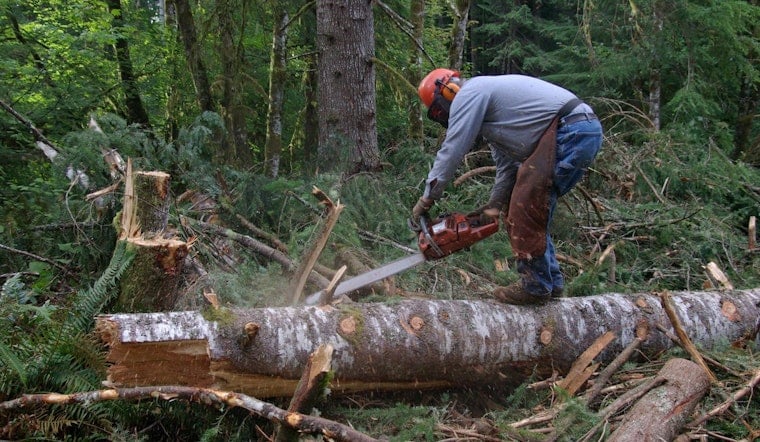
Chainsaws are running again in the Gifford Pinchot National Forest outside Carson, where crews have resumed logging work on a federal timber sale for the first time in years. For a county where nearly 90% of the land is federally or state owned and cannot be taxed for local services, the return of active harvesting carries outsized weight — even as some in the community wonder how long it will last.
A Long-Awaited Return to the Woods
The project driving the activity is known as Big Huck Thin, a U.S. Forest Service sale in the Mt. Adams Ranger District near Carson that was awarded in August 2025 and covers an estimated 15,727 hundred cubic feet of Douglas fir, or roughly 9,100 thousand board feet, according to the U.S. Forest Service. High Cascade Inc. purchased the Big Huck contract about a year before the sale was reported, and John Paul Anderson, the company's purchaser representative, has spent 26 years in the logging industry, as reported by KPTV. Anderson said he hopes the new timber contracts mark a turning point for Skamania County, though he does not expect the current push toward more federal logging to bring back the clear-cutting practices of decades past.
Skamania County sits between the Gifford Pinchot National Forest and the Columbia River Scenic Highway, per the same KPTV account, and the community has been defined by logging for generations. The work underway now looks nothing like the harvests of the mid-20th century. Crews are using selective cutting, removing smaller or diseased trees within a 15-foot radius of the largest tree to reduce competition for nutrients and sunlight, KPTV notes. Current thinning projects leave roughly 40% to 60% of the forest canopy intact, and land managers say that approach also cuts the forest's vulnerability to wind and fire damage.
Why Skamania County Needs the Trees
The stakes go well beyond the woods themselves. Only 1.8% of Skamania County's total land area is taxable private property capable of generating local revenue, while more than 80% is federally managed and another 18% is state land, according to the U.S. House of Representatives. Forest-related revenue programs supply between 20% and 25% of the county's budget, per county commissioners cited in KPTV's report, and that money has been shrinking for a decade.
The consequences have already landed on local kids. The Stevenson-Carson School District shuttered Wind River Middle School in Carson last August after losing about $830,000 in federal funding tied to the expired Secure Rural Schools program, with students shifted into Carson Elementary and Stevenson High School, according to Oregon Public Broadcasting. Hoodline has previously reported on how disappearing timber revenue has forced rural school budget cuts across Washington. The pattern in Skamania County traces back decades: the county received $10 million from active forest management in 1990, worth about $22.4 million in 2025 dollars, but that revenue collapsed to near zero by 2001 after environmental restrictions under the Northwest Forest Plan took hold, the Daily Chronicle has reported, and the resulting budget crunch forced the county government to eliminate 36% of its workforce over the following decade. Reduced logging has reshaped the community broadly, driving job losses and pushing families to leave the area, KPTV reports.
Congress Steps In, But Only Through Next Year
Lawmakers moved to slow the bleeding in December 2025, when the U.S. House passed bipartisan legislation reauthorizing the Secure Rural Schools program through fiscal year 2026, extending timber replacement payments to more than 700 counties in 40 states. The fix is temporary, and it arrives against a backdrop of declining federal harvests forestwide — timber sales in the Gifford Pinchot National Forest averaged about 44 million board feet annually over the five years leading up to 2023, a steep drop from the 689 million board feet sold in 1990, according to The Reflector.
The Trump administration has announced plans to increase logging on federal land even as it has cut Forest Service staffing and funding, per KPTV's reporting, a combination that is already raising doubts about how sustainable the current uptick will be. A Government Accountability Office report from June found that the Forest Service managed to hold timber sale volumes steady in fiscal year 2025 only with supplemental funding, and warned that budget constraints and staffing shortages could limit sales starting this fiscal year. The GAO specifically audited Region 6, which includes the Gifford Pinchot National Forest.
Collaboratives Keep the Peace Between Loggers and Conservationists
What has kept timber sales like Big Huck Thin moving without ending up in court is a forest collaborative model that brings together the Forest Service, logging companies, conservation groups and other stakeholders to hash out a plan before any trees come down. Those agreements specify where and how many trees can be cut, and contracts can also require road repairs and campsite maintenance, according to KPTV. The Pinchot Partners collaborative, formed in 2003 by the Cowlitz Indian Tribe, conservationists, timber industry representatives and local community leaders, grew directly out of the litigation gridlock that once paralyzed logging in the forest, per the group's own account.
Molly Whitney, executive director of the Cascade Forest Conservancy, testified before the U.S. House Agriculture Subcommittee on Forestry and Horticulture in June, telling lawmakers that public participation and collaborative planning make timber projects more efficient and help head off environmental litigation. Her organization, part of the collaborative working in the Gifford Pinchot forest, has acknowledged that the era of so-called timber wars hit small local communities and livelihoods hard. KPTV reports that cuts to Forest Service staffing and funding have introduced new tension into that collaborative process, and that these partnerships are becoming more essential precisely as other avenues for public engagement grow limited.
For now, the sound of saws in the Big Huck sale area is a welcome one for workers like Anderson, who has watched the industry shrink over most of his career. Whether it signals a lasting recovery for Skamania County's schools, budgets and job market, or just a brief reprieve tied to temporary federal funding, remains an open question that county officials, timber crews and conservation groups will be watching closely in the months ahead.



