

























































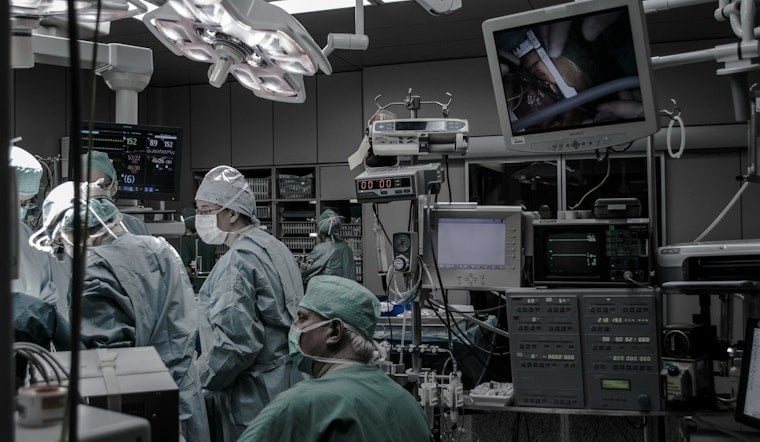
A 2-year-old girl from south St. Louis County is dancing around her family's home after receiving a rare procedure that could spare her a lifetime of risky open-heart surgeries. Luciana Peters underwent a partial living heart transplant on August 3, replacing only the valves of her heart with living tissue donated by another transplant recipient, in a chain of donation known as a domino transplant.
Luciana was diagnosed prenatally with truncus arteriosus, a condition that caused her heart valves to function improperly, according to St. Louis Public Radio. She underwent her first surgery at one week old and a second procedure at four months old, and doctors have said patients with similar conditions have historically needed multiple valve-replacement surgeries or had to wait for a whole-organ transplant. Her mother, Margarita Aguirre, said the family is now seeing glimpses of the Luciana they knew before surgery, and her father, Bobby Peters, said she has been more upbeat since leaving the hospital.
The procedure, performed at SSM Health Cardinal Glennon Children's Hospital, replaced Luciana's heart valves with living tissue from another transplant patient rather than the synthetic or bovine materials frequently used in pediatric valve replacements. Peter Pastuszko, chief of pediatric cardiothoracic surgery at Cardinal Glennon, has said a heart removed from a primary transplant patient may still have working valves worth reusing, since heart transplant recipients often have healthy heart tissue suitable for donation even after their own heart is removed.
How One Donor Heart Can Help Multiple Children
A domino transplant starts with a deceased donor giving an organ to a primary transplant patient, whose own heart — including valves that may still function normally — is then removed. That second patient both receives and donates, passing along usable heart valves to a third patient. In Luciana's case, a single organ donor helped save two lives this month. St. Louis Children's Hospital performed the procedure for the first time last year, and Cardinal Glennon's team has now completed its own version of the operation.
Cardinal Glennon has completed more than 60 pediatric heart transplants over the history of its transplant program, according to SSM Health. Taufiek Rajab, a cardiothoracic surgeon at Arkansas Children's Hospital, has said synthetic valves are not living structures and do not grow in children, which historically forces pediatric patients into repeated open-heart surgeries. Duke Health, which performed the world's first partial heart transplant in April 2022 on a 17-day-old infant named Owen Monroe, found in a January 2024 study published in JAMA that transplanted living valves grow along with the pediatric patient and require roughly a quarter of the immunosuppressant medication needed for a full heart transplant, according to Duke Health.
Why Living Valves Matter for Growing Children
Standard non-living synthetic or animal tissue valves do not grow as a child matures, historically requiring pediatric patients to undergo repeated open-heart surgeries that carry an estimated cumulative mortality rate of up to 50%, per Duke Health's research. Because Luciana's new valves are expected to grow along with her, the partial living heart transplant could reduce the number of surgeries she needs as she ages, potentially meaning fewer risky operations and hospital stays down the road. Still, the long-term results of partial living heart transplants remain unknown, since the procedure is still new and offered by only a small number of children's hospitals throughout the U.S.
The shortage of size-matched infant donor hearts adds urgency to approaches like this one. National organ registry data published in 2025 show that nearly 600 children are added to the U.S. heart transplant waiting list each year, and 12% to 17% of pediatric candidates die before a suitable donor organ becomes available, according to data compiled by Ovid. Adult donors outnumber pediatric donors, and partial organ tissue is often used for small patients because whole organs would simply be too large. Physicians writing in the Annals of Thoracic Surgery have said partial heart transplants represent a new era of medical innovation and organ stewardship, and could potentially multiply the number of children saved by heart tissue donations.
Recovery, Music and a Toddler Back in Motion
Ten days after her operation, Luciana was dancing and running around the garden on Cardinal Glennon's hospital campus, feeling better than she had in the days immediately following surgery. Music therapy has been helping her recover, and her family says she loves music and dancing. She is now recovering at home in St. Louis County.
Truncus arteriosus, the defect Luciana was born with, occurs when a single main vessel fails to divide into the aorta and pulmonary artery in utero. It is rare, affecting approximately 1 in 15,984 live births in the United States — about 230 babies each year — according to CDC birth defect data released in 2024. Congenital heart defects overall are the most common type of birth defect in the U.S., affecting roughly 40,000 infants a year, or nearly 1% of live births, and accounting for about 25% of all birth-defect-related infant deaths, per the North Carolina Medical Journal.
Cardinal Glennon's success adds to a growing national pattern. Dell Children's Medical Center in Austin performed Texas's first pediatric partial heart transplant in June 2023, part of a wider expansion of the technique beyond pioneering academic centers, as Hoodline previously reported. Cardinal Glennon itself is in the middle of a broader expansion, having topped out a new 14-story, roughly 200-bed hospital tower in Midtown St. Louis in April, set to open in 2027.





