

























































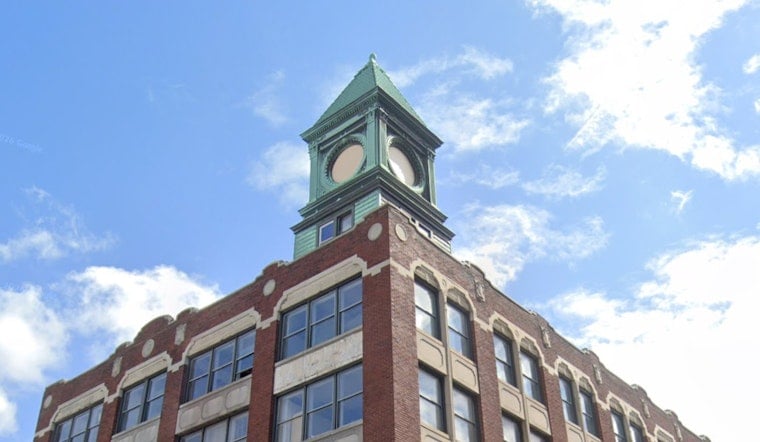
Workers are already prepping the site at the corner of State and Main streets in downtown Springfield, where a long-awaited $68 million rehabilitation of the historic Clock Tower building and three neighboring properties is finally set to break ground in the last three months of 2026. The project will convert the four buildings into 99 market-rate apartments with 12,500 square feet of ground-floor retail, transforming a cluster of long-neglected downtown landmarks into what city officials hope will become a bustling residential and shopping hub.
Chicago-based developer McCaffery Interests submitted a building permit application for the project, which covers the former Masonic lodge with its copper clock tower at 113-115 State St., the Stockbridge building at 11-21 Stockbridge St., the historic Colonial building at 1139-1155 Main St., and a building at 1163 Main St., according to MassLive. The Springfield Redevelopment Authority owns all four buildings and has already paid for some preliminary work on them, per the same report. Three of the buildings were previously part of a mortgage foreclosure before landing in public hands.
A Clock That Finally Tells Time Again
McCaffery Interests has already repaired the building's historic clock so that it tells time for the first time in years, restoring and illuminating the turret timepiece that had been stuck for more than three decades under prior private ownership, according to the City of Springfield. The Masonic Building itself dates to 1893, designed by architect F.R. Richmond in the Richardsonian Romanesque style to house local Masonic lodges before the fraternity relocated up State Street in the 1920s, as detailed by BusinessWest. The building was reclad in brick decades later but still retains its original arched sandstone doorways.
The Colonial building carries its own century-old pedigree. Constructed between 1902 and 1905 by local developer Pascal L. Morse in Classical Revival and Queen Anne styles, it was one of Springfield's earliest mixed-use properties, combining ground-floor retail and offices with upper-floor apartments, and once housed Colonial Hall, a major civic meeting space in early 20th-century Springfield, according to the City of Springfield.
Retail as the Front Door, Not an Afterthought
McCaffery principal Edmund Woodbury said that in many housing-focused redevelopment projects, retail can become an afterthought, but that is not the case here. Woodbury said McCaffery views retail as the front door of the project, explaining that high-quality retailers signal high-quality apartments upstairs, per MassLive's report. He described the firm's approach as executing Springfield's own vision for the corridor rather than imposing an outside plan.
Timothy Sheehan credited that retail-first philosophy with putting McCaffery's proposal in first place three years earlier, when the firm won a nationwide competition for the project in 2023. Sheehan said the planning process is now over and construction will soon begin, according to the same MassLive account. The project is expected to take 15 to 18 months to complete once underway.
Financing Blends Public Money and Private Capital
The rehabilitation relies on a mixture of public and private funding, with roughly 30% of financing coming from a bank loan and another 25% to 30% coming from state and federal historic redevelopment tax credits, per MassLive. Those state credits trace back to a 2023 law signed by Governor Maura Healey that expanded the Housing Development Incentive Program's annual cap from $10 million to $30 million, offering tax credits of up to 25% for market-rate housing in 26 Gateway Cities including Springfield, according to the Commonwealth of Massachusetts. Springfield was the fourth municipality in the state to establish a designated Market Rate Housing Incentive Zone, a mechanism created to bridge the gap where construction costs match Boston-area prices but achievable rents lag far behind, per the City of Springfield.
That financing puzzle isn't unique to this project. The nearby $51 million conversion of the historic 31 Elm Street building into 74 apartments by WinnDevelopment and OPAL Real Estate opened in 2024 and leased up immediately, leaving a waiting list, according to BusinessWest. That building had sat vacant for more than 30 years before public-private financing made its conversion possible, underscoring the pent-up demand for downtown Springfield housing that the Clock Tower project is banking on.
A Parking Garage to Match the Ambition
A separate $24 million project will add a 400-space parking garage on Willow Street to support the residential tenants and retail businesses expected at the Clock Tower site, though it is a distinct undertaking from McCaffery's building rehab, per MassLive. Sheehan said the Willow Street parking is needed to make the broader redevelopment vision a reality, according to the same report.
MGM's Idle Corner Draws the Mayor's Ire
Not every corner of State and Main is moving forward at the same pace. Mayor Domenic J. Sarno has criticized MGM's maintenance of its corner at the intersection, where the casino operator's property at 101 State St. remains undeveloped behind scaffolding despite a commitment made under its Host Community Agreement for the 2018 casino opening. MGM Springfield has refused to discuss the state of the building, according to MassLive, and Sarno pressed the issue at a Massachusetts Gaming Commission meeting last November, per Massachusetts Gaming Commission minutes.
Sarno has reiterated his vision of a pedestrian-friendly shopping promenade stretching from the MassMutual Center and MGM Springfield casino to the South End's Italian-American shops, tying the Clock Tower project to that broader ambition. He also said he expects development news soon for the city-owned Chicken Building across State and Main, which the Springfield Redevelopment Authority also owns, according to MassLive's reporting by Jim Kinney for The Republican.





