

























































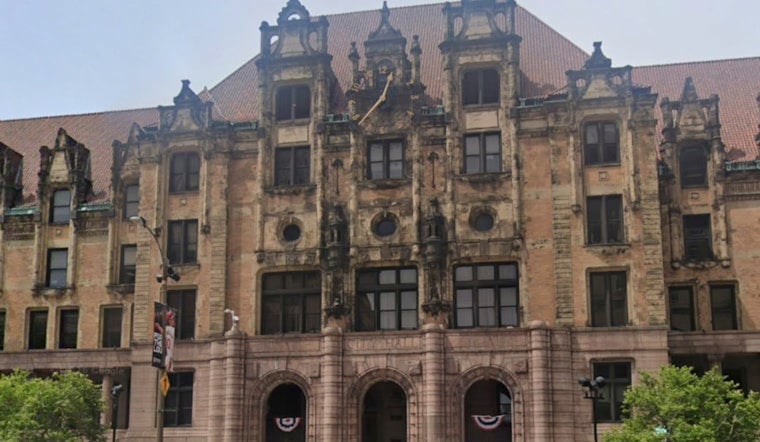
A city request to tear down the entire St. Liborius church campus in North St. Louis is drawing sharp pushback from preservationists who say the fire-damaged complex's brick walls and bell tower are still structurally sound and worth saving. The dispute pits neighbors who see the scorched, vacant buildings as a dangerous eyesore against advocates who warn that demolishing the 130-year-old landmark would erase a piece of history that can never be replaced.
The City of St. Louis asked for bids to demolish the entire St. Liborius campus, according to FOX 2, a move that initially caught the building's owners, Sk8 Liborius, off guard. The station reports that St. Louis City Hall alerted residents to the demolition plan, prompting immediate concern from neighbors and preservation advocates who have fought for years over what should happen to the site. Stuart Keating, who is with the St. Louis Landmark Association, said demolishing the entire complex is unnecessary and financially harmful to the city.
Keating told FOX 2 the city could save money by separating demolition bids so that only the structures that truly must come down are included, rather than bidding out the whole campus at once. He pointed specifically to the bell tower and the outer church walls as structures that could be restored rather than razed, and he proposed redirecting some of the demolition savings toward restoring other buildings on the site. Keating also warned that the historic buildings, once demolished, cannot be replaced.
Neighbors Divided Over Safety and History
Not everyone in the neighborhood agrees with the preservationist push. Robbin Craig said neighbors celebrated when the demolition request became public because they believed the city had finally heard their concerns, describing the abandoned campus as an eyesore that dominates the neighborhood despite acknowledging the buildings are magnificent structures built by German craftspeople. Virginia Druhe echoed that sentiment, telling FOX 2 that neighbors are very concerned about asbestos released by the fire and remain uncertain how safe the buildings actually are — even as she called the potential loss of the historic buildings very sad but necessary.
Those safety concerns trace back to a four-alarm fire that gutted the former sanctuary on June 28, 2023, an inferno that mobilized more than 100 firefighters as wind-blown embers traveled three blocks to ignite a vacant home, according to Hyperallergic. Emergency crews worked to douse surrounding structures in the Old North neighborhood to keep the blaze from spreading further. Early post-fire assessments found that while the wooden roof and interior skate structures were entirely destroyed, the exterior masonry walls and main superstructure remained standing and structurally intact, per reporting from STL Public Radio.
A Building With Deep Roots in North St. Louis
St. Liborius was established in 1856 to serve German Catholic immigrants and grew to a peak membership of 4,500 by 1948, before shifting demographics led the Archdiocese of St. Louis to close the church in 1992, according to the St. Louis Genealogical Society. The German Gothic Revival sanctuary, designed by New York architect William Schickel, was completed in 1889, with a rectory added in 1890 and a convent in 1905; an 80-foot stone lace-work spire was removed in the 1960s due to deterioration. After parish closure, the building briefly served as a shelter for abused women before falling vacant.
The complex earned protection as St. Louis City Landmark #77 in 1975 and was added to the National Register of Historic Places on October 11, 1979, according to the City of St. Louis. Those designations require specialized preservation review before any city demolition permit can move forward, which is why the matter is headed to the St. Louis Preservation Board. Sk8 Liborius co-founder Dave Blum acquired the complex in 2012 and ran underground skate sessions there before registering Liborius Urban Art Studios as an official 501(c)(3) nonprofit in 2016, turning the space into what FOX 2 described as an underground community that gave new purpose to the abandoned church.
City Officials Say the RFP Isn't Final
Ward alderman Rasheen Aldridge, who has advocated for St. Liborius neighbors, said the city is not committed to only one demolition plan and that there remains an opportunity to amend the request for proposals. Aldridge, who also called the large abandoned building embarrassing to see from the street, told FOX 2 he plans to look into the demolition issue at City Hall. The city can still amend the demolition RFP before it closes, and the St. Louis Preservation Board is scheduled to meet on August 26 to review preservation options and municipal actions surrounding the campus, according to STL.News.
Keating reported that only one or two companies in town are even equipped to bid on a demolition project of the entire campus's scale, underscoring the logistical complexity of the city's current approach. A Sk8 Liborius board president arranged a follow-up meeting with FOX 2 on site, blaming a miscommunication with the city for the confusion and saying that issue is being resolved. The board president also said Sk8 Liborius has an alternative plan aimed at saving taxpayers money while preserving the campus's most crucial structures, though FOX 2 reported it was unable to reach the convent's separate owner for comment.
Statewide Preservation Backing and a Larger Pattern
The fire-damaged campus has drawn attention beyond the neighborhood. In October 2023, Missouri Preservation designated St. Liborius as one of the state's annual Places in Peril sites, a program meant to rally statewide advocacy for saving endangered landmarks, according to Missouri Preservation. Following the fire, Sk8 Liborius leaders launched online recovery fundraising and volunteer cleanups, pivoting from an earlier $1 million capital campaign that had aimed to bring the building into full city code and ADA compliance.
The St. Liborius blaze also fits into a broader pattern of fires striking vacant or repurposed historic churches across the city, including major fires in Soulard in 2023 and the Central West End in 2021 and 2025, as noted by Firehouse. Urban structures built with century-old timber remain uniquely vulnerable to rapid fire destruction, a vulnerability that has repeatedly complicated preservation efforts across St. Louis's historic districts. Whether the city agrees to split its demolition request before the Preservation Board's August 26 meeting remains an open question that will shape St. Liborius's fate.



