

























































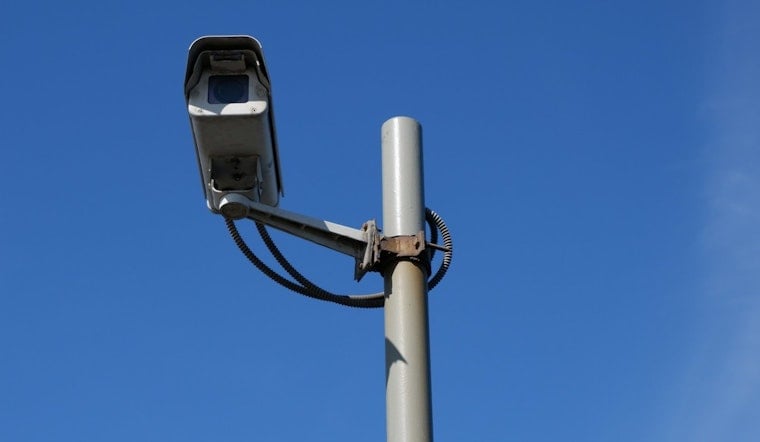
St. Paul City Council President Rebecca Noecker plans to author a resolution calling on the city and Ramsey County to end their Flock Safety camera contracts, arguing that the automated license plate readers have created what she calls a mass surveillance state. St. Paul police currently operate two Flock cameras in the city, while the Ramsey County Sheriff's Office owns ten more inside city limits as part of a larger 19-camera contract, and the council did not take up the matter at its meeting Wednesday.
“Our data should not be for sale,” Noecker said, according to the Pioneer Press, adding that she believes communities need investment, not surveillance. The Ramsey County Sheriff's Office's contract for its 19 directly owned cameras costs $67,000 a year, with the State of Minnesota covering $18,000 of that total through a grant, per the same report. St. Paul police signed their initial Flock contract in February 2025 for $50,400, and had 16 cameras installed as of last summer before consolidating down to the two now positioned at Kellogg Boulevard and Smith Avenue near Grand Casino Arena.
Flock Safety cameras use artificial intelligence to identify vehicles by license plate, make, model, and color, and the company's devices have been deployed in more than 120,000 locations across 49 states. The system feeds vehicle data into a national database that participating law enforcement agencies can search and share across jurisdictions, and any search requires officers to enter a case number and information tied to a legitimate investigation, the Pioneer Press reports.
Sheriff Calls Flock a Top Crime Tool, but Data-Sharing Splits Departments
Ramsey County Sheriff Bob Fletcher has defended the technology in stark terms, saying Flock is one of the most effective crime-fighting tools he has seen in 40 years. His office maintains 35 Flock cameras throughout Ramsey County, uses the system primarily to identify stolen vehicles and vehicles tied to other crimes, and receives daily alerts on stolen cars countywide. The county's Carjacking and Auto Theft Team responds directly to Flock's stolen-vehicle alerts, according to the Pioneer Press.
The two agencies operate differently when it comes to outside access. St. Paul police confirmed in their last six-month audit that they did not share Flock data with out-of-state law enforcement agencies, and a department spokesperson, Alyssa Arcand, said there are no current plans to expand the city's camera network. The Ramsey County Sheriff's Office, by contrast, does not allow other law enforcement agencies to search its Flock data at all, though it is discussing possible expansion with suburban communities and is not currently planning to expand use within St. Paul itself. The two departments also do not coordinate with each other on camera placement inside the city, the newspaper reports.
Twenty sergeants within the sheriff's office have access to Flock data, and the office audits their search activity every two weeks. Suburban cities where the sheriff's office provides policing separately own 16 additional Flock cameras. St. Paul police recently asked the Minnesota Bureau of Criminal Apprehension to update its camera listing after a device at East Seventh and Cypress streets was removed.
A Statewide Backlash Against Camera Networks
Noecker's push fits into a wider regional retreat from Flock surveillance. West St. Paul, Columbia Heights, North Branch, Isanti County and Sherburne County have all canceled or suspended Flock contracts in recent months, with officials in those communities citing eroded public trust and privacy concerns, according to Bring Me The News. Hoodline previously reported on Isanti County pulling its cameras after vandals struck the devices three separate times, and physical attacks on the hardware have spread elsewhere in the state, with Winona reporting eight vandalized cameras and Duluth reporting six stolen or damaged devices, per KNSI.
Some of that distrust traces back to a July investigation showing that roughly 30 state, county and federal agencies ran hundreds of searches against Twin Cities suburban Flock databases for civil immigration enforcement between November and March, according to Metro State's Metropolitan. Nationally, an audit tracker maintained by the Institute for Justice has documented more than 140 verified cases of officers misusing ALPR databases, including instances in Florida where officers entered fake case numbers to track romantic partners.
Flock Safety CEO Garrett Langley announced changes to the company's platform earlier this month, cutting default data retention from 30 days down to seven and promising AI-driven audit tools by the end of the year designed to automatically flag suspicious search behavior. The company has said it will still preserve data longer when it is tied as evidence to a specific case number. Minnesota law already requires that unflagged vehicle data be destroyed within 60 days under Minn. Stat. § 13.824, which also mandates public logs of officer queries and biennial independent audits.
Legislative Fix Stalled, Mayor Noncommittal
State lawmakers tried to tighten those rules further earlier this year through House File 3856 and Senate File 4739, which would have centralized ALPR data within the Bureau of Criminal Apprehension, cut standard retention to 48 hours and banned out-of-state data transfers. The bills stalled after a 7-7 House committee vote in March, according to MinneapoliMedia.
Mayor Kaohly Her does not support adding more Flock cameras, according to the Pioneer Press, though her office has not signaled support for Noecker's push to end the existing contracts entirely. Noecker's resolution would need buy-in from both the city administration and Ramsey County partners, mirroring her earlier successful push this month that saw the council vote 7-0 to claim veto power over major municipal vendor contracts following a dispute over a $115 million trash-hauling deal that had bypassed council sign-off.
Nearby, Anoka County Sheriff Brad Wise signed a $174,500 pilot contract with Flock Safety in June for up to 75 cameras and 10 drones, a deal priced $500 below the $175,000 threshold that would have required County Board approval, sparking municipal opt-outs including from Columbia Heights. Whether St. Paul and Ramsey County follow the growing list of Minnesota communities abandoning the technology, or side with Sheriff Fletcher's assessment of its crime-fighting value, remains an open question the council has yet to formally take up.




