

























































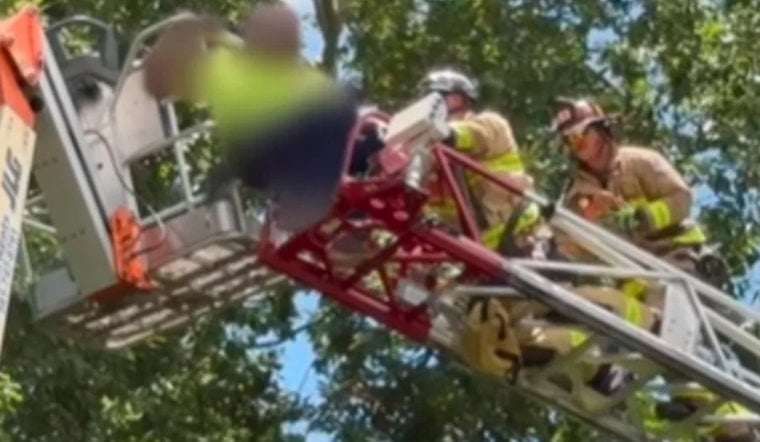
A tree trimmer working in the 8400 block of S.W. 17th Avenue in Stuart found himself stranded roughly 40 feet in the air on Saturday afternoon after his elevated lift stopped working entirely mid-job. Martin County Fire Rescue crews were dispatched around 1 p.m. and arrived to find the man stuck on the broken platform, unable to move it up or down.
The man had been trimming trees when his equipment simply quit, according to CBS12. What started as a routine tree-trimming job turned into a full rescue operation once crews realized standard ladder truck access to the platform was blocked at the site.
With that traditional access obstructed, firefighters had to get creative. Per Martin County Fire Rescue, crews first removed nearby tree limbs to clear a path, then executed a high-angle rope rescue maneuver, securing the stranded worker, transferring his weight, and lowering him safely to the ground.
A Technical Rescue Built for Exactly This Scenario
The response drew on specialized resources not found on every fire engine. Martin County Fire Rescue credited C-shift crews from Heavy Rescue 23, Battalion 2, EMS 2, and EMS 22 for pulling off the rescue, the station's report notes. Heavy Rescue 23 operates out of Station 23 on S.W. Kanner Highway in Stuart, a facility that houses specialized extrication and technical rescue equipment for calls just like this one.
That heavy rescue unit is part of the department's dedicated Technical Rescue Team, trained under National Fire Protection Association high-angle and rope rescue standards specifically to extract victims from elevated platforms, construction sites, and other hard-to-reach spots. Once the worker reached the ground, paramedics evaluated him on scene. He suffered only minor injuries and declined transportation to the hospital.
Why Lifts Fail — and Why the Ground Controls Sometimes Don't Save the Day
Federal OSHA regulation 29 CFR 1926.453 requires that mobile aerial lifts include ground-level controls capable of overriding the platform controls, so someone on the ground can lower a stuck basket during a mechanical failure. But as Saturday's incident showed, when the lift itself fails outright, even those override systems can be rendered useless, leaving technical rescue as the only remaining option.
Florida regulators keep close tabs on this kind of equipment. Aerial lift violations involving fall protection, ground control maintenance, and operator training rank among the most frequently cited workplace infractions in the state, with penalties that can exceed $160,000 per serious violation, according to Forklift Safety Training Florida.
A Dangerous Job by the Numbers
Tree care remains one of the riskiest lines of work in the country. The Bureau of Labor Statistics recorded 10 workplace fatalities among tree trimmers and pruners across Florida in its 2024 Census of Fatal Occupational Injuries. Nationally, tree trimmers face an occupational fatality rate of roughly 110 deaths per 100,000 full-time workers, about 30 times higher than the average across all industries, according to an analysis by Arbor Compass of federal labor data.
Mechanical failures like the one behind Saturday's rescue are a recurring hazard in that grim tally. The Tree Care Industry Association documented 243 fatal tree care incidents nationwide between 2020 and 2023, with falls from aerial lifts responsible for 19 of those deaths, driven mainly by mechanical boom failures, tip-overs, and unbuckled fall harnesses.
Martin County Fire Rescue covers 528 square miles of suburban, coastal, and agricultural territory out of 22 fire stations serving roughly 160,000 residents, according to Radio Reference. Saturday's rescue is the latest reminder that the department's technical rescue teams stay ready for the moments when standard equipment, whether a stalled lift or an unreachable ladder truck, simply isn't enough.



