

























































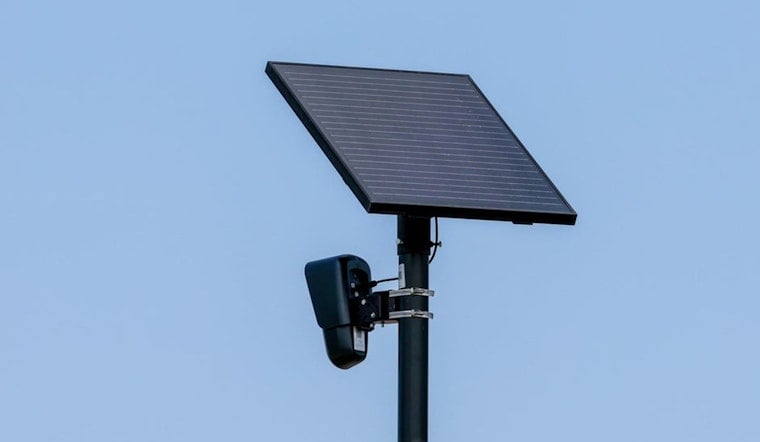
An 18-year-old man was arrested after Riverside County sheriff's deputies say he cut down a Flock Safety license plate camera in Temecula and loaded it into a vehicle, only to be located after a bystander called in the getaway car's license plate. Andrew Anderson was booked on suspicion of felony vandalism and grand theft, and he has since been released from custody with a court date set for November 20, according to court records.
The chain of events began when a citizen reported seeing a group of people load a cut-down Flock Safety camera into a vehicle, then provided deputies with the vehicle's license plate number, according to CBS Los Angeles. Deputies who were patrolling near E. Benton Road and De Portola Road relayed the vehicle information to the department's aviation unit, which located the vehicle at a home in the 43000 block of Matera Court. Deputies then conducted a traffic stop, detained the occupants without incident, and recovered the stolen camera, which is slated to be returned to Flock Safety. The Riverside County Sheriff's Office identified Anderson as the primary suspect and released the vehicle's other occupants, per the same report.
Second Camera-Related Arrest in Riverside County Within a Week
The Temecula arrest is not an isolated case. Just days earlier, on August 24, Riverside County sheriff's deputies arrested 31-year-old Nathan Ceballos in Palm Desert after he allegedly attacked a Flock Safety contractor who was replacing a previously vandalized camera, slashed the utility vehicle's tires, and threatened the worker with a knife, according to the Riverside County Sheriff's Office. Hoodline previously reported on that Palm Desert incident, which marks the first of two camera-related arrests the county has pursued within the span of a single week.
Under California Penal Code Section 594, vandalism is a wobbler offense that can escalate from a misdemeanor to a felony once property damage reaches $400 or more, carrying penalties of up to three years in state prison and fines as high as $10,000, according to the Esfandi Law Group. Anderson's additional grand theft booking stems from California Penal Code Section 487, which defines grand theft as unlawfully taking property valued above $950 and is itself punishable by up to three years in prison when charged as a felony, per Eisner Gorin LLP. The Riverside County Sheriff's Office has stated that intentional damage, destruction, or tampering with Flock cameras will lead to felony charges and arrest, and the agency is encouraging communities to report suspicious activity.
A Sprawling Camera Network Facing Growing Resistance
Following his booking, Anderson was held at the Cois M. Byrd Detention Center in Murrieta. The arrest lands amid a massive local buildout of surveillance infrastructure: the Riverside County Sheriff's Department runs 564 Flock automated license plate reader cameras across unincorporated desert communities and contract cities as of this month, Hoodline previously detailed in its coverage of the county's surveillance hub. The department's plate readers are used for law-enforcement purposes.
The Temecula incident comes amid broader debate over anti-surveillance technology this year. Elsewhere in Riverside County, neighboring Menifee police recently relied on the same Flock camera network to arrest two Indiana fugitives, a case Hoodline covered in a report on tracking out-of-state suspects, illustrating the split reaction to the same technology within a single county.
Privacy Fights Escalate Alongside the Vandalism
The physical destruction of cameras coincides with mounting legal and corporate pressure on Flock Safety itself. Flock Safety's searchable database has drawn privacy concerns over law-enforcement access to driver data. Flock cameras have drawn criticism across Southern California in recent months, and a Ventura County audit revealed that Flock inadvertently shared Ventura County data with out-of-state law enforcement agencies, including federal agents, according to that audit's findings.
Flock Safety announced on August 13 that it was shortening its recommended default data retention period for camera footage from 30 days to seven days nationwide, a move the company attributed to public criticism over privacy and data oversight. Similar vandalism disputes have played out elsewhere in the country this month, including in Fort Lauderdale, where Hoodline reported cameras were melted and slashed in a $6,000 damage case, and in Minnesota, where officials in Isanti County discontinued their Flock trial, as Hoodline also reported from that county.





