

























































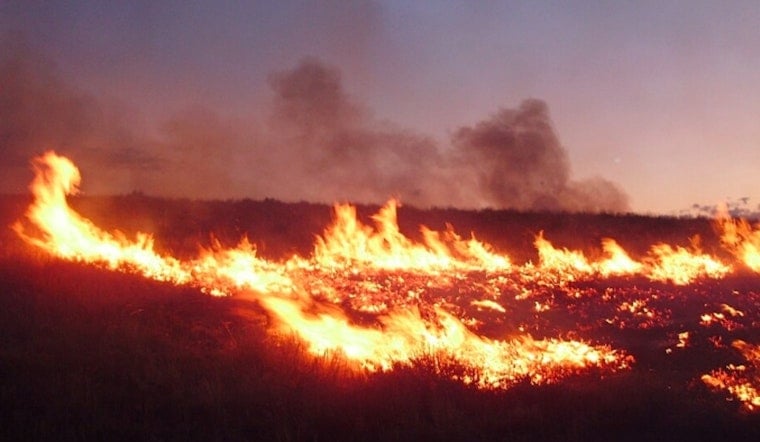
A stretch of Krome Avenue between SW 8th Street and SW 88th Street shut down completely Friday night as fire crews battled three separate wildfires burning along the edge of the Everglades in west Miami-Dade. The Radio Tower Fire alone had scorched roughly 700 acres and reached 50% containment by late Friday, while the nearby Trail Fire burned 25 acres and was 80% contained. A third blaze, the Caddis Fire, was still at 0% containment after charring 75 acres.
The closure stranded evening commuters in zero-visibility smoke for as long as two hours, according to WSVN 7News. Miami-Dade Fire Rescue crews worked the Radio Tower Fire near 5755 Southwest 177th Avenue, with Chopper 4 capturing footage of heavy plumes rising over the marshland, according to CBS Miami. The station reported the fire had grown to 188 acres per Watch Duty tracking data, with the Trail Fire burning near the 2000 block of Southwest 8th Street.
Florida Forest Service crews sent additional units to assist Miami-Dade firefighters, per the same CBS Miami report. The station also noted that Miami-Dade Fire Rescue attributed the Krome Avenue shutdown directly to low visibility caused by smoke drifting across the roadway, a hazard that has repeatedly forced closures on this stretch of State Road 997.
Aerial Drops Keep Flames Away From Homes
Crews leaned on aerial water drops pulled from a nearby lake to knock down the persistent flames, a tactic often used when dense Everglades terrain keeps ground vehicles at bay, WSVN 7News reported. Despite smoke drifting toward residential neighborhoods near Kendall Drive, officials reassured the public Friday night that neither the Radio Tower Fire nor the Trail Fire threatened homes or commercial structures.
The Caddis Fire added a third front for fire rescue crews to manage simultaneously, according to a report from KendallSocial. Multiple simultaneous ignitions along the same corridor tend to occur during stretches of dry, high-wind conditions, and this marks the third notable brush fire to hit the SW 8th Street and Krome Avenue area within two weeks.
A Corridor With a Troubled History This Summer
Less than two weeks earlier, on August 3, the 750-acre Blue Gill Wildfire burned in nearly the same stretch of West Miami-Dade, as Hoodline previously reported. That fire also began with 0% containment before crews brought it under control. The pattern stretches back further still — in June, west Miami-Dade saw a massive surge of brush fires, including the 19,003-acre Quarry 2 Fire and the 1,525-acre Well Fire, which together torched more than 20,000 acres and forced multi-day shutdowns of both Krome Avenue and Florida's Turnpike, according to CBS Miami's earlier coverage of that outbreak.
Florida Forest Service officials tied that June outbreak to a regional rainfall deficit exceeding 12 inches combined with heat index values between 105 and 110 degrees, conditions that rapidly dry out sawgrass and brush fuels, per Local 10 News. Statewide, the numbers back up how active this fire season has been: between January 1 and July 26, state and federal lands across Florida recorded 2,907 wildfires that burned a combined 246,316 acres.
Drought Has Left the Everglades Primed to Burn
Underlying all of it is a persistent South Florida drought. By May, underground water levels in Water Conservation Area 3, which borders Krome Avenue directly to the west, had dropped to 1.71 feet below normal, according to data from the National Weather Service. That kind of groundwater deficit leaves Everglades vegetation extremely dry and flammable heading into the heart of the dry season.
Krome Avenue functions as the primary eastern border between urban Miami-Dade development and the Everglades wildland-urban interface, which is exactly why even moderate brush fires can trigger a full shutdown of the highway between Tamiami Trail and Kendall Drive. The road carries heavy agricultural freight and commuter traffic that often uses it to avoid the eastern expressways, meaning closures ripple quickly through the region's evening commute. For now, fire rescue crews and the Florida Forest Service continue to face the compounding challenge of multi-hour detours, degraded air quality, and multiple simultaneous ignitions as the 2026 dry spell drags on.



