

























































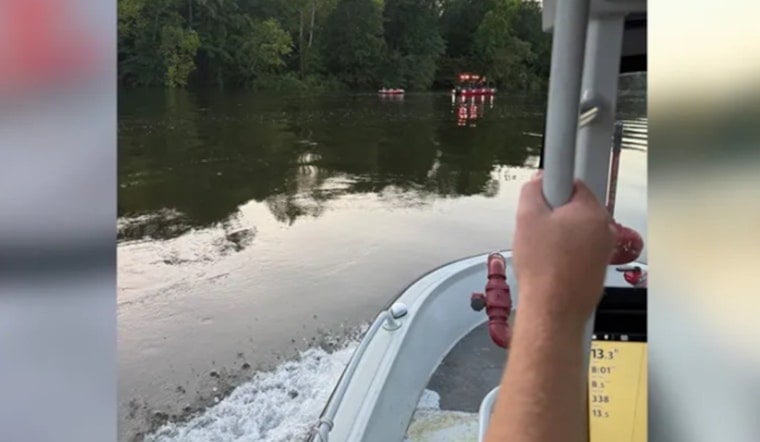
Three people exploring Mountain Island Lake were swept downstream yesterday and pulled to safety by Huntersville Fire Department crews, who brought them aboard a department boat before reuniting them with family waiting onshore. MEDIC officials reported no hospital transports were needed following the rescue.
The Huntersville Fire Department responded to the lake on Tuesday and rescued the trio after they had been pushed downstream while out exploring the water, according to Queen City News. Crews from Mount Holly assisted Huntersville Fire in the response, a reflection of the cross-county mutual aid that regularly covers Mountain Island Lake. The outlet reported that all three were recovered onto the Huntersville Fire Department boat and reunited with family waiting onshore, with MEDIC confirming no one required hospital care.
A Lake Known for Sudden, Hidden Currents
Mountain Island Lake is not an ordinary swimming hole. Created in 1924 by Duke Energy's hydroelectric station, the 3,281-acre reservoir stretches across 61 miles of shoreline and serves as the primary drinking water source for more than a million residents in Charlotte, Mecklenburg County, Mount Holly, and Gastonia, according to background compiled from Wikipedia. It is also a narrow, dammed stretch of the Catawba River squeezed between Cowans Ford Dam upstream and Mountain Island Dam downstream.
That positioning matters because Duke Energy's hydroelectric releases along the Catawba River chain can rapidly change water volume and generate strong currents with little warning, according to Lakes Online. Automated turbine activations or spillway adjustments can shift water velocity and depth across the reservoir without any visual cue for people on the water, which helps explain how casual explorers can suddenly find themselves pushed off course.
Not the First Water Emergency on This Lake
Tuesday's rescue is far from an isolated incident on this stretch of the Catawba. In August 2023, a multi-agency search involving Huntersville Fire, Charlotte Fire, Cooks Volunteer Fire, and the Charlotte-Mecklenburg Police Department ended when the body of a 33-year-old swimmer was recovered nearly half a mile from where he had gone missing, per WCNC. That tragedy underscored just how quickly the lake's currents and underwater hazards can turn dangerous.
Weather has also complicated conditions on the reservoir in recent months. Back in June, Huntersville Fire ordered boaters off the water as thunderstorms brought 40 mph wind gusts and lightning to both Mountain Island Lake and Lake Norman. Sudden shifts like those can leave small or non-motorized craft especially vulnerable to being swept downstream, a risk that runs parallel to the hydroelectric currents already present on the lake.
Regional Crews Built for Water Rescues
The rescue's smooth execution reflects the resources both agencies bring to the reservoir. Huntersville Fire Department covers 62 square miles of Mecklenburg County with 23 full-time and more than 70 part-time firefighter-EMTs, answering roughly 7,000 calls annually out of four stations. Mount Holly-area crews, meanwhile, draw on Lucia-Riverbend Fire Department's Fireboat 31, a 26-foot landing craft built with a 410-horsepower jet drive and 3,000-gallon-per-minute pump capacity specifically assigned to incidents on Mountain Island Lake.
Oversight of the lake itself falls to the Mountain Island Lake Marine Commission, a tri-county body with jurisdiction extending up to 1,000 feet beyond the lake's full pond elevation to regulate navigation, maintain safety buoys, and coordinate public safety across Mecklenburg, Gaston, and Lincoln counties. Under North Carolina Wildlife Resources Commission rules, boating incidents on public waters must be formally reported when they involve loss of life, medical treatment, a disappearance, or property damage exceeding $2,000 — a threshold that helps explain why Tuesday's rescue, with no injuries or hospital transports, remained a comparatively minor entry in the lake's safety record.
State law also sets baseline safety standards for anyone on the water. Children under 13 are required to wear an approved personal flotation device while aboard a moving recreational vessel, with violations carrying a $50 fine per child, according to the NC Wildlife Resources Commission. Separately, anyone born on or after January 1, 1988, must complete an approved boating safety course before operating a vessel with an engine of 10 horsepower or greater on public waterways.




