

























































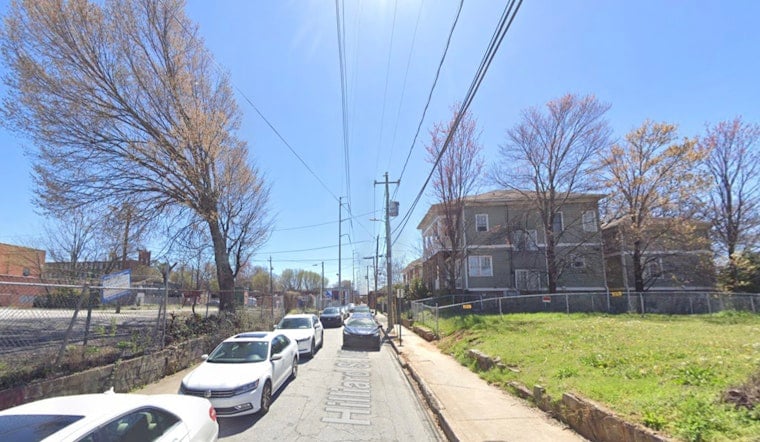
A vacant sliver of land east of the Downtown Connector in Sweet Auburn is entering the final stretch of construction on an unusual bet: that a lot barely bigger than a few parking spaces can help solve Atlanta's affordable housing crunch. The project, called the Firehouse, will deliver 10 income-restricted one-bedroom, one-bathroom studio apartments at 26 Hilliard St. NE, with rents expected to cap out at $1,250 a month, all utilities and fees included.
The building is going up on just 0.04 acres, or 1,742 square feet, according to Fulton County land records cited by CRE Guru. The parcel last sold in December 2018 for $43,000 and sits within the HC-20C SA4 historic zoning overlay that protects the architectural character of the Martin Luther King Jr. Landmark District along Edgewood and Auburn avenues. As reported by Urbanize Atlanta, the Firehouse is being developed and built by Under New Management, the firm led by Saba Loghman, and is marketed toward first-responders and downtown workers looking for a foothold near the urban core.
Loghman previously worked as an executive and now serves as an advisor with Empire Communities, per the Urbanize Atlanta report. The development team also includes Line + Angle Architecture and interior designer Martin Rickles Studio, and the project is expected to wrap by the end of this year. Total investment is pegged at $1.9 million, a figure attributed to Atlanta Downtown Inc.
A Public-Private Financing Stack Built for Small Lots
Getting a project this small penciled out required stitching together public, philanthropic, and private support. Under New Management first brought the plan to Neighborhood Planning Unit M in May 2024, requesting $1,000,000 in grant funding from Invest Atlanta to help cover the total cost, according to meeting records from the City of Atlanta NPU-M. Development officials say the project received unanimous support from NPU-M and surrounding neighborhood groups, per Urbanize Atlanta's reporting.
More capital arrived in July 2025, when the Community Foundation for Greater Atlanta conditionally approved a $400,000 impact investment loan for the project through its GoATL and TogetherATL Housing Fund, which targets households earning between 60% and 80% of Area Median Income, according to a financing update obtained via Scribd. That income band matters: under the city's 2025 Inclusionary Zoning guidelines, 60% AMI sets the maximum income for a single-person household at $45,180, with studio rents capped near $1,200, while 80% AMI raises that ceiling to $60,240, per the City of Atlanta Office of Housing and Community Development. At $1,250 a month, or roughly $15,000 a year per unit, the Firehouse's rent structure lines up closely with that 60% AMI benchmark.
Invest Atlanta, Crippen Consulting, District 5 Councilmember Liliana Bakhtiari, and the Community Foundation for Greater Atlanta are all listed as public-private partners on the project, according to Urbanize Atlanta. The Firehouse sits within walking distance of the Atlanta Streetcar, Old Fourth Ward, the Sweet Auburn Curb Market, MARTA's King Memorial Station, and downtown Atlanta, positioning the tiny building as a test case for whether micro-infill can work near major transit nodes.
Part of a Bigger Push in Sweet Auburn
The Firehouse isn't the only major bet on this stretch of the district. Invest Atlanta's Eastside Tax Allocation District and Central Atlanta Progress previously funded a technical assistance program that identified a $400 million real estate investment pipeline across 20 sites in Sweet Auburn, according to a 2021 Urbanize Atlanta report. Nearby, developer Gorman & Company secured a $28.3 million tax-exempt loan from Invest Atlanta for Sweet Auburn Grande, a roughly $56 million multi-phase project that will deliver 166 affordable apartments starting later this year, as previously reported by Hoodline. Where Sweet Auburn Grande redevelops an entire blighted block, the Firehouse offers a micro-scale counterpoint: 10 units squeezed onto a lot most developers would consider too small to bother with.
The project also fits into Mayor Andre Dickens' citywide housing strategy. In May, Dickens and Atlanta Housing released an updated roadmap aimed at creating and preserving 10,000 affordable units across the city, leaning heavily on public-private developer partnerships, as Hoodline detailed in its report on the 10,000-unit roadmap. Small-lot projects like the Firehouse are the kind of model city officials are counting on to help hit that number without requiring large-scale land assembly.
Loghman's Wider Footprint Across Southeast Atlanta
Under New Management is running several similar plays elsewhere in the city. This month, Atlanta's Department of City Planning approved a Special Administrative Permit for the firm to adaptively reuse a vacant 5,000-square-foot commercial building at 1075 Boulevard SE in Chosewood Park, a project Hoodline covered in its story on the neighborhood's long-vacant graffiti-covered building. The company also unveiled Downtown Chosewood in 2025, a 15-building, Main Street-style mixed-use project at 531 Englewood Ave. SE near the Beltline Southside Trail, and Under New Management has proposed another adaptive-reuse project for a long-empty building near the Beltline, according to Urbanize Atlanta. The firm is separately building a mixed-use townhome project with a warehouse component across from Pullman Yards in Kirkwood.
Loghman's growing profile in the region was on display this month when he appeared as a featured speaker on private investment and quality growth at the Council for Quality Growth's INTERSECTION Quality Development Conference, according to Metro Atlanta CEO. Whether the Firehouse's model can actually scale beyond Sweet Auburn remains to be seen, but for now, the small lot east of the Connector is close to proving that even the smallest urban parcels can produce housing that stays within reach of the workers who keep the city running.



