

























































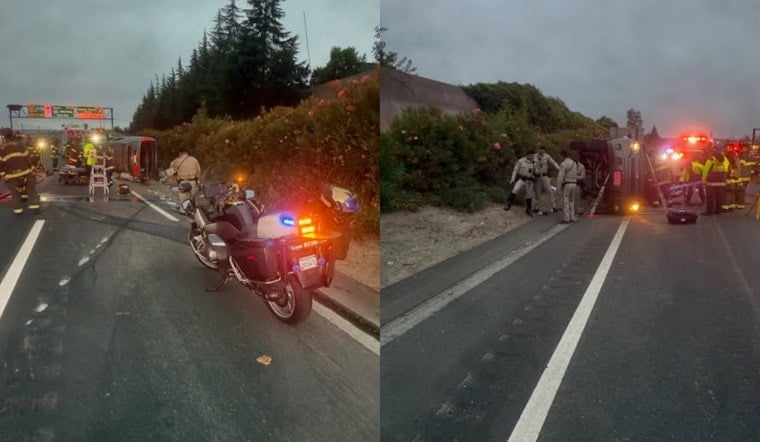
A driver was trapped inside an overturned vehicle after a severe solo-vehicle rollover crash on southbound State Route 87 in San Jose, just north of Santa Teresa Boulevard, last Saturday. San Jose Fire Department personnel performed an emergency extraction to free the driver as California Highway Patrol officers worked alongside them at the scene.
The crash forced CHP to temporarily close lanes two and three on southbound SR-87 to keep the rescue crews safe while they worked, according to a CHP - San Jose post detailing the incident. SR-87, also known as the Guadalupe Freeway, is a heavily traveled commuter corridor linking South San Jose near Santa Teresa Boulevard to downtown San Jose and major interchanges at Interstate 280 and State Route 85, according to the City of San Jose.
First responders face severe dangers on highways every time they step out of their vehicles to work a crash, and this incident was no exception. To pull off the extraction, the same CHP post notes, officers had to manage both the trapped driver's rescue and the flow of traffic, squeezing past a partially closed freeway.
Why Rollovers Demand Heavy Rescue Gear
Rollover crashes are relatively rare compared to other types of collisions, but they are disproportionately deadly. National Highway Traffic Safety Administration data indicates that rollovers make up only about 3 percent of all highway collisions, yet they account for roughly one-third of all occupant fatalities nationwide, according to NHTSA. The severe deformation these crashes cause often traps occupants inside crumpled vehicles, requiring technical extrication rather than a simple door-opening.
To handle exactly that kind of scenario, the San Jose Fire Department relies on hydraulic extrication tools commonly known as the Jaws of Life, including heavy spreaders and cutters capable of dismantling crushed or overturned vehicles. Those tools exert thousands of pounds of pressure, allowing crews to cut through reinforced automotive steel to reach trapped occupants.
California's Expanded Move Over Law
The rollover comes as California enforces a broader version of its Move Over law. Effective January 1, 2026, Assembly Bill 390 expanded California Vehicle Code Section 21809 to require drivers to move over or slow down when approaching any stationary vehicle displaying hazard lights, flares, or warning markers on highway shoulders, extending protections beyond emergency and utility crews to all stranded motorists, per the Kern County Traffic Ticket Attorney.
In its post, California Highway Patrol reminded motorists that state law requires drivers to slow down when approaching a stationary emergency vehicle with flashing emergency lights, and to move over at least one lane when it is safe to do so. CHP added that motorists can help prevent secondary crashes simply by maintaining focus and giving first responders adequate space to work.
The stakes for ignoring that law go beyond a ticket. Violating Vehicle Code Section 21809 carries a base fine of $50, but mandatory court and state penalty assessments push the total cost to between $235 and $295, plus one point on the driver's DMV record, according to Ticket Crushers. Under Assembly Bill 390, failing to move over or slow down for a disabled vehicle also establishes a negligence per se standard in civil court, meaning a statutory violation becomes presumptive evidence of fault if it leads to a secondary crash.
A Persistent Awareness Gap
Those penalties exist because the risks to roadside crews are well documented. Between 2017 and 2021, three California Highway Patrol officers were killed and 146 were injured, nine of them severely, while working on freeway medians or shoulders statewide, according to figures compiled jointly by Caltrans and CHP. Yet a survey by the AAA Foundation for Traffic Safety found that nearly 25 percent of drivers did not even know their state had a Move Over law requiring them to change lanes or slow down near roadside emergency scenes.
Every minute a primary incident like Saturday's rollover remains uncleared, the risk of a secondary crash climbs sharply, per Federal Highway Administration research cited in Hoodline's earlier coverage of a fatal 11-car pileup near Hercules. That dynamic is exactly why closing adjacent lanes, even briefly, is standard practice for crews handling extended extractions like the one on SR-87 — it protects rescuers, but it also means backed-up traffic has to be navigated carefully by everyone approaching the scene.
The SR-87 rollover is the latest in a string of California freeway incidents this month that have prompted renewed Move Over reminders, following a fatal shoulder crash on Highway 50 in Sacramento and a rollover on the 405 in Van Nuys that sent five people to hospitals. Nationally, the U.S. Department of Transportation estimates 36,640 people died in motor vehicle crashes in 2025, part of a multi-year decline from pandemic-era peaks that federal officials attribute in part to stricter enforcement of laws like Move Over.





