

























































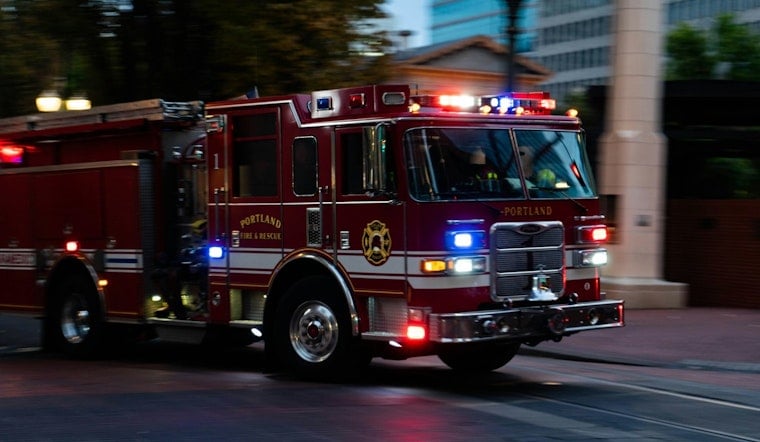
Firefighters from Station 7 raced to a Southeast Portland vehicle incident Friday afternoon, where Truck 7 crews worked to extricate a trapped occupant while Engine 7 stood by to provide patient care. Engine 11 also arrived and deployed a precautionary hose line, a standard safety step taken even before any fire was confirmed at the scene.
The response was announced by Portland Fire & Rescue shortly after 2 p.m., which posted that Station 7 had arrived and that “Truck 7 will be working on getting the occupant of the vehicle extricated, and Engine 7 will have patient care.” The department added that Engine 11 had also arrived and would be “deploying a hose line as a precautionary measure.” Key details, including the exact crash location, what caused the collision, and the severity of the trapped occupant’s injuries, have not yet been released by fire or police officials.
Why Different Rigs Handle Different Jobs
The division of labor described in Friday’s alert reflects standard Portland Fire & Rescue procedure for serious motor vehicle collisions. Ladder truck crews like Truck 7 carry the heavy hydraulic cutters and spreaders needed to physically disentangle a trapped occupant, while engine companies like Engine 7 handle immediate medical care, according to agency procedure detailed by East PDX News. Deploying a second engine’s hose line, as Engine 11 did, is a widely used precaution meant to guard against sudden fires from leaking fuel, hot engine components, or sparking rescue tools, per longstanding guidance from Firehouse Magazine.
Truck 7 is a 2024 Pierce Arrow XT 107-foot Ascendant tractor-drawn tiller ladder, giving it the maneuverability to navigate tight intersections in dense outer Southeast Portland while carrying specialized heavy rescue gear, per the Firefighting Wiki. Engine 7 and Engine 11 are both frontline Pierce Enforcer pumpers with 1,500 GPM pumps and 500-gallon water tanks, according to 5280Fire, giving each unit the same rapid hose-deployment capability regardless of which crew is providing medical support versus fire cover.
Two Busy Stations, One Shared District
Station 7 sits at 1500 SE 122nd Avenue in Mill Park, one of the bureau’s busiest houses with more than 10,000 calls a year, and it also hosts Battalion 3 and the Oregon Regional Hazardous Materials Team 7, according to the City of Portland. Station 11, home to Engine 11, sits nearby at 5707 SE 92nd Avenue in Lents and covers one of the city’s busiest single-engine districts along the Interstate 205 corridor and into northern Clackamas County. The two stations serve adjacent, high-volume sectors of outer Southeast Portland along busy arterial roads, which explains why units from both responded to Friday’s incident.
To keep pace with that workload, the bureau added a dedicated two-person rescue team to Station 11 in January to relieve Engine 11 on minor calls, a staffing move covered in Hoodline’s look at Station 11’s evolution. Portland Fire & Rescue is the largest fire and emergency medical provider in Oregon, running 31 stations and roughly 91,000 calls a year across 151 square miles, per Wikipedia.
Part of a Rough August for Portland Roads
Friday’s extrication is the latest in a string of serious Portland-area crashes this month that have required heavy rescue tools. Earlier in August, a semi-truck and sedan collided at SW Naito Parkway downtown, and a crash on NE Lombard Street trapped a truck driver and injured five people, both requiring extrication crews. In July, Station 7’s Engine 7 also responded when a car drove completely through a commercial building in Mill Park before the driver fled the scene, underscoring how frequently vehicle collisions have tested outer Southeast Portland crews this year.
Fire officials have not released further updates on the condition of the occupant freed Friday or the cause of the crash. Hoodline will update this story as Portland Fire & Rescue or police release additional information.




