

























































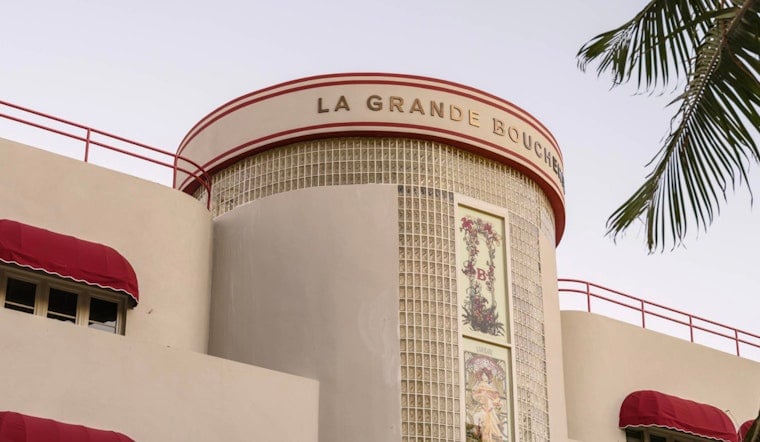
Two of Miami Beach's most talked-about restaurant imports have quietly gone dark this summer, and neither has said when — or if — they're coming back. La Grande Boucherie, the French brasserie import at 81 Washington Avenue, and Las' Lap, the West Indian and Afro-Caribbean party spot inside the Daydrift Hotel, both remained closed as of Tuesday, leaving diners and industry watchers guessing.
La Grande Boucherie's Miami Beach location is listed on OpenTable as temporarily closed, according to Miami New Times, which first reported the dual closures. The restaurant, which opened in January 2025, is The Group Hospitality's first Florida venture and its seventh Boucherie location overall, an offshoot of the original concept that got its start in New York. It has not said whether it plans to reopen before Miami Spice, the dining promotion the Greater Miami Convention & Visitors Bureau created to bring diners into local restaurants, wraps up on September 30. The bureau lists La Grande Boucherie as a 2026 Miami Spice participant, which makes its continued closure notable given the timing.
The 366-seat restaurant sits inside a restored 1938 Art Deco building designed by architect Henry Hohauser, a space that has hosted French dining concepts before, including Au Pied du Cochon and La Gloutonnerie, according to commercial real estate outlet Traded. Executive Chef Leonardo Pablo, who previously cooked at Jean-Georges and W South Beach, leads the kitchen, and the interior — co-designed by Legeard Studio and Emil Stefkov — draws inspiration from designer Paul Poiret's 1920 Oasis Party, according to Modern Luxury. The restaurant has described its current closure as a brief seasonal pause, per the New Times report, though it has offered no further specifics on timing.
Las' Lap Goes Quiet Without a Word
Across town at 2216 Park Avenue, Las' Lap has also gone dark for the summer with no announced reopening date. The restaurant, which opened in Miami Beach in August 2025, is the second location of the Lower East Side bar and pairs West Indian and Afro-Caribbean cooking overseen by chef Kwame Onwuachi with a nightly shift from dinner service into a late-night party. Its name nods to the Trinidadian Carnival tradition of “las' lap,” the final hour of revelry, according to Resy Blog, which detailed how co-founder Ryan Shaffer partnered with Onwuachi after meeting at a White House holiday party.
Las' Lap's website still lists regular hours running Wednesday through Sunday, but the restaurant has not said when its closure began or when it expects to reopen, the New Times reported. Unlike La Grande Boucherie, which at least characterized its shutdown as a pause, Las' Lap has offered no public explanation at all — a silence that stands out even against a summer full of unexplained Miami Beach restaurant exits.
A Pattern of Summer Pauses — and Some Permanent Ones
These closures fit a broader pattern that has played out across South Beach's dining scene this summer. Gordon Ramsay's Lucky Cat closed in August 2025 and was described by Gordon Ramsay Restaurants as temporarily closed until further notice, with the closure itself framed as a moment to reset. Coconut Grove's Sereia paused operations in May 2025, describing the move as a chance to rest and recharge — and by 2026, Greek restaurant Manoli, led by chef Emmanouil Aslanoglou and seating 140, had claimed Sereia's former space on Main Highway.
Not every closure this summer has been about the seasonal lull. Byblos, the Eastern Mediterranean restaurant on Collins Avenue, closed in July 2025 as the Royal Palm hotel underwent a renovation costing more than $100 million; OpenTable describes Byblos as closed for renovations until November 1, 2026, though the Royal Palm itself reopened in July. That closure was tied to construction rather than a summer slowdown, distinguishing it from the ambiguous pauses at La Grande Boucherie and Las' Lap.
The economic backdrop makes the closures harder to explain away as simple belt-tightening. Miami-Dade County drew a record 28.3 million visitors in 2025, generating $32.2 billion in economic impact, according to the Greater Miami Convention & Visitors Bureau. Miami Beach itself collected nearly $11.8 million in resort taxes in May, a 4.5% jump from a year earlier, per Miami's Community Newspapers. Yet those citywide numbers mask a much rougher reality for individual operators during the hottest months, when both tourists and locals thin out and margins get squeezed by high rents and labor costs.
James Beard Award-winning chef Michael Schwartz told CBS News in 2025 that intense market saturation has made it unprecedentedly difficult to capture diner attention during Miami's summer slump, while Coyo Taco co-owner Scott Linquist said the three summer months bring a mass departure of both residents and tourists. That tension between citywide tourism strength and restaurant-level survival has become a defining feature of Miami Beach's summer dining scene, and it is not the only closure story unfolding right now — Hoodline recently reported that Yardbird's 15-year run ended abruptly, and just days later, 38-year South Beach staple Sultan Mediterranean Cuisine also closed its doors on Collins Avenue.
Even as some spots go dark, others are moving in. Miami's Community Newspapers reported that five new dining venues opened within a two-mile radius of South Beach over a recent 90-day span, including Greek-Mediterranean concept Gaia and Eyal Shani's Naked Tomato at the Moxy South Beach. Chopped champion Giorgio Rapicavoli has also just brought his Luca Trattoria concept to Miami Beach, underscoring that the market's churn cuts both ways — for every high-profile exit, there's a new name angling to fill the void.





