

























































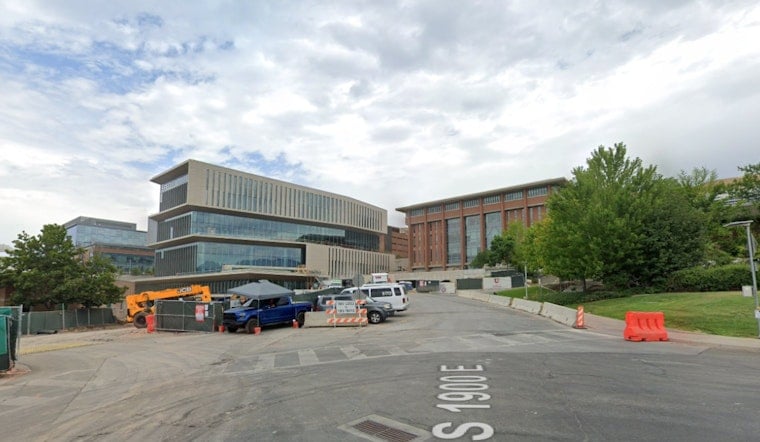
Medical students at the University of Utah walked into a brand-new eight-story building this month, and for the first time in the program's history, they did not have to hop between separate buildings for lectures, labs, and study space. The Spencer Fox Eccles School of Medicine's new facility on the university's campus is now open, replacing a medical education building that dated back to the 1960s.
“It's been a long time coming,” said Bob Carter, the University of Utah's senior vice president for health sciences and CEO of University of Utah Health, according to the Salt Lake Tribune. Before the new building's opening, students and faculty had to travel between multiple campus sites for lectures, administrative offices, and study spaces, a fragmented setup that shaped decades of medical training at the university, according to The University of Utah.
A Consolidated Campus Built Into the Hillside
The new 211,457-square-foot building was constructed by general contractor Jacobsen Construction and designed by VCBO Architecture in partnership with Yazdani Studio, per ENR. Built onto a steep hillside between existing campus medical infrastructure, the facility includes adaptive learning studios with round tables meant for collaborative case work, outdoor wellness terraces overlooking the Wasatch Mountains, an advanced simulation center, a gross anatomy lab, and the multi-story Nora Eccles Harrison Forum, according to design details from Yazdani Studio. The layout reflects a broader shift away from traditional lecture halls and toward small-group, hands-on learning.
Photos of the finished building, taken by Rick Egan, show the scale of the new facility and its position on the university's medical campus, per the seed story's attribution. The Spencer Fox Eccles School of Medicine is located directly on the University of Utah campus, anchoring what is now a consolidated home for the school's students and faculty.
How the $185 Million Project Came Together
The project's roughly $185 million price tag was covered through a mix of philanthropy and public funding. A landmark $110 million gift arrived in 2021 from the George S. and Dolores Doré Eccles Foundation and the Nora Eccles Treadwell Foundation, while state lawmakers approved $50 million in 2017 and added another $60 million in 2022, bringing state legislative appropriations to $110 million, according to Associated Construction Publications reporting cited by the same outlet.
That funding pattern is part of a larger pattern of investment tied to the Eccles family and Utah's state government. In March 2025, the university announced a separate $75 million gift from the Eccles Foundation to anchor an $855 million, 800,000-square-foot hospital and health campus in West Valley City, which broke ground in June 2025 and marks the first off-campus hospital in the university's 175-year history, according to West Valley Utah News.
Addressing Utah's Physician Shortage
The new building arrives as Utah confronts persistent gaps in its physician workforce. Only 44.1 percent of physicians who complete residency training in Utah stay in the state to practice, according to 2025 graduate medical education data from the Association of American Medical Colleges. Utah also ties for the second-lowest density of active direct patient care general surgeons in the nation, with just 5 per 100,000 residents, per the same organization's 2025 workforce statistics.
University of Utah Health functions as the sole academic medical center in the Mountain West, serving patients and training clinicians across a region covering nearly 10 percent of the continental United States' landmass, including Utah, Idaho, Wyoming, Montana, and Nevada, according to The University of Utah Magazine. That regional reach helps explain why university leaders have pushed to expand training capacity both in Salt Lake City and beyond it.
One such effort is already underway in southern Utah. In a partnership announced last year, the university teamed up with Utah Tech University to launch a Southern Utah Regional Medical Campus in St. George, offering an accelerated three-year M.D. track designed to feed graduates directly into rural residency programs. Whether that pipeline, along with the new Salt Lake building's added capacity, will meaningfully shift where Utah's doctors ultimately practice remains an open question.
Competitive Seats, Rising Costs
Demand for a spot in the program remains steep. For the 2025-2026 academic year, the Spencer Fox Eccles School of Medicine accepted 125 students out of 3,085 applicants, an acceptance rate of roughly 4.05 percent, according to data from College Tuition Compare. Annual tuition for the coming class is set at $34,553 for Utah residents and $66,318 for non-residents.
For now, the opening of the new building marks a milestone moment for a program that has spent decades split across separate facilities. With the medical school's community finally sharing one home, university leaders are betting the consolidated campus will support both the school's growing enrollment and its broader mission of training physicians for a five-state region still working through significant workforce shortages.



