

























































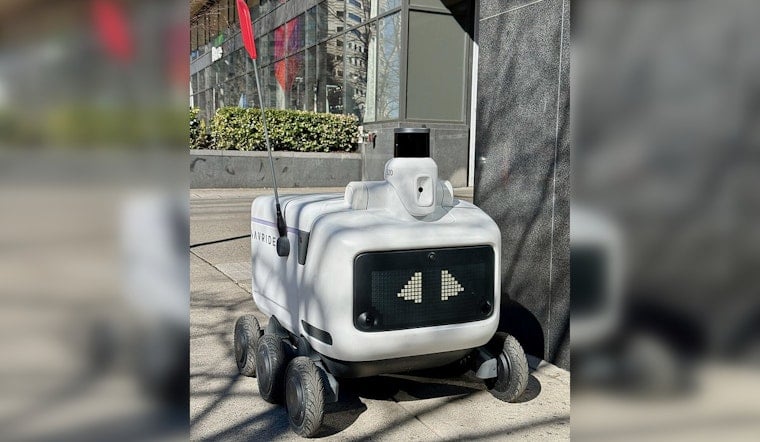
The little food-delivery robots rolling across the University of Tennessee, Knoxville campus this fall look different than the ones students got used to over the past four years. Starship Technologies, the company that put 40 robots on campus back in 2022, has been swapped out for Avride, an Austin, Texas-based company whose bots are bigger, faster and equipped with a front screen that can display eyes or images. Students can now order food through Grubhub for delivery by the new fleet.
The switch traces back to a decision Starship announced in June 2026 to scale back its campus delivery operations so it could focus more on grocery store and city food delivery, according to Knoxville News Sentinel. That pullback set off a scramble across higher education, and UT Knoxville was one of the schools that landed on Avride as its replacement. The company is launching fleets onto 25 university campuses as part of the transition, per the same report.
Avride was launched in 2017 and focuses on autonomous food delivery and taxi driving services. The company's origins trace back further than that, though: it developed as the self-driving technology division of Russian tech giant Yandex before spinning off, divesting its Russian assets and setting up its corporate headquarters in Austin in 2024, according to Forbes.
Bigger Bots, Bigger Loads
The most tangible upgrade for hungry students is cargo space. Avride's robots can carry up to 55 pounds, more than double the 20-pound limit on Starship's older machines, according to the University of North Carolina Wilmington, which is adopting the same fleet this fall. The bots use LiDAR, radar and ultrasonic sensors to navigate, plus those customizable LED displays capable of showing campus graphics or animated eyes as they roll along.
UT Knoxville is far from alone in making the switch. UNCW and James Madison University are also adopting Avride for the fall 2026 semester after Starship's announcement that it would redeploy more than 1,200 robots toward grocery and urban delivery work instead. Nationally, Avride says it will have more than 1,000 active robots operating around the country, and the company has reported that 99% of its deliveries have been completed without human assistance, per its own press release.
A Campus Island Under State Rules
UT's campus streets and sidewalks are regulated by the state rather than the city, which matters because Knoxville itself has taken a much harder line on sidewalk robots. The Knoxville City Council voted unanimously in April 2024 to prohibit personal delivery devices from operating on municipal streets and public rights-of-way, citing narrow sidewalks and obstructions like patio cutouts and streetlights, according to WBIR. That prohibition did not affect the university campus, leaving UT's grounds as essentially an autonomous-delivery island within a city that otherwise won't allow the robots on its streets.
State lawmakers, meanwhile, have been moving in the opposite direction. Tennessee's existing law, TCA § 55-8-209, already allowed personal delivery devices in pedestrian areas at speeds up to 10 mph, provided operators carry at least $100,000 in general liability insurance and equip devices with lights visible from 500 feet, per Justia Law. A newer law, Public Chapter 581, took effect July 1, 2026, and expands where the devices can operate to include bicycle lanes, road shoulders and parking lots at speeds up to 20 mph outside pedestrian zones, according to BillTrack50, while still leaving local governments some authority to regulate under state standards.
How Avride Has Performed Elsewhere
The Ohio State University offers the clearest preview of what a large Avride fleet can do. Avride and Grubhub launched a 112-robot fleet there in January 2025 that now completes between 1,200 and 1,300 deliveries a day, described as the largest autonomous robot deployment on a U.S. college campus. Grubhub has built out a network spanning more than 360 universities, with autonomous robot delivery now available across more than 40 campuses through partners including Avride, Cartken and Kiwibot, per Business Insider.
The expansion hasn't come without friction elsewhere. Hoodline previously reported that an Austin cyclist filed a $250,000 personal injury lawsuit against Avride in October 2025, alleging one of its sidewalk robots failed to yield the right-of-way and caused a collision. It's a reminder that as these fleets multiply across college towns and city sidewalks alike, questions about liability and pedestrian safety are following close behind the robots themselves.





