

























































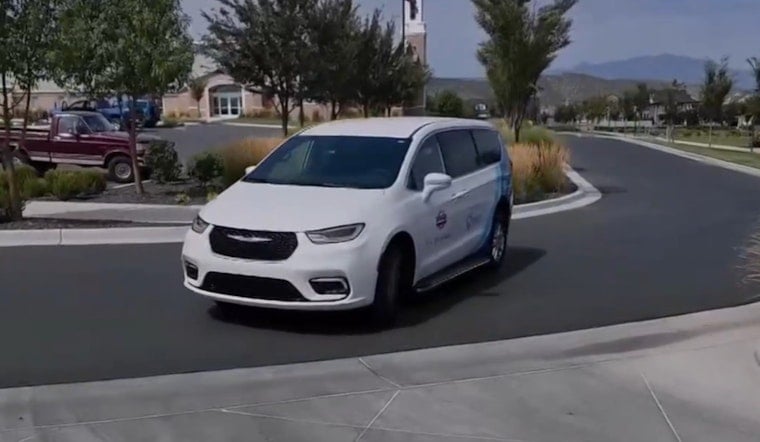
A fleet of 16 curb-to-curb vans is already crisscrossing northern Utah County ahead of a formal ribbon-cutting Thursday, offering rides for $2.50 apiece across nine of the region's fastest-growing cities. The service, called UTA On Demand, launched to connect residents in Eagle Mountain, Saratoga Springs, Lehi and six neighboring communities to the rest of the region's bus and rail network, filling gaps that traditional fixed-route buses have struggled to reach.
According to KUTV, the new zone covers roughly 77 square miles across American Fork, Pleasant Grove, Lindon, Highland, Cedar Hills, Alpine, Eagle Mountain, Saratoga Springs and Lehi — a footprint the Utah Transit Authority says expands microtransit access across the county's fast-growing northern corridor. Riders request a pickup through the UTA On Demand app, and vans run Monday through Saturday from 6 a.m. to 9 p.m., with rides capped at 6 miles between pickup and drop-off, except when a passenger is heading to a FrontRunner station, in which case longer trips are allowed.
Utah County Commissioner Skyler Beltran, who said the area had been underserved, told KUTV that riders can expect to be picked up 5 to 20 minutes after requesting a ride. He said he began meeting with UTA on the idea early in 2025. Northwestern Utah County is described in the KUTV report as the county's most congested area, and the station notes that $1.4 billion in road projects are currently underway there, with officials expecting major improvement over the next two or three years.
Why Northern Utah County Needed the Fix
The demand for the service traces back to explosive population growth. Eagle Mountain ranked as the ninth-fastest-growing city in the United States in 2025, according to KUTV's reporting, while Hoodline previously reported that Saratoga Springs added 4,682 residents that same year, per estimates from the Utah Population Committee. That surge has outpaced the fixed-route bus network built for a much smaller suburban footprint.
The scale of the new zone is significant: local estimates cited by the Lehi Free Press put the 77-square-mile mobility area at roughly 181,000 residents and 71,000 jobs, with projections of around 400 microtransit rides per day. Utah Transit Authority materials describe the expansion as beginning on the agency's Fall Change Day in August, adding six additional cities beyond the three named in the original rollout.
How the Fare and Booking System Works
A ride costs $2.50 each way, with a $1 reduced fare for eligible riders, and UTA says that price includes free transfers to fixed-route buses, TRAX light rail and FrontRunner commuter rail within a two-hour window. Seth Woodson, who commutes to Brigham Young University, said the new option helps people get around and called $2.50 per ride affordable as gas prices rise. UTA On Demand also enables travel from Eagle Mountain's city center all the way to downtown Salt Lake City by public transit, connecting northwest Utah County residents to the broader UTA network.
The booking system includes a built-in efficiency check: if a rider tries to book a trip that a nearby bus or train could complete faster, the app redirects them to that fixed-route option instead, per UTA's service rules. During peak demand, some riders booking through the app may instead be assigned a Lyft vehicle under UTA's partnership with the technology provider Via, according to KSL TV — with no separate app download or added fare required.
Who's Paying for It, and Why the County Pushed Back
Utah County is funding the service through a five-year contract with UTA, using dollars from the county's fifth tax, a dedicated local option sales tax for transit projects. The Lehi Free Press reported that the county committed $18.5 million over five years, while UTA On Demand's operating cost runs an estimated $3 million to $4 million per year. Officials describe public transit broadly as a tool for easing traffic and supporting the independence and economic mobility of riders — including teenagers and senior citizens reaching doctors' appointments and grocery stores — who might otherwise lack transportation.
The launch follows friction between county officials and the transit agency. The Daily Herald reported that Utah County commissioners pushed back on UTA in October 2025 after a proposed 2026 transit budget allocated $43 million in state and local funds to Salt Lake, Davis and Weber counties while slating zero new projects for Utah County — even as the county accounted for 43% of the state's population growth that year.
Part of a Bigger Regional Transit Push
UTA On Demand already operates on the west side of Salt Lake City and in southern Davis County, and northern Utah County's rollout marks the program's sixth microtransit zone along the Wasatch Front, per KUTV's reporting. The permanent program, first established in late 2019, delivered more than 645,000 rides in 2025 alone, with systemwide ridership growing 13% year-over-year as UTA expanded microtransit to replace low-density bus routes, according to the Lehi Free Press.
The new vans are also designed to feed a much larger infrastructure investment. Federal regulators recently advanced the $3.2 billion FrontRunner 2X double-tracking project into its FTA engineering phase, targeting 26.1 miles of new track to enable 15-minute peak service between Weber, Salt Lake, and Utah counties. UTA On Demand zones in Utah County are configured to connect commuters directly to FrontRunner stations in Lehi and American Fork, tying the last-mile van service to that long-term rail expansion.





