

























































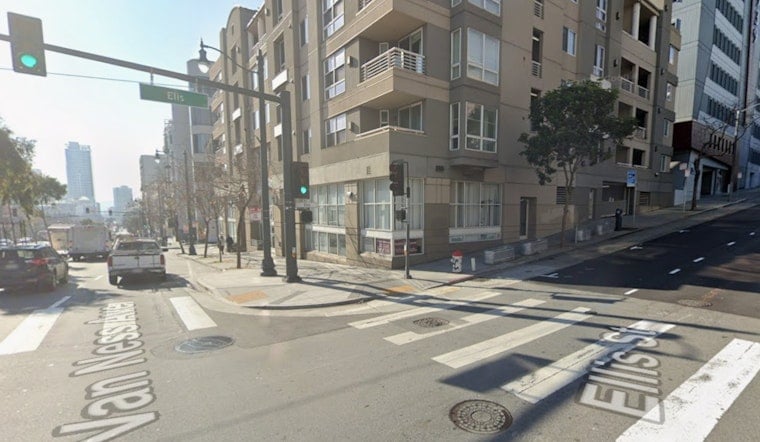
A car crashed into a building and a fire hydrant near Van Ness Avenue and Ellis Street in San Francisco around 11 AM yesterday, sending five people to local hospitals with minor injuries. Seven people were involved in the two-vehicle crash, though it remained unclear how the second car was involved in the collision.
According to the San Francisco Chronicle, five of the seven people involved were taken to hospitals for minor injuries, while others declined ambulance transport at the scene. The crash sent one vehicle into both a fire hydrant and a nearby building, though the paper did not specify further details about the structure's damage. The Chronicle's report, credited to Hearst fellow Brooke Park, is the primary account of the incident so far, and several basic questions remain open, including how the second vehicle was involved and what triggered the crash in the first place.
A Corridor With a Troubled Recent History
Sunday's wreck adds to a run of serious collisions along Van Ness Avenue, which sits on San Francisco's Vision Zero High Injury Network — the roughly 12 percent of city street miles where 68 percent of severe and fatal traffic collisions occur, according to the SFMTA. Just five weeks earlier, on July 19, a police pursuit on South Van Ness Avenue ended in a crash at 14th Street that injured nine people and sent debris into a fire hydrant and a car dealership, as Hoodline previously reported.
In December 2025, a separate crash near California Street and Van Ness Avenue injured three people when a vehicle struck a historic San Francisco cable car before the driver abandoned the car and fled on foot, a case Hoodline also covered. That same month, a fatal crash struck the U.S. 101 on-ramp at South Van Ness Avenue, and in May, a deadly midnight crash rocked the nearby intersection of 16th and Mission streets.
Why the Street Is So Hard to Fix
Part of the difficulty in addressing Van Ness Avenue's crash record stems from its dual identity: the street also functions as U.S. Route 101 through San Francisco, giving the California Department of Transportation joint jurisdiction over street design, pavement, and corridor safety alongside city agencies, according to the San Francisco County Transportation Authority. That shared oversight has historically complicated efforts to redesign the corridor quickly.
The SFMTA has gained some new tools to respond. Under state Assembly Bill 43, the agency now has authority to reduce speed limits by 5 mph on designated commercial safety corridors, citing speeding as the leading driver of traffic fatalities and severe injuries citywide. Separately, pedestrian advocacy group Walk San Francisco documented multiple severe collisions on nearby stretches in 2024, including a fatal crash on Ellis Street near Jones Street and another on Van Ness Avenue at Broadway, underscoring that the danger extends beyond any single intersection.
Open Questions Remain
Investigators have not yet detailed what caused Sunday's crash, including whether speed or a red light played a role, nor have they clarified the extent of damage to the building the car struck. The precise sequence between the two vehicles involved also has not been made public. San Francisco has faced significant costs tied to vehicle collisions in recent years — the city paid nearly $40 million between 2019 and 2024 to settle legal claims stemming from municipal vehicle crashes on its streets, according to The San Francisco Standard, though that figure reflects citywide claims rather than this specific incident.





