

























































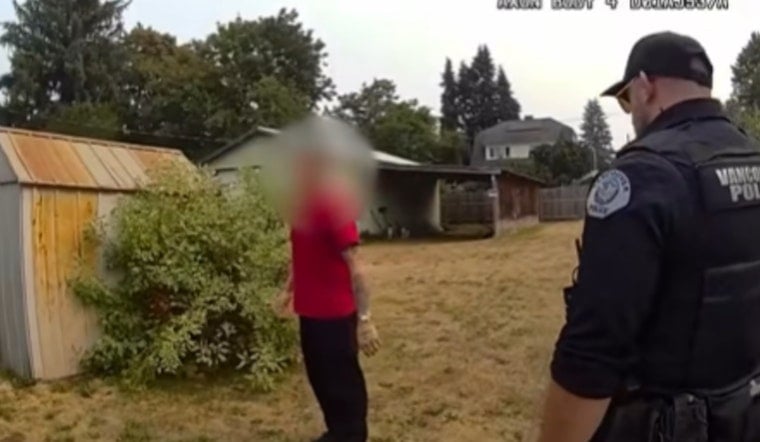
A routine welfare check at a Vancouver residence turned into a felony arrest, a foot chase, and a mid-search overdose scare after officers discovered the man they found on scene was wanted on multiple out-of-county warrants. Police say the man reached toward his pocket before running into a backyard, prompting officers to deploy a drone to track him down. He was located hiding in a driveway, and during the subsequent search he suddenly became unresponsive, requiring two doses of Narcan before he could be taken into custody.
According to the Vancouver Police Department, officers responded to the welfare check and encountered the man, who reached toward his pocket before bolting into the backyard once he was told he was under arrest. Officers used an uncrewed aircraft system, or UAS, to locate him hiding in a nearby driveway rather than immediately giving chase on foot. The department's account, posted to Facebook, includes an accessible audio-described version of the video available on YouTube.
Drone Deployment Has Become Standard Practice
The use of a drone to corner a fleeing suspect is not new for Vancouver police. As far back as June 2024, the department documented deploying the same UAS technology to track a suspect jumping through residential backyards, feeding real-time coordinates to officers on the ground. By May 2025, the department's drone fleet had grown to roughly two dozen aircraft, deployed nearly 150 times that year alone for high-risk warrants, search operations, and crime scene documentation, according to KGW. The station also reported the department was exploring automated docking stations around the city as part of a longer-term drone-as-first-responder program.
Once officers had the man in custody, a search turned up suspected methamphetamine and a knife. It was during that search that he became unresponsive, and officers administered two doses of Narcan before he was transported to a hospital. He was medically cleared there before being booked into the Clark County jail.
Why the Hospital Stop Came Before Booking
The hospital detour was not optional. Clark County Department of Jail Services protocols require that any suspect who becomes unresponsive or shows signs of a suspected drug overdose be medically cleared at an emergency room before the jail will accept custody, a standard meant to prevent in-custody medical emergencies. Vancouver officers carrying naloxone is itself a longstanding practice; the department was among the earliest agencies in the Pacific Northwest to equip frontline officers with nasal naloxone kits, according to a 2016 report from Global News.
Once he was booked, the man landed in a facility with notable resources for opioid-related medical needs. The Clark County Jail became the first correctional facility in Washington licensed to provide on-site methadone treatment for opioid use disorder, and it installed a lobby vending machine offering free naloxone and fentanyl test strips, Oregon Public Broadcasting reported in March 2025. Research cited in that report found more than half of Washington's jail population suffers from opioid use disorder.
Multiple Warrants, New Domestic Violence Charges
The man had several outstanding warrants out of Kitsap County, including theft of a motor vehicle, unlawful imprisonment, and two counts of violation of a court order. Police also say he was believed to possess a vehicle reported stolen out of Kitsap County. In Vancouver, he now faces several new domestic violence-related charges along with obstructing a law enforcement officer, stemming from his flight into the backyard.
The charges carry significant weight under Washington law. Theft of a motor vehicle is a Class B felony punishable by up to 10 years in prison and a $20,000 fine, while unlawful imprisonment is a Class C felony carrying up to five years and a $10,000 fine for knowingly restraining another person without consent, according to legal resources cited in the case. Obstructing a law enforcement officer is a gross misdemeanor under state law, punishable by up to 364 days in jail and a $5,000 fine for willfully hindering or delaying an officer.
Some might wonder whether the man's overdose and the emergency aid he received shield him from prosecution. Washington's Good Samaritan Law grants immunity from simple drug possession charges for people who seek medical help during an overdose, but it explicitly does not protect against outstanding arrest warrants or non-possession felony charges, meaning the Narcan administered in the field did nothing to erase the Kitsap County warrants or the new charges filed in Vancouver.
Motor vehicle theft warrants like the ones out of Kitsap County are common across Washington jurisdictions. State legislative findings recorded that motor vehicle thefts increased more than 55 percent between 1994 and 2005, averaging over 138 stolen vehicles per day statewide, underscoring why cross-county warrants for stolen cars remain a routine part of law enforcement work. It remains unclear whether additional drug-related charges will be filed pending lab confirmation of the substances found during the search, and the condition of the vehicle believed to be tied to the Kitsap County theft warrant has not been detailed.




