

























































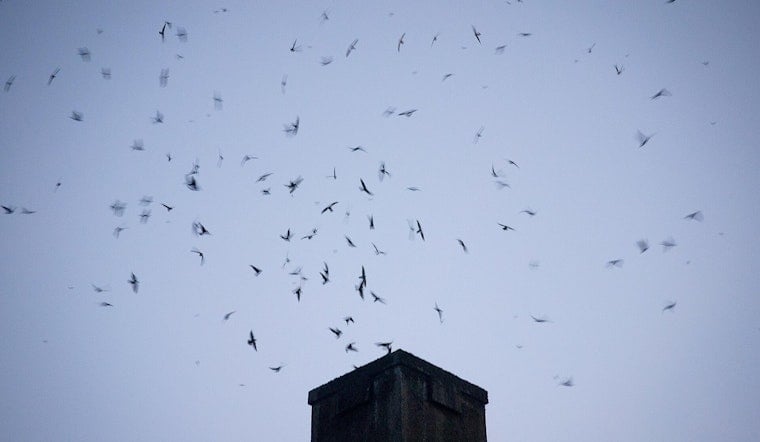
Portland's night skies are about to fill with tiny, chattering birds again. Vaux's swifts are expected to return to the Portland region by mid-September 2026, according to KOIN, kicking off another season of neighborhood watch parties centered on whichever brick chimney the flock decides to call home this year.
That last part is the twist that's defined the last two migrations. For nearly four decades, Chapman Elementary School in Northwest Portland was the undisputed center of the phenomenon, drawing as many as 20,000 birds a night and thousands of human spectators who'd spread blankets on the hillside to watch, as reported by Willamette Week. Then, in September 2024, the birds simply left. Nightly counts at Chapman collapsed from 5,430 on September 2 to under 1,000 by September 12, to just 60 four days later, and finally to zero by September 18, according to Portland Monthly.
Where the Swifts Went Instead
Since abandoning Chapman, the flock has scattered across the city's masonry chimneys rather than settling on one new headquarters. In fall 2025, volunteers with the Bird Alliance of Oregon documented more than 7,000 swifts roosting in a single night at Abernethy Elementary School in Southeast Portland, the largest documented congregation that season, per the same account. Other swifts gathered at the Holy Trinity Greek Orthodox Cathedral on NE Glisan Street, where up to 5,000 birds were counted, the outlet notes.
KOIN's report frames the coming weeks as a fresh guessing game: Portlanders will need to observe where the birds land this fall before they know this year's favorite spot. Meteorological autumn begins September 1, and sunsets in Portland will be closer to 7:20 p.m. by mid-September, roughly when the swifts usually start swirling around larger chimneys just before settling in for the night, per KOIN's report.
Why the Birds Left Chapman Remains Unclear
Bird Alliance of Oregon staff inspected the Chapman chimney in October 2024 and found no physical blockages, and longitudinal data on local predators such as Cooper's hawks and falcons showed no unusual spikes that would explain the shift, the article notes. Biologists with the organization, formerly known as the Audubon Society of Portland before it changed its name in February 2024, describe roost switching as normal, natural behavior for migratory swifts along the Pacific Flyway rather than a sign of a specific problem at the school. Beyond ruling out those two possibilities, the exact reason the swifts left remains unresolved.
The chimney itself carries decades of community investment. When Portland Public Schools decommissioned Chapman's heating plant in 2001, Portland Audubon raised $60,000 to replace the school's heating system so the historic 1923 brick chimney could stay intact purely as bird habitat, according to the same report. Vaux's swifts can't perch on branches or walk on the ground, according to the Golden Gate Bird Alliance; they sleep clinging vertically to rough surfaces inside hollow trees or brick chimneys, which is why old masonry structures like Chapman's became so critical as old-growth forests disappeared.
Part of a Bigger Flyway Story
Portland's counts don't exist in isolation. They feed into Vaux's Happening, a West Coast community science project coordinated by researcher Larry Schwitters to map and protect roost chimneys from Canada to Mexico, according to High Country News. Fifty miles northwest, a church chimney in Rainier, Oregon, hosts up to 20,000 swifts on single nights in September, a scale swifts began reaching there in 2019 after an obstructing grate was removed in 2015, per Portland Monthly.
Whatever chimney the swifts choose this year, the birds remain federally protected under the Migratory Bird Treaty Act, which makes it illegal to disturb active roosts or harass the birds. Spectators are typically reminded that flying drones near roost chimneys violates those same federal protections. For now, Portlanders eager to catch the show will simply have to wait for sunset in the coming weeks and see which neighborhood chimney fills with swirling wings first.


