

























































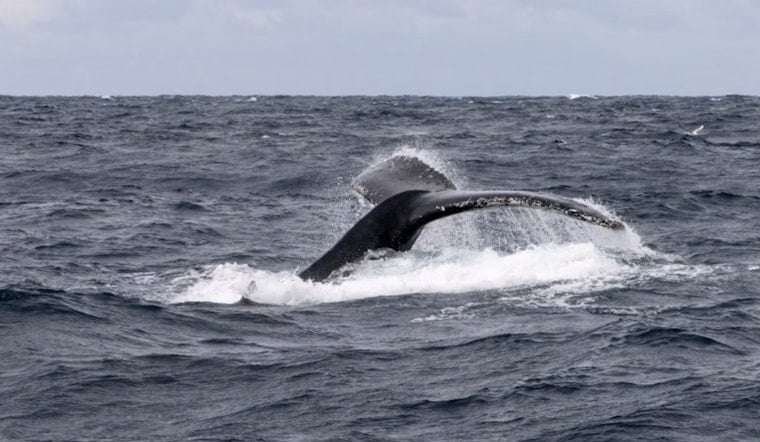
An adult female humpback whale bound so tightly in fishing gear that responders described it as hog-tied is swimming freely again off the Washington coast, after a quick-thinking boater's tip led rescuers straight to her. The whale, identified by researchers as CRC-19155, had buoys anchored near her head and heavy gear weighing down her body when she was spotted last Friday off Westport.
The entanglement was serious enough that lines ran through the whale's mouth and wrapped around her tail, restricting her ability to swim, according to the FOX 13 Seattle report on the rescue. As detailed by Chinook Observer, the configuration amounted to a hog-tie, with heavy gear anchoring the animal and connecting lines threaded through her mouth and flukes — a setup that both hampers feeding and swimming and demands a careful, specific cutting order to avoid injuring the whale further.
Sam Azar IV, an Olympia-area resident out on the water Friday, spotted the entangled whale and immediately called NOAA's entanglement hotline. He kept his distance while relaying continuous position updates to responders until help arrived, according to the same Chinook Observer account.
Racing Against a Moving Target
By the time Cascadia Research Collective's entanglement response network launched an inflatable response vessel and a research vessel from Westport, the whale had already dragged her anchoring gear roughly one mile from where Azar first spotted her, per Cascadia Research Collective. Responders used a drone and an underwater camera to assess the wounds, which appeared fairly recent, before determining the order in which to cut the lines binding her.
Crews attached a control line to a buoy near the whale's head, then adapted their approach by shortening the trailing gear and removing a buoy and control line before finally cutting the lines tangled around her flukes. After the adjusted approach, the humpback made a prolonged dive and resurfaced at a distance — a sign, tracked afterward by Cascadia Research Collective, that she was swimming normally again.
A Familiar Face on the Washington Coast
CRC-19155 is no stranger to researchers. She was first documented in 2009 and has been spotted primarily near Westport and the mouth of the Columbia River in the years since. She winters in Hawaii and was last seen with a calf in the same Washington waters back in 2023. Doug Sandilands said he hopes she returns to Westport again next summer.
“Real-time reporting can make whale rescues possible,” Sandilands said, according to Cascadia Research Collective's press release on the operation. He added that more people who know how to report an entangled whale and stand by until help arrives can give whales like CRC-19155 a real chance at survival.
Part of a Larger Pattern Along the Coast
The Westport rescue lands amid what researchers describe as a sustained surge in West Coast entanglements. Federal data compiled by the Center for Biological Diversity shows 33 whales were confirmed entangled off the U.S. West Coast in 2025, following 34 in 2024 — the highest totals since 2018 — with at least nine more entanglements already logged in early 2026. Nationally, NOAA Fisheries confirmed 95 large whale entanglements in 2024, up from 64 the year before and well above the 17-year historical average of 71.4 cases annually.
Humpback whales feeding off Washington's coast, like CRC-19155, belong primarily to the Central America distinct population segment, listed as endangered under the Endangered Species Act, and the Mexico DPS, listed as threatened, according to NOAA Fisheries regulations. That legal status underscores why individual adult females matter so much to population recovery — and why entanglements remain, per Cascadia's press release, one of the leading human-caused threats to large whales along the coast.
Not every rescue ends as well. Oregon Coast Explored reported that rescue teams and commercial fishermen worked together in July 2026 to free a young humpback 20 miles off Newport, Oregon, only to determine that its jaw had been permanently disfigured and that the whale was unlikely to survive. It's a sobering contrast to the Westport outcome, where responders cut the gear before lasting structural damage set in.
Westport's Whaling Past, Rescue Present
Westport's role as a staging ground for whale rescues stands in stark contrast to its history. Between 1911 and 1925, the American Pacific Whaling Company ran a shore-based whaling station at nearby Bay City, killing nearly 2,000 humpback whales before local stocks collapsed, according to the Encyclopedia of Puget Sound. A century later, the same stretch of coast now serves as a launch point for the crews working to keep whales like CRC-19155 alive.
Hoodline has tracked a similar rescue involving a humpback nicknamed Pop Tart in the Salish Sea, where whale-watch vessels and marine responders spent days confirming she had shed more than 30 meters of trailing rope and buoys. Fishery managers are also testing ropeless pop-up trap gear that keeps buoy lines bundled on the seafloor until acoustically triggered, technology that achieved a 98% reliability rate in 2024 commercial trials, aimed at preventing the vertical-line entanglements that snare whales like CRC-19155 in the first place.
Any disentanglement work is governed under federal Permit #24359, which mandates strict safety protocols and bars unauthorized citizens from entering the water, according to NOAA Fisheries. Anyone who spots a whale in danger should report it to NOAA's entanglement hotline at 1-877-SOS-WHALE and stay at least 100 yards away while awaiting responders.


