

























































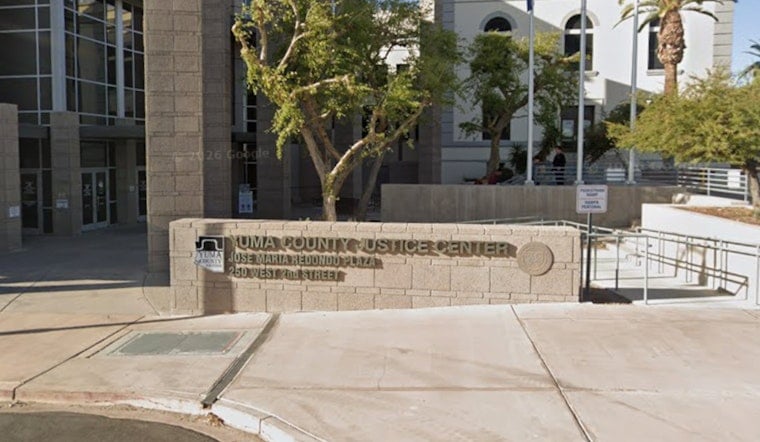
A former U.S. Customs and Border Protection agent and his fiancée have been sentenced to three years of probation and ordered to repay $26,424 after collecting food assistance benefits they were not entitled to for years while the agent drew a federal paycheck. A Yuma County Superior Court judge handed down the sentence on Wednesday against Saul Rivas Hau and Hilda Sanchez following their guilty pleas to Class 4 felony theft.
The sentencing was announced by the Arizona Attorney General's office, which said the pair each received 36 months of supervised probation. The restitution order followed a scheme that authorities say ran for years across two separate federal safety-net programs, according to the same office.
Court records described by the Attorney General's office show the SNAP fraud stretched from March 11, 2022, through August 30, 2025, while the unlawful acquisition of WIC benefits, which stands for the Women, Infants, and Children program, occurred between February 13, 2023, and January 16, 2024. Combined losses to both programs topped $25,000, the office said.
An Agent on the Federal Payroll, Drawing on Food Aid
What sets this case apart, as reported by Scottsdale Signal, is that Hau remained actively employed as a CBP agent throughout the entire period during which the public assistance theft occurred. He was drawing a federal salary while also illegally collecting needs-based food benefits designed for low-income households, the outlet reported.
Before the plea deal, a state grand jury had indicted Hau and Sanchez on a broader set of felony counts, including conspiracy, fraudulent schemes and artifices, theft, and forgery, according to KAWC. That multi-count indictment was ultimately resolved through a negotiated plea agreement that reduced the charges against each defendant to a single Class 4 felony theft count.
Multiple Agencies Teamed Up on the Investigation
The case required coordination among several federal and state agencies. Per KTAR, the joint investigation was carried out by the CBP Office of Professional Responsibility, the U.S. Department of Agriculture Office of Inspector General, and the Arizona Department of Economic Security, with operational assistance from the Arizona Department of Public Safety. Arizona Assistant Attorney General Mariana B. Sanchez prosecuted the case on behalf of the state, the outlet noted.
Under Arizona Revised Statutes § 13-1802, a Class 4 felony theft conviction carries a sentencing range from supervised probation up to 3.75 years in prison for first-time offenders, along with potential fines of up to $150,000 plus surcharges, according to the Salwin Law Group. Arizona generally classifies theft severity by the dollar value involved, and property theft valued at $25,000 or more is typically charged as a Class 2 felony, while Class 4 felony theft usually applies to property valued between $3,000 and $4,000, per the James E. Novak Law Office. Although the total losses in this case exceeded $25,000, the defendants resolved their cases through a plea agreement to the lower Class 4 felony theft charge.
How Arizona Oversees Food Assistance Eligibility
Arizona administers SNAP through the Department of Economic Security under broad-based categorical eligibility, which sets the state's gross income limit at 185% of the federal poverty level, according to clayso.com, a threshold higher than the standard federal baseline of 130% FPL that allows more working households to qualify. The Department of Economic Security's Quality Control unit conducts regular case reviews of active and negative actions to monitor compliance with SNAP requirements and identify deficiency trends, the agency says, working alongside state and federal inspectors general to investigate suspected fraud.
Arizona Attorney General Kris Mayes addressed the case directly following the sentencing, saying programs like SNAP and WIC exist to help Arizona families put food on the table — not to be exploited for personal gain. Mayes's office said it will continue working with federal and state partners to hold accountable anyone who defrauds SNAP and WIC programs.





