

























































A small wooden-and-stone church on Arden Road in Buckhead has stood for 157 years, and this summer the City of Atlanta made it official: New Hope A.M.E. Church and its historic cemetery are now protected local landmarks. The designation preserves one of the last physical markers of a Black community that once thrived in an area now dominated by luxury towers and shopping malls.
New Hope's congregation traces its roots to formerly enslaved people who founded the church as a formal place of worship after the Civil War, according to WABE. Before emancipation, Black worshippers had gathered in hidden wooded areas known as hush harbors, and camp meetings held on the property eventually led to New Hope's formal founding in 1869, the station reports. That same year matches the account from Buckhead Heritage, which says the New Hope congregation formed in 1869 and worshipped at the New Hope Camp Ground along Arden Road.
The land itself came from an unlikely source. In 1872, a white landowner willed around two acres for use as a church and school for Black residents, per WABE's reporting. Buckhead Heritage identifies that landowner as James H. Smith, a white Buckhead resident who stipulated in his will on May 29, 1872, that two parcels of his farmland be given for a church and school for “colored persons.”
From a Black Carpenter's Frame to Stone Walls
The area's only Black carpenter built the original wooden-frame church building in 1874, according to the station's report. A fire tore through that structure in 1927, and the congregation encased the surviving wooden frame in stone the following year, WABE notes — a repair that means some of the building's elements are now 90 to 100 years old. Rough Draft Atlanta reports that the fire destroyed the original building and that the structure standing today was completed in 1936, after the sanctuary was added that year, per WABE. Rough Draft Atlanta describes New Hope as one of the last remaining buildings that marks the African American history of the area.
Pastor David F. Richards III, who has led the congregation for nine years, said worshippers were drawn to the church's specific location, according to the same account. Richards said the sanctuary and church building should be preserved and remain usable for the community, not simply frozen as a museum piece.
Two Cemeteries, Hundreds of Unmarked Graves
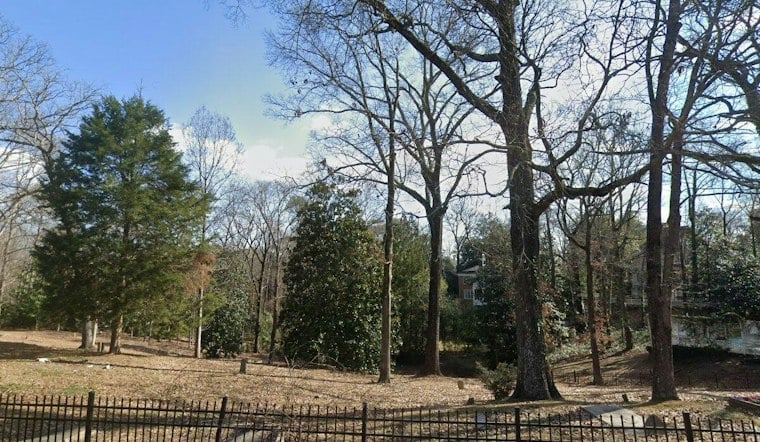
Across the street from the church sit two cemeteries on the New Hope grounds, one of which is a site for enslaved people, per WABE's reporting. Both cemeteries contain unmarked graves. Buckhead Heritage describes the cemetery as 1.86 acres, located across the street from the church and containing hundreds of graves, with the first documented burial — based on church history and oral tradition — dated to 1889.
A cemetery survey identified 100 unmarked graves and a possible crypt on the site, according to Patch. The preservation project aims to place a small, historically appropriate marker on each unmarked grave, Patch reports, and more broadly, more than 650 historic and cultural assets have been identified within the Buckhead community. The cemetery is also listed on the National Register of Historic Places alongside New Hope African Methodist Episcopal Church, according to Buckhead Heritage.
Denise Jones, 72, has ancestors who were part of New Hope's congregation, WABE reports. Jones said her father and his family are buried across the street from the church — a personal thread connecting her directly to the cemetery's hundreds of graves.
City Council Marks the Milestone
Atlanta officials designated New Hope A.M.E. Church as a historic landmark in June, according to WABE's reporting, a status separately confirmed by 11Alive, which reports that the City of Atlanta recently designated New Hope AME Church and its historic cemetery as local landmarks. The church was already listed on the National Register of Historic Places before receiving the local protection, 11Alive notes, and is now undergoing a major restoration project to preserve its original structure.
City Council member Mary Norwood presented the pastor and congregation with a proclamation during a council meeting last month, according to WABE. Norwood said generations of congregants have worshiped on the same property throughout the church's history.
What Buckhead Lost — and What Barely Survived
New Hope's survival stands out because so few traces remain of Buckhead's Black communities. Black residents once comprised nearly 20% of Buckhead's total population, per WABE's reporting, after fleeing north to rural Buckhead to escape racial violence. Johnsontown and Macedonia (Bagley) Park were among the Black communities that once existed in the area, the station reports, and city legislation and annexation dismantled established Black communities around the 1940s. WABE also cites a private 1943 letter in which then-Mayor William B. Hartsfield described racial motivations behind Atlanta's expansion.
Atlanta Magazine fills in more of that history: Johnsontown survived after Lenox Square opened next door in 1959, only to later be targeted for a MARTA parking deck. Macedonia Park, founded by former slaves, grew into a subdivision of about 50 families by the 1920s before Fulton County began buying up homes in the mid-1940s to build a public park, often paying just a few hundred dollars per house under threat of eminent domain. The magazine reports that Macedonia Park's only physical remnant, the small Mt. Olive church cemetery, was sold by the county for back taxes in 2009. Johnsontown, meanwhile, was extensively documented by the Library of Congress before it was razed, and Atlanta Magazine notes that Buckhead Heritage has planned more than 50 interpretive signs and permanent exhibits across the area to document that lost history.
Piney Grove Cemetery offers a similar cautionary tale. Buckhead Heritage describes it as the last remaining historic landmark of Piney Grove, a former African American community that may date back as far as the mid-1820s, holding more than 300 graves, some believed to be slave burials. The Piney Grove Missionary Baptist Church building itself was demolished after storm damage in 1996, leaving only the cemetery behind — the same fate that could easily have befallen New Hope had its congregation and building not endured.
What Comes Next for New Hope
The preservation project at New Hope is still in its preliminary phases, according to WABE. Plans call for structure and roof restoration, cemetery upkeep, and a modern sanctuary equipped with recording capabilities, the station reports. For a congregation that has occupied the same ground since 1869, the work ahead is less about starting something new than about making sure what has already survived 157 years keeps standing.



