

























































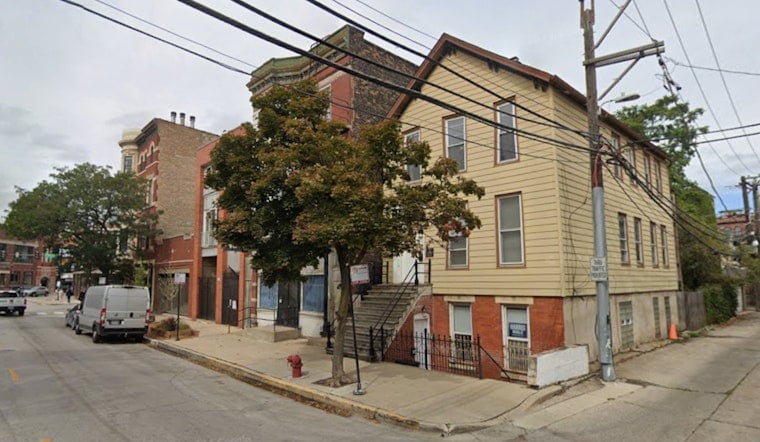
An 1888-built multi-unit residence at 950 West Willow Street in Lincoln Park has given way to a new four-unit building, after the city issued a replacement construction permit on September 1. The project comes just months after developer Landex Holding Company LLC bought the property for $750,000 in January and pivoted away from the previous owner's plan to renovate the existing structure, opting instead for a full teardown and ground-up build.
According to Chicago YIMBY, Landex received permission to erect a three-story-plus-basement, four-unit building on the lot, with Charles Schwartz listed as architect of record and Fargo Group LLC serving as general contractor. The plans call for a private roof deck with a roof canopy and access stair enclosure, a four-story rear egress stair, and a three-car concrete parking pad at the back of the property, accessible from both North Sheffield Avenue and Willow Street. The publication reported the new construction permit carried a cost of $950,000 and had been pending in the city's data portal since April 4, sitting for 150 days before issuance. Chicago YIMBY noted it had not independently confirmed the demolition's status, though city records show Landex applied for the demolition permit in March, and a permit was issued in June.
The site's paper trail stretches back further. City of Chicago records show an initial demolition permit application for the address was filed in October 2025 by Brophy Excavation on behalf of then-owner Luka Pecic, before being voided ahead of the March 2026 application filed under Landex's ownership. Chicago YIMBY separately identified Brophy Excavation as the demolition contractor.
From Renovation Plans to a Full Teardown
The zoning history reveals a notable strategy shift. Official Chicago City Council Committee on Zoning records from October 2025 show that Pecic and applicant 3523 Bosworth LLC originally sought to reclassify the property from RT-4 to RM-5 in order to renovate the existing dwelling units, not demolish the building, according to the Committee on Zoning, Landmarks and Building Standards. An administrative adjustment was granted that same October. Once Landex acquired the parcel in January, the site's future changed from renovation to full demolition and new construction, per the same zoning records.
That RM-5 reclassification matters because it substantially expands what can be built on the lot. Per PropertyZoned, moving from RT-4 to RM-5 under the Chicago Zoning Ordinance raises the maximum Floor Area Ratio from 1.2 to 2.0 and lowers the minimum lot area required per dwelling unit from 1,000 square feet to just 400 square feet — the kind of density bump that makes four-unit infill pencil out where a two-flat once stood.
Transit Access and a Broader City Policy Shift
Future residents will live about a quarter-mile from the North/Clybourn subway station at West North and North Clybourn Avenues, Chicago YIMBY reported, with the Armitage Brown Line platform roughly two blocks north. Route 72 North Avenue and Route 8 Halsted Street buses stop adjacent to the Red Line station, and Route 73 buses stop about two blocks north near North/Clybourn as well.
That proximity to transit lines up with a citywide policy shift. The Connected Communities Ordinance, passed by Chicago City Council in July 2022, eliminated minimum off-street parking mandates for residential projects within a half-mile of CTA rail stations, according to Thompson Coburn LLP. Developers have leaned on that combination of transit-oriented rules and RM-5 upzoning to justify denser residential builds across Lincoln Park.
Historic Preservation Rules Versus a Hot Market
Chicago's 2003 Demolition-Delay Ordinance is designed to slow projects like this one down. Structures listed in the Chicago Historic Resources Survey trigger an automatic 90-day hold so the Department of Planning and Development can explore preservation options before a teardown permit is issued, per Preservation Chicago. That tension between preserving 19th-century housing stock and the pace of infill redevelopment is playing out across the 43rd Ward, where Alderman Timmy Knudsen oversees zoning reviews and constituent outreach for Lincoln Park.
The financial incentives behind the pivot are steep. Median home prices across North Side Chicago neighborhoods hit a record $500,000 in the second quarter of 2026 as available inventory fell 22.8% year-over-year to just 1,125 listings, according to Baird & Warner. Lincoln Park's single-family market is even tighter: inventory there dropped 51.2% year-over-year through mid-2026, pushing the median single-family sale price up 22.5% to $2.5 million, per market analysis from Jovanka Novakovic.
Landex is not a one-off player in this market. Municipal permit records show the company registered for additional Chicago residential permits in August, including standard plan review approvals for construction on South Museum Campus Drive.
The Willow Street project also fits a pattern Hoodline has tracked across Lincoln Park this year, including a 1898 home razed on Diversey, a 59-unit Clybourn proposal, and a 24-unit Clybourn approval from City Council in August. Each reflects the same underlying math: aging low-rise structures giving way to denser, transit-adjacent multi-unit housing as the neighborhood's supply crunch deepens.



