

























































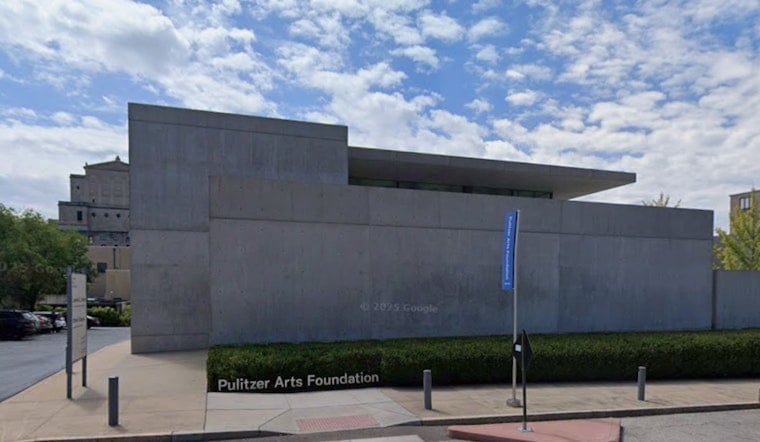
A 94-year-old Colombian textile artist whose work now fetches millions at auction is getting her most comprehensive American showcase yet, and it's opening in St. Louis before it ever reaches New York. Olga de Amaral: Weaving the Infinite debuts at the Pulitzer Arts Foundation with 86 distinct works spanning nearly seven decades of a career that turned woven fiber into something closer to architecture.
The exhibition, which opens with a reception from 6 to 9 p.m. on September 10, is co-curated by Pulitzer Senior Curator Molly Moog alongside collaborators at Cooper Hewitt, Smithsonian Design Museum, according to St. Louis Magazine. After closing in St. Louis on January 31, 2027, the show will travel to Cooper Hewitt in New York, where it runs from April 2 through October 12, 2027, according to Lisson Gallery. The Pulitzer's presentation marks the most comprehensive exhibition to date exploring how Amaral bridged fine art, traditional craft, and functional design across her career, per Arte Al Dia.
From Bogotá Drafting Tables to Cranbrook Looms
Amaral was born in Bogotá, Colombia, and later studied fiber arts at Cranbrook Academy of Art in Bloomfield Hills, Michigan, per the St. Louis Magazine report. Before Cranbrook, though, she studied architectural drafting in Bogotá, an education that Arte Al Dia notes directly inspired her 1970s Muros tejidos, or “Woven Walls,” series — off-loom constructions built from wool and horsehair. At Cranbrook, St. Louis Magazine reports she also absorbed Scandinavian and Finnish weaving techniques that would shape her material vocabulary for decades. It was there she met her husband, Jim Amaral, a fellow Cranbrook student, and the two later opened a commercial design studio together called Telas Amaral.
Moog told St. Louis Magazine that Amaral's work is stunning and materially inventive, drawing on three-dimensional sculptural forms rather than flat, traditional weaving. Moog also said the exhibition's title reflects Amaral's free-flowing approach to weaving, one that produces truly unique pieces rather than repeatable patterns. That approach, Moog explained, draws heavily on Andean weaving traditions and broader South American culture — and working with her hands rather than a loom let Amaral move past the physical limitations a mechanical loom would impose.
Gold, Palladium, and a 93-Foot Weaving
Among the works on view is Amaral's 1980 textile Paisaje de calicanto, which the Pulitzer Arts Foundation says translates calicanto — a Colombian masonry technique of binding stones with mortar — into a multi-material weaving of wool, cotton, and horsehair. The show also includes two panels from a multi-panel weaving that once stretched 93 feet tall, according to St. Louis Magazine, alongside drawings, notes, and personal collectibles that trace Amaral's process outside the finished works themselves.
Moog described Amaral as a lifelong student of weaving techniques and said she hopes audiences will come away seeing the interlacing methods underlying each piece. Amaral's use of reflective materials including gold, palladium, silver, and plastic, alongside coarser materials built into free-standing structures, has drawn comparisons to Japanese kintsugi — the practice of using gold to repair broken pottery shards — for the way both traditions turn material and repair into visible, celebrated elements of the finished object.
A Six-Story Wall and a $3.1 Million Auction Record
Amaral's architectural ambitions weren't confined to gallery walls. In 1976 she completed El Gran Muro, or “The Great Wall,” a six-story installation for the Westin Peachtree Plaza hotel in Atlanta — her largest completed architectural weaving commission, according to Ocula. She represented Colombia at the 42nd Venice Biennale in 1986, and in 1973 became the first Colombian artist awarded a John Simon Guggenheim Memorial Foundation Fellowship.
Her commercial and critical standing has only accelerated recently. In November 2025, a work by Amaral sold for a record $3.1 million at Christie's in New York, according to Artsy. The St. Louis opening follows major solo surveys of her work at Paris's Fondation Cartier pour l'art contemporain from October 2024 through March 2025 and at Buenos Aires's MALBA in 2025–2026, positioning the Pulitzer's show as part of a broader, multi-year international reassessment of her career.
Opening Night Doubles as a Grand Center Arts Happening
The September 10 opening reception lands on the same evening as launch activities for Counterpublic 2026: Coyote Time, the citywide public art triennial staging live performances and music in the Pulitzer's adjacent Spring Church and green spaces. Hoodline previously reported that the Pulitzer is a Counterpublic partner, and the overlap sets up a dense night of programming in the Grand Center Arts District. The foundation previously partnered on the 2023–2024 architectural exhibition Urban Archaeology: Lost Buildings of St. Louis, part of an ongoing pattern of pairing its gallery shows with the city's broader cultural calendar.
Weaving the Infinite runs at the Pulitzer Arts Foundation from September 10, 2026, through January 31, 2027, before its move to Cooper Hewitt next spring. For St. Louis, the show offers a rare first look at a body of work that institutions and collectors worldwide are now racing to reconsider.





