

























































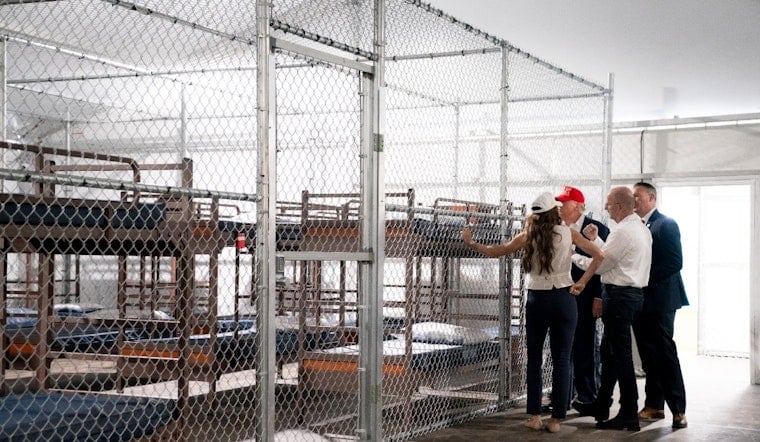
Two former guards at Florida's now-shuttered Alligator Alcatraz detention center have pleaded not guilty to misdemeanor battery charges stemming from a January incident that left a detainee with serious injuries. Collier County prosecutors charged Andre Seenaraine and Stephen Trejos in connection with an altercation involving detainee Rigoberto Rodriguez Arce that occurred on January 25, five months before the facility was ordered closed.
According to court records reported by the Miami Herald, Seenaraine and Trejos went after Rodriguez Arce during the incident, and a former detainee said Seenaraine punched Rodriguez in the face while Trejos confronted him, slammed him to the ground and struck him. Trejos was arrested by the Collier County Sheriff's Office on June 24, and Seenaraine was arrested in Ocala and booked into the Marion County Jail on June 26, with WINK first reporting the guards' arrests. Both men were released after posting $1,000 bond each.
Trejos' attorneys offer a different account of what happened. Defense counsel said Rodriguez Arce was banging his handcuffs against a metal bench while men in his cell chanted “libertad,” and that Rodriguez then spat on Trejos, prompting Trejos to deliver a single compliance strike to the side of the detainee's head. The attorneys said surveillance footage corroborates their account and shows Trejos and another officer took Rodriguez Arce to the ground, with no further physical contact after that point. A former detainee, meanwhile, said detainees waiting for hours to be transferred were left without food or water and banged their handcuffs against metal benches out of desperation — an account that does not fully align with the defense's framing of the confrontation as detainee-initiated.
Legal Exposure Under Florida's Battery Statute
Under Florida Statute Section 784.03, first-degree misdemeanor battery carries maximum penalties of up to one year in county jail, 12 months of probation, and a $1,000 fine, according to the Brancato Law Firm. Under Florida law, simple battery involves intentional, unwanted touching or striking and does not require proof of permanent injury, though the Herald reports Rodriguez Arce sustained serious injuries in the encounter.
Evan Pfeifer, an attorney involved in the case, called the charges serious allegations but said much of the circulating information came from unverified accounts. Pfeifer said Seenaraine was innocent until proven guilty and that the case would ultimately be decided in court. Separately, Adriana Rodriguez said she would pursue all available legal remedies and hold every responsible individual and entity accountable.
The case marks what the Herald describes as the first known criminal prosecution tied to detainee abuse allegations at Alligator Alcatraz, a facility that drew complaints from former detainees and their families about inhumane treatment, beatings and inadequate medical care throughout its operation. The Trump and DeSantis administrations dismissed those allegations as false. The Department of Homeland Security directed questions about the facility to the Florida Division of Emergency Management, which oversaw operations at the site.
According to the DHS Office of Inspector General, it issued the results of an unannounced inspection of ICE's Krome North Service Processing Center in Miami, Florida, on 04/16/2024. According to ICE's FY 2024 Annual Report, its Inspection and Compliance Unit conducted 194 detention-facility compliance inspections, including 43 unannounced inspections.
A Facility Built Fast, Shut Down Under Pressure
Alligator Alcatraz opened inside Big Cypress National Preserve on July 3, 2025; a federal judge found that the facility was built without required environmental impact studies, according to WGCU News. The camp operated for nearly a year at an estimated total taxpayer cost exceeding $1 billion before DeSantis announced its closure on June 25, 2026. Florida hired Critical Response Strategies to provide guards overseeing the facility, and Seenaraine was employed by CRS at the time of the January incident.
According to a National Park Service Finding of No Significant Impact issued on 16 Apr 2020, the entirety of Big Cypress National Preserve occurs within the Federal Emergency Management Administration 1% (zone AE) Annual Flood Hazard Area. According to a National Park Service water management plan, the preserve's environmental strategy calls for removing or bypassing artificial barriers and plugging man-made canals within Big Cypress National Preserve.
That $78.5 million staffing contract, secured by the Jacksonville-based contractor in July 2025 according to Action News Jax, later became a flashpoint for transparency advocates. The Florida Division of Emergency Management removed detailed public contract records for the facility from the state's public database that same month, replacing them with summary pages citing proprietary information, according to the Brechner Freedom of Information Project. Despite that scrutiny, CRS was among seven vendors that submitted responses to a Florida Highway Patrol request for information seeking operators for at least five new adult detention facilities statewide.
Court Battles Over Access and Environmental Harm
The battery case follows other legal fights over conditions at the Everglades camp. On March 27, 2026, U.S. District Judge Sheri Polster Chappell issued a preliminary injunction requiring confidential legal phone calls and unannounced attorney visits for detainees after civil rights groups filed a class-action lawsuit alleging severe restrictions on attorney access. Environmental litigation also dogged the site, with environmental groups continuing to pursue legal action over the Everglades facility.
Hoodline previously reported that after the facility's closure, transferred detainees were relocated to the Federal Detention Center in downtown Miami, where reports described severe heat, pests and water problems, with more than 1,300 people held at the facility. Advocacy groups have raised concerns about detainee treatment, while transferred detainees were relocated to Miami's federal jail.





