

























































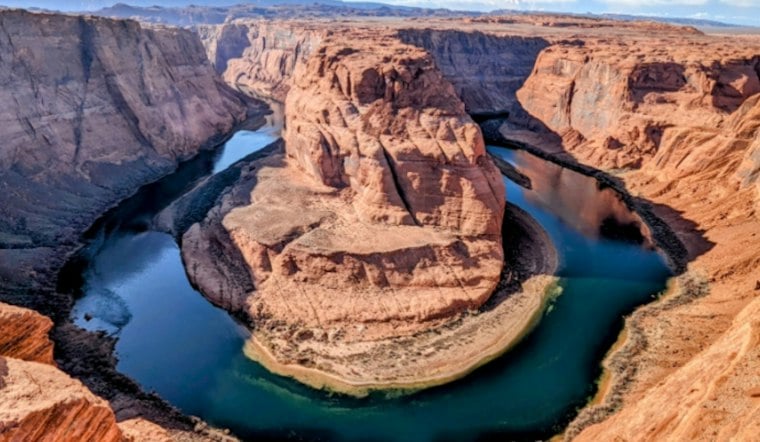
Amazon is putting $20 million behind a new coalition aimed at conserving water in the Colorado River basin, a watershed that supplies nearly 40 million people and powers Hoover Dam, as the river's two largest reservoirs sit below 30% capacity following 25 years of megadrought. The money will fund leak repairs in Orange County, irrigation sensors on tribal farmland near Lake Mead, and other projects designed to claw back water before a new decade of federal rules takes hold.
According to FOX5 Las Vegas, Amazon launched the effort — called the Colorado River Basin Collaborative — with the stated goal of building one of the largest corporate water conservation efforts ever aimed at a single U.S. watershed. The company says it also joined the Water Resilience Coalition, a group that says it aims to catalyze collaborative action on priority water challenges around the world. As part of the new push, Amazon is investing $2.2 million over three years with the Municipal Water District of Orange County, which provides water to 3.2 million residents, to fund leak repairs and expand leak detection to communities that can't otherwise afford it. That project alone is expected to save more than 189 million gallons of water per year, per the same report.
Amazon is also putting $2.4 million into a partnership with Arable, an agricultural technology company, to improve irrigation efficiency on tribal farmland in the Lower Colorado River Basin. The project relies on AWS-powered sensors that give farmers real-time data on when crops actually need water, helping them draw less from Lake Mead — Las Vegas' primary water source. FOX5 Las Vegas reports the Arable project is expected to save approximately 238 million gallons of water per year.
A River Stretched Thinner Than Ever
The stakes behind these numbers are steep. The Colorado River supports over 5.5 million acres of farmland across seven U.S. states and Mexico, backs farms that grow 90% of the country's winter vegetables, and serves 30 tribal nations, according to the outlet. Yet the river's annual flow has dropped 20%, and the gap between water supply and demand now runs roughly 1 trillion gallons a year.
The broader Colorado River Basin Collaborative, co-championed by Amazon alongside Grundfos and The Coca-Cola Foundation, is aiming to mobilize $100 million over two years for watershed conservation, with participating partners committing $32 million at launch, according to Las Vegas Review-Journal. Additional coalition members include Aldi, Ecolab, EdgeConneX, Vantage, and Xylem, per Grundfos. The report notes that participating companies will pursue separate projects and deploy funding into vetted projects across the watershed, with the coalition's funding set to be deployed through 2028. That funding is set to support precision irrigation technology, urban leak reduction, and broader conservation work across the basin.
Combined Reservoir Storage Hits Historic Low
The corporate dollars are arriving at a fraught moment for the river's governance. After multi-state consensus talks collapsed, the U.S. Bureau of Reclamation issued a Record of Decision in August establishing a 10-year framework covering 2027 through 2036, with mandatory two-year interval guidelines for Lake Powell and Lake Mead operations. The framework replaces the expiring 2007 interim guidelines and 2019 Drought Contingency Plans, according to the federal agency.
Combined storage in Lake Powell and Lake Mead fell in August to its lowest point since Lake Powell first began filling behind Glen Canyon Dam in 1963, following record-low snowpack over the 2025-2026 winter, per Bureau of Reclamation data. That backdrop has fueled friction between states: Nevada announced plans in August to sue the Department of the Interior, according to FOX5 Las Vegas, after proposed federal guidelines called for slashing the state's Colorado River allocation by up to 71% while leaving Upper Basin state contributions voluntary, the Las Vegas Review-Journal reports. The watershed's stakes go beyond faucets and farms — it underpins an estimated $1.4 trillion in annual economic activity and supports roughly 16 million jobs across seven states and Mexico, according to Grundfos.
Water Efficiency Claims Meet Data Center Scrutiny
Amazon has been touting its own water efficiency gains alongside the new coalition. The company reported in June that its Amazon Web Services data centers hit a global Water Usage Effectiveness of 0.12 liters per kilowatt-hour in 2025, a 52% improvement since 2021, putting AWS at 75% of its goal to become water positive by 2030, according to ESG News. That figure is well below the industry average of 0.84 L/kWh, the outlet notes. Amazon says it had already funded more than 50 water replenishment projects globally before launching the Colorado initiative, projects expected to return more than 22 billion liters — about 5.8 billion gallons — of water per year to local communities once fully operational.
Still, the efficiency claims come with a caveat that outside observers have flagged. The water positive by 2030 pledge applies specifically to AWS's cloud division rather than Amazon's much larger retail business, which internal company documents obtained by news media showed consumed more than 105 billion gallons of water annually, according to The Guardian. Meanwhile, hyperscale data centers powering AI workloads can consume up to 5 million gallons of cooling water daily — roughly what a city of 50,000 residents uses — a demand that has drawn increasing regulatory scrutiny in water-stressed Western states, per the Lincoln Institute of Land Policy.
What Comes Next for the Basin
Amazon's investment lands squarely amid Arizona's own reckoning with the new federal rules — Hoodline previously reported that Arizona absorbs the biggest cuts under the decade-long framework, while Apache Junction has committed $60 million to a new water plant to offset its own reductions. Whether corporate capital like Amazon's can meaningfully close a supply-demand gap measured in the trillions of gallons remains an open question, but for now, the leak-repair crews in Orange County and the sensor-equipped farms near Lake Mead represent the river basin's newest line of defense.





