

























































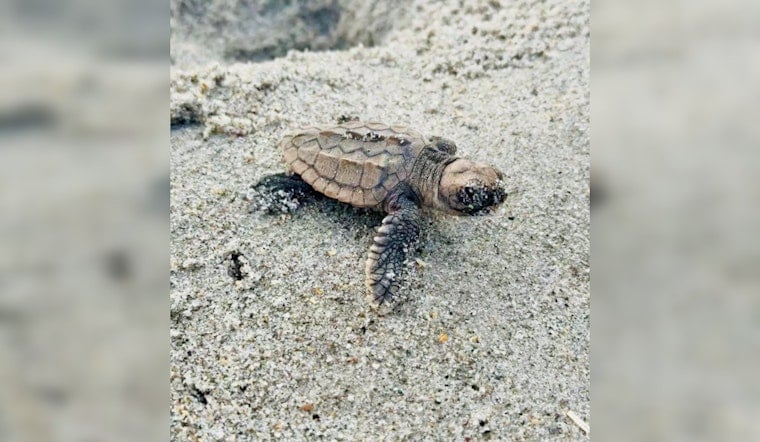
Fifty-five loggerhead hatchlings died along Gulf Drive on Anna Maria Island after artificial lights from nearby homes and businesses pulled them away from the water and into the road, marking the largest single-location hatchling mortality event recorded in 28 years of monitoring on the island. As Florida's record-breaking 2026 nesting season stretches toward its final weeks, wildlife officials are pleading with beachgoers to darken their properties before more hatchlings die trying to find the sea.
The Florida Fish and Wildlife Conservation Commission issued a Labor Day advisory urging beachgoers to protect nesting sea turtles and newly hatched turtles as the season continues through the end of October, according to FOX 13 News. The commission asked beachgoers to call the wildlife alert hotline if they encounter a hatchling away from the beach or an injured sea turtle, rather than attempting to move the animal themselves. Newly emerged hatchlings are wired to crawl toward the brightest horizon, which under natural conditions is moonlight reflecting off the Gulf — but artificial lighting from homes, hotels and businesses can send them inland instead, according to the same report.
The Gulf Drive deaths were reported by Anna Maria Island Turtle Watch and Shorebird Monitoring, and they came just weeks after a separate rescue effort pulled more than 70 hatchlings, five dead hatchlings, and two more recovered from a swimming pool and a storm drain from a nest laid by Krysta, a loggerhead tracked by satellite as part of the Sea Turtle Conservancy's 2026 Tour de Turtles marathon, according to WTSP. Krysta had been outfitted with her satellite transmitter on Coquina Beach in June before migrating toward Fort Myers, the station reported. The two hatchlings pulled from the pool and drain were brought to Mote Marine Laboratory and Aquarium for care.
A Nest-by-Nest Disorientation Problem
The Gulf Drive incident is not an isolated one. Through mid-August, Anna Maria Island Turtle Watch had recorded a 36 percent nest disorientation rate — up from 31 percent in 2025 — affecting an estimated 1,534 to 3,550 hatchlings across 54 disoriented nests out of 148 that had hatched, according to the AMI Sun. Officials with the group have attributed part of the surge to the destruction of coastal sand dunes and sea oats during Hurricanes Helene and Milton in 2024, storms that stripped away natural barriers that once blocked inland glow from reaching the beach, as reported by The Anna Maria Islander.
Carley Oakley said hatchlings are being retrieved from storm drains, residential pools and storage closets, while Autumn Neilson-Herring said visitors often do not realize sea turtle season is still active, according to FOX 13 News. Wildlife officials said beaches should remain dark, clean and free of obstacles for the remainder of the season, the outlet reported.
What FWC Is Asking Beachgoers To Do
Ahead of the holiday weekend, FWC recommended a list of precautions for anyone visiting Gulf Coast beaches: turning off lights visible from the beach after sunset, closing curtains on beachfront properties, and avoiding flashlights, cell phone lights and flash photography after dark. The commission also recommended staying at least 50 feet away from nesting sea turtles and hatchlings, keeping personal fireworks off the beach, filling in holes dug in the sand, properly disposing of trash and fishing line, and removing beach chairs, toys and umbrellas before leaving the beach at night.
The stakes for ignoring those guidelines are not just ecological. Under Florida Statute § 379.2431, known as the Marine Turtle Protection Act, illegally taking, disturbing, mutilating, destroying or harassing any sea turtle, hatchling, nest or egg is classified as a third-degree felony carrying state criminal penalties and mandatory fines, according to the Florida Senate. That state law works alongside the federal Endangered Species Act to protect nesting marine species along Florida's coastline.
A Record Season Undercut By Light Pollution
The losses on Anna Maria Island are unfolding against the backdrop of what has otherwise been an unusually strong nesting year. The Florida Fish and Wildlife Conservation Commission reported an exceptionally strong start to the statewide season in May, recording 1,450 loggerhead nests early on — an 82 percent increase over the same period in 2025, according to Human Progress. On Florida's Atlantic coast, the Loggerhead Marinelife Center in Juno Beach recorded 13,770 loggerhead nests along an 8.5-mile stretch of shoreline by mid-August, setting an all-time record for the area, The Guardian reported. Hoodline previously reported a similar nesting surge in Boca Raton.
Statewide, research cited by the Sea Turtle Conservancy indicates that artificial beachfront lighting disorients more than 100,000 sea turtle hatchlings across Florida every year, with wildlife biologists estimating that up to 30 percent of all Florida hatchlings perish as a result. Mote Marine Laboratory and Aquarium's Sea Turtle Rehabilitation Hospital and Stranding Investigations Program treated 2,786 sea turtle hatchlings and responded to 117 stranded sea turtles across Sarasota and Manatee counties in 2025, underscoring the scale of the region's rescue and rehabilitation effort.
The long-term stakes of this season's losses will not be clear for decades. Loggerhead sea turtles take roughly 30 to 35 years to reach sexual maturity, meaning hatchlings emerging on Florida beaches this year would not return to nest until sometime between 2056 and 2061 — and marine biologists estimate that only about one in 1,000 hatchlings survives to adulthood in the first place. For now, wildlife officials are asking Gulf Coast residents and Labor Day visitors alike to keep the shoreline dark, quiet and clear as the season runs its final weeks toward the end of October.




