

























































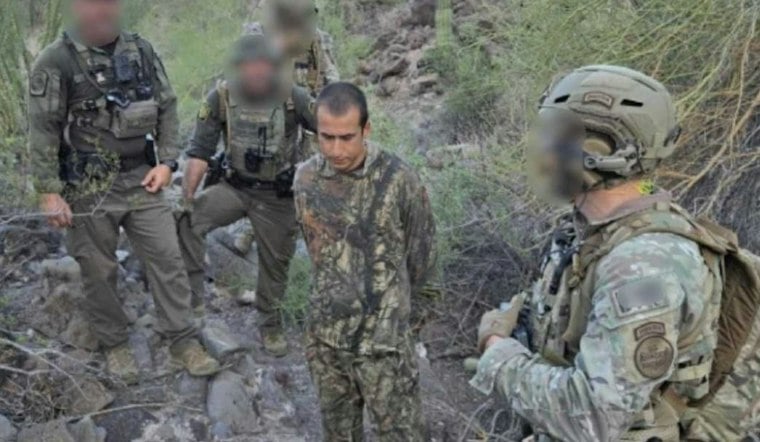
Federal agents fast-roped out of a hovering Black Hawk helicopter onto a rocky desert ridge near Ajo, Arizona, to arrest a man accused of working as a border scout, U.S. Customs and Border Protection announced. The tactical takedown happened on September 4, though the agency did not make details public until eleven days later, on September 15.
Drone Spots a Hidden Desert Lookout
The operation began when an MQ-9 Predator B surveillance drone spotted what turned out to be a hidden campsite tucked into rugged terrain outside Ajo along State Route 85, according to Blaze Media. As FOX 10 Phoenix reports, Border Patrol reconnaissance personnel then confirmed an active scout was hiding in the area, and the Tucson Air Branch dispatched both an H125 AStar helicopter and a UH-60 Black Hawk to the site.
The drone that first flagged the campsite was operated by the National Air Security Operations Center in Sierra Vista, Arizona, per The Fulcrum. The AStar and Black Hawk were dispatched to the site, and the Black Hawk crew fast-roped a team of five tactical agents directly onto the rocky outpost, drawn from the Border Patrol Special Operations Detachment and the Border Patrol Search, Trauma and Rescue unit, the station's report notes.
A Paratrooper K-9 Joins the Rappel
Among the five agents who dropped onto the ridge was a paratrooper K-9 fitted with protective tactical goggles to shield its eyes during the airborne descent and desert landing, FOX 10 Phoenix reported. The team used a fast-rope insertion to reach the outpost.
Once on the ground, the tactical team arrested the alleged scout at the outpost, which included a solar panel wedged beneath boulders that had been used to charge electronic devices for tracking law enforcement movements. Scouts have used solar panels to power communications equipment during extended stays in remote areas.
Vast, Rugged Terrain Complicates Enforcement
The arrest took place within the Ajo Station's area of responsibility, which spans approximately 8,800 square miles and 52 miles of international border, including environmentally sensitive public lands like Organ Pipe Cactus National Monument and Cabeza Prieta National Wildlife Refuge, per U.S. Customs and Border Protection. That kind of desert wilderness limits ground vehicle access, which is part of why aerial interdiction teams like the one deployed near Ajo have become a go-to tool for reaching remote lookout posts.
It is not the first time authorities in the region have uncovered this kind of mountaintop scouting operation. Authorities have also reported arrests involving the “Los Memos” faction of the Sinaloa Cartel in the Silverbell and Maricopa Mountains.
Suspect Now in Tucson, Key Details Withheld
Following the arrest, the suspect was transported to the Tucson Sector for criminal processing. Authorities have not released the suspect's name, age, nationality, potential cartel affiliation or specific charges. Federal prosecutors typically pursue cases like this under 8 U.S.C. § 1325 for unlawful entry and 8 U.S.C. § 1324 for alien smuggling or conspiracy, often seeking sentencing enhancements when scouting is tied to a criminal organization, per U.S. Customs and Border Protection.
Acting Tucson Sector Chief Patrol Agent Henry N. Laxdal said the operation reflected how air assets, surveillance technology and specialized ground agents are being integrated to respond to remote threats. “The combined capabilities” of those resources, Laxdal said, allow agents to “quickly locate and arrest” people facilitating illegal activity in hard-to-reach desert areas. Laxdal previously served as Deputy Executive Director of the Program Management Office Directorate at Border Patrol Headquarters, where he oversaw acquisition of border surveillance technologies, according to the Homeland Security Defense Forum.
Federal authorities say they will continue targeted interdictions across the Arizona desert as scouts and lookout networks remain active along the transit corridor north of the border.





