

























































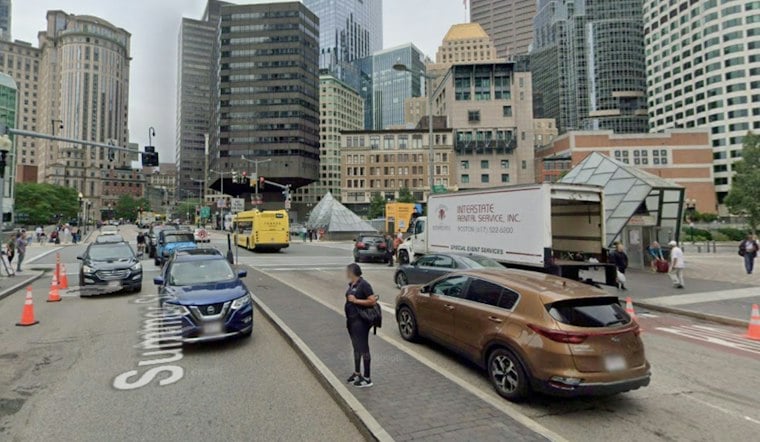
Drivers who block bus lanes or bus stops along Boston's SL4 and SL5 routes are about to get a new kind of company: cameras mounted on the buses themselves. Starting October 1, 2026, the MBTA's Automated Camera Enforcement Program will begin watching routes SL4 and SL5, capturing images of vehicles that block the way — the first step toward a system of fines that could reach $125 for repeat offenders.
How the Rollout Will Work
The program does not start with punishment. According to the MBTA, a public education period runs from October 1 through December 31, 2026, during which drivers caught on camera will get written notices rather than bills. Actual ticketing on the SL4 and SL5 routes begins January 1, 2027, and the transit agency has said it plans to expand automated enforcement to more bus routes sometime in early 2027.
The mechanics are straightforward, per the same agency: cameras installed on MBTA buses automatically capture license plates of vehicles blocking lanes or stops, but no ticket goes out until a human reviewer checks the images for accuracy. As CBS News reported, the MBTA has said violations will be automatically captured by the cameras, and a team of human evidence reviewers will confirm whether an actual violation occurred before any fine is issued. The MBTA has also said the cameras will not track vehicles, and that the resulting data can only be used to enforce bus lane and bus stop violations.
What It'll Cost — and Why the Numbers Differ Slightly
The fine structure treats bus-lane and bus-stop violations differently. Per the MBTA's own program page, a driver who blocks a bus lane may receive a warning for a first violation only if it did not cause danger to public health, security, or safety; bus-lane fines range from $25 to $125. Bus stop violations get no such grace period — a first-time offense results in an automatic ticket, not a warning, with the fine set at $100 every time.
Exactly when that top $125 bus-lane fine kicks in is murkier. CBS News reported that bus-lane violations can increase to as much as $125 for four or more violations within 180 days, while Streetsblog Mass reported that passenger-vehicle bus-lane fines would rise to $125 for the fourth and subsequent offenses within a 60-day period. The two accounts describe different windows for reaching the top fine, and the dossier does not resolve which timeframe the MBTA ultimately adopted.
Why the MBTA Says This Matters
MBTA General Manager Phil Eng framed the program around safety and reliability rather than revenue, saying it is about keeping buses moving, keeping people safe, and giving everyone valuable time back, according to CBS News. Eng also pointed to accessibility concerns, saying that when bus stops are blocked, people with disabilities, people with strollers, and anyone with mobility challenges lose the option for level boarding. The MBTA's own program materials echo that point, noting that when a stop is blocked, riders using mobility aids may not be able to board or exit the bus at all.
CBS News reported that blocked bus lanes and stops impact thousands of riders and cause people to lose time from their schedules every day. That's a real stake for a system the MBTA says keeps 1,000 buses operating and carries about 300,000 riders daily, according to the agency's own bus schedule page. The transit agency has also said it is partnering with more than 50 municipalities and MassDOT through its Better Bus Project.
Built-In Exceptions and the Appeals Process
The program isn't a blanket trap for every driver who so much as taps the brakes near a bus lane. The MBTA says it will make exceptions for drivers turning in a bus lane or preparing to park in a spot next to a bus lane — though in those cases drivers must still yield to an approaching bus — and drivers who stop in a bus stop or lane to make way for an emergency vehicle. Fines, when they do arrive, will be mailed to the address where the vehicle is registered, and the MBTA says drivers can submit an appeal within 60 days of the alleged violation.
The legal basis for all of this traces back to a Massachusetts law enacted in 2025 that allows the MBTA to use cameras to ticket drivers who get in the way of buses, according to Streetsblog Mass. That same outlet has reported that the MBTA's program is designed to be revenue-neutral, aimed at changing driver behavior rather than generating fine income.
Boston Isn't the First to Try This
Boston is following a path other transit systems have already tested. Philadelphia's Parking Authority, SEPTA, and OTIS launched a comparable Automated Bus Camera Enforcement Initiative in April 2025, using forward-facing Hayden AI cameras mounted on buses and trolleys to catch vehicles obstructing transit, according to the Philadelphia Parking Authority. That program also started with mailed warning notices before citations and fines began on May 7, 2025.
New York's MTA runs its own automated bus-lane enforcement system, with fines that start at $50 and climb by $50 per additional violation up to a $250 maximum, according to the MTA. Boston's fine structure, by comparison, tops out lower — but for the SL4 and SL5 corridors, drivers now have a firm date to start paying attention: October 1.




